Raise Robotics Highlights Engineering Capacity for Scale
Raise Robotics will use RoboBusiness to address how engineering capacity should be allocated when scaling field robots, a question with direct relevance for industrial automation suppliers.
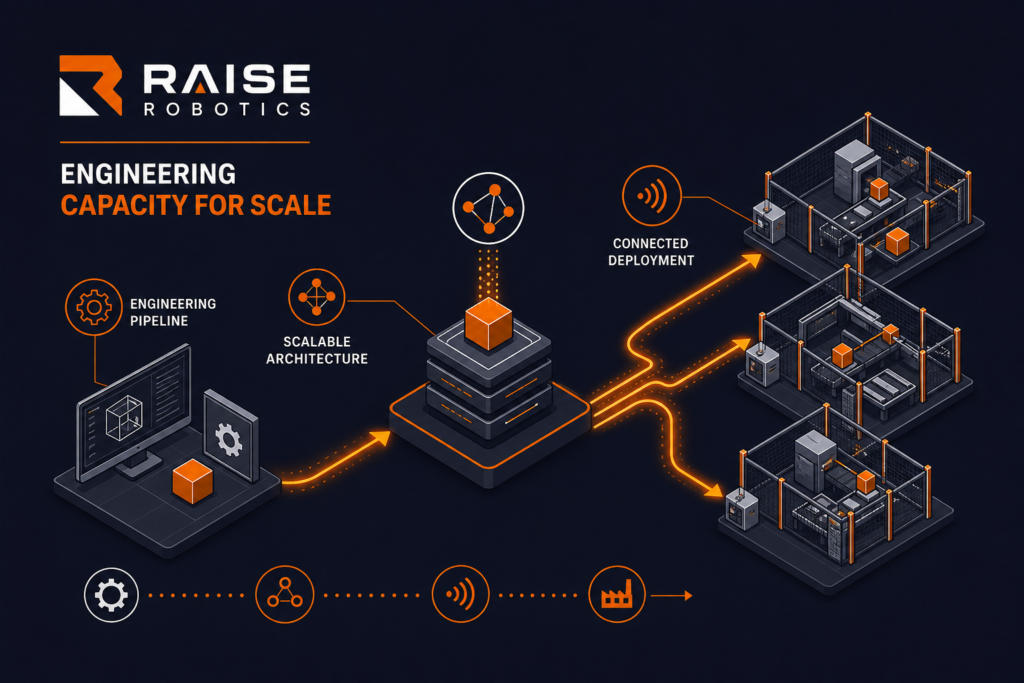
Raise Robotics is using RoboBusiness 2026 to focus attention on a problem that extends well beyond construction and field deployment: how robotics companies allocate scarce engineering capacity as they move from pilot projects to repeatable scale. According to The Robot Report, Kenrick Tjandra, who leads robotics deployment at Raise Robotics, will present a session titled “Closing the Capability Gap: A Leadership Framework for Scaling Field Robotics”. The session is expected to outline a decision rule for assigning engineering resources and a vocabulary for two hidden failure modes that can undermine deployment growth. For production leaders and automation integrators, the topic is familiar: many robotics programs fail not because the core machine cannot perform a task, but because organizations struggle to standardize support, commissioning, process knowledge, and change management across multiple sites.
From pilot success to deployment discipline
The scaling issue described by Raise Robotics mirrors a broader industrial automation pattern. A robot cell that works in one environment often depends on expert intervention, undocumented process tuning, or unusually high engineering attention. That may be acceptable in an early proof of concept, but it becomes expensive when a supplier must replicate the system across plants, shifts, or customer sites. McKinsey has similarly argued that manufacturers need to scale beyond the pilot phase by reducing dependence on scarce expertise and building resilience into operations. In practical terms, this means engineering teams must decide whether their next hour is best spent on debugging edge cases, improving software robustness, simplifying fixturing, standardizing operator interfaces, or redesigning the process so that less support is needed in the field.
That question matters to established robot suppliers as much as to younger robotics firms. Integrators working with ABB, KUKA, FANUC, Yaskawa, Universal Robots, or Doosan routinely face trade-offs between customization and repeatability. A highly tailored robotic welding cell may win a project technically, yet become difficult to commission quickly or maintain consistently across a customer’s network. Conversely, a more modular architecture with standardized torch packages, positioners, safety logic, and HMI templates may reduce engineering burden and improve lifecycle economics. The same logic applies to mobile or field robotics: deployment scale depends not only on hardware capability, but on how much engineering effort each additional installation consumes.
Why engineering allocation is becoming a strategic issue
The renewed focus on engineering allocation also reflects the growing complexity of robot applications. As robotics suppliers add AI-based perception, adaptive path planning, remote monitoring, and cloud-connected diagnostics, engineering teams are asked to support more layers of the stack. Another RoboBusiness session highlighted by The Robot Report will examine how physical AI can scale, reinforcing that the industry is now balancing software ambition with deployment discipline. For B2B buyers, the key question is no longer simply whether a robot can complete a task in a controlled demo, but whether the supplier can industrialize the application with predictable lead times, training requirements, and service models.
Standards and compliance add another layer to the capacity challenge. In industrial robot integration, engineering resources must cover not only process performance but also risk assessment, functional safety, and conformity with applicable standards such as ISO 10218 for industrial robots, ISO/TS 15066 for collaborative applications, and relevant IEC and EN electrical and machinery safety requirements. This is particularly relevant when companies discuss cobots as a shortcut to rapid deployment. As one practical automation guide notes, a collaborative robot is not inherently safe in every application; the complete system and task must be assessed, especially when tools such as welding torches or sharp end effectors are involved, as highlighted in the Fairino article citing NIST principles on collaborative applications. For engineering managers, that means capacity planning must include safety validation, documentation, and operator training, not just robot programming.
What this means for welding cell integrators
For robotic welding and cobot welding suppliers, the Raise Robotics discussion is directly relevant because welding automation often reaches a scaling barrier after the first successful installation. A cell may produce acceptable weld quality in a pilot line, yet require frequent intervention from senior welding engineers to manage joint variation, torch access, spatter, distortion, or part presentation. When the same concept is rolled out to multiple SKUs or plants, engineering capacity can quickly become the bottleneck. Integrators therefore need a clear rule for where expert time creates the most leverage: refining weld procedures, improving seam tracking, standardizing fixtures, expanding offline programming libraries, or redesigning the cell so operators can recover from common faults without specialist support.
This is where platform choices become consequential. Integrators building cells around ABB OmniCore, KUKA KR systems, FANUC Arc Mate platforms, Yaskawa Motoman welding robots, Universal Robots cobot arms, or Doosan collaborative robots all face similar scaling questions. The winning design is rarely the one with the most custom code; it is usually the one that balances process capability with maintainability, safety, and repeatable commissioning. For welding cells, that can mean using common torch cleaning stations, harmonized PLC and safety architectures, reusable weld parameter databases, and digital service tools that reduce on-site engineering time. It can also mean deciding early whether a collaborative format is genuinely suitable or whether a conventional guarded cell offers better throughput, process stability, and standards compliance under ISO and EN machinery rules.
Broader implications for automation suppliers
The value of the Raise Robotics session lies in reframing scale as an organizational design problem rather than only a robotics problem. Automation suppliers that want to grow in manufacturing, logistics, field operations, or metal fabrication must understand which engineering tasks create durable capability and which merely keep fragile deployments running. That distinction affects margin, serviceability, and customer confidence. It also influences procurement decisions, because Tier-1 manufacturers and SME fabricators increasingly evaluate whether an automation partner can replicate a solution across lines and sites without excessive dependence on a few experts.
For companies planning new robotic welding cells or collaborative welding stations, the lesson is straightforward: scalability should be engineered from the start, not added after a successful pilot. Readers assessing how to allocate engineering effort across welding automation projects can request a quote to compare cell architectures, safety concepts, and deployment models suited to repeatable industrial scale.
Related articles
Request a quote
Looking for a specific configuration, or want to discuss our current stock? Tell us about your project — we reply within 24 hours from our Bilbao office.