Comau and Nvidia Push AI Robotics for Industrial Welding
Comau is integrating Nvidia Jetson, Isaac Sim and Isaac Lab to speed AI-enabled industrial robotics, with implications for adaptive welding, simulation and safer cell design.
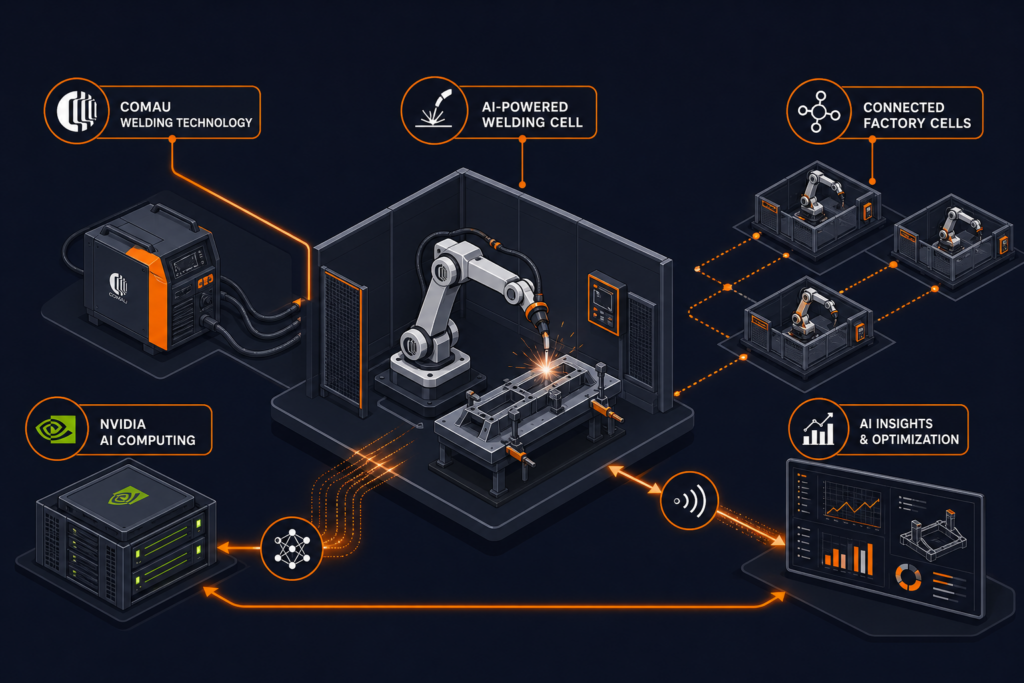
Comau expands AI robotics stack with Nvidia
Comau is accelerating the development of AI-enabled industrial robotics by integrating Nvidia technologies into both its products and engineering workflow, a move that could have direct consequences for welding automation, collaborative applications and digital commissioning. According to the original report in Robotics & Automation News, the partnership combines Comau’s robotics background with Nvidia physical AI simulation libraries and accelerated computing to support more intelligent and autonomous systems. Additional details published by Comau indicate that the company is integrating Nvidia Jetson, Isaac Sim and Isaac Lab technologies to simulate, train and validate industrial, collaborative and mobile robotic applications before deployment. For production managers and manufacturing engineers, that matters because AI capability is no longer limited to cloud analytics or offline optimization; it is increasingly being embedded closer to the robot controller, where perception, path adaptation and process decisions can influence cycle time, quality and uptime on the shop floor.
The industrial significance lies in how physical AI tools can shorten the path from concept to validated automation cell. Isaac Sim and Isaac Lab are positioned as enablers for virtual testing, synthetic data generation and reinforcement-learning workflows, allowing robot behaviors to be developed in simulation before they are transferred to real equipment. In practical terms, this can reduce the engineering burden associated with variable parts, mixed-model production and unstructured environments that have traditionally challenged robotic welding and handling. A further report from TechTimes says Nvidia has certified Comau to run Isaac Sim inside factory robot controllers, while Jetson Thor at controller level could support perception and AI decision tasks within the same deterministic framework as conventional motion control. If that architecture matures in production, it may help bridge the gap between classic PLC-robot integration and newer AI-driven functions such as vision-guided part localization, seam tracking and adaptive process correction.
Why physical AI matters in factory automation
For industrial users, the discussion is less about generic AI and more about whether AI can be deployed in a way that respects throughput, repeatability and safety. Welding cells are a good example. Traditional robotic welding has relied on fixed fixturing, pre-taught paths and tightly controlled part presentation. That model remains effective, especially with established robot vendors such as ABB, KUKA, FANUC and Yaskawa, but it becomes less efficient when part tolerances vary, product mix increases or manual upstream processes introduce inconsistency. AI-enhanced perception and simulation can help compensate for these realities by enabling robots to identify workpiece position, refine torch approach, or adapt trajectories based on sensor input. In collaborative environments, where Universal Robots and Doosan are frequently evaluated for lower-force applications, AI may also support more intuitive programming and faster redeployment, although welding still requires careful assessment of heat, fumes, arc radiation and guarding requirements.
There is also a standards dimension. As AI functions move closer to machine control, integrators and end users will need to align innovation with established machinery and robot safety frameworks, including ISO 10218 for industrial robots, ISO/TS 15066 for collaborative robot operation, and broader machinery safety expectations under IEC and EN standards such as EN ISO 13849 for safety-related control systems and IEC 60204-1 for electrical equipment of machines. For welding applications, process quality standards and traceability requirements remain equally relevant, particularly in automotive and structural fabrication. AI does not remove the need for deterministic safety architecture; instead, it raises the bar for validation, simulation fidelity and change management. That is why the ability to simulate and verify robot behavior before physical deployment is likely to become a stronger purchasing criterion for Tier-1 suppliers and system integrators.
What this means for welding cell integrators
For welding cell integrators, Comau’s Nvidia alignment signals a broader market direction rather than an isolated vendor announcement. The key takeaway is that future robotic welding cells may be designed around a tighter coupling of robot control, machine vision, simulation and AI-assisted process optimization. In a conventional MIG/MAG or TIG robotic cell, integrators already combine the robot, power source, torch cleaning, positioners, extraction and safety systems into a coordinated package. With physical AI added to the stack, the design task expands to include synthetic training data, digital twins, sensor fusion and controller-level compute capacity. That could improve performance in applications such as adaptive welding on variable assemblies, bin-to-fixture material flow, or mobile manipulation around large weldments. It may also influence vendor selection, as buyers compare not only robot payload, reach and repeatability, but also the maturity of simulation ecosystems and the openness of controller architectures across Comau, ABB, KUKA, FANUC, Yaskawa, Universal Robots and Doosan.
At the same time, integrators will need to remain pragmatic. AI-enabled welding does not automatically solve poor part fit-up, unstable wire feed, weak grounding or inadequate fixture design. The strongest business case will likely be found where AI complements robust mechanical engineering rather than replacing it: for example, reducing commissioning time, improving first-pass yield on variable parts, or enabling faster changeovers in high-mix production. Manufacturers considering new cells or retrofits should therefore assess whether AI features are linked to measurable KPIs such as arc-on time, scrap reduction, offline programming efficiency and maintenance diagnostics. For companies planning robotic or cobot welding projects, this is a useful moment to review how simulation, controller computing and standards compliance fit into long-term automation strategy.
Readers evaluating a new robotic welding cell, a cobot welding station or an upgrade to an existing line can request a quote to compare architecture options, safety concepts and integration scope against their production targets.
Related articles
Request a quote
Looking for a specific configuration, or want to discuss our current stock? Tell us about your project — we reply within 24 hours from our Bilbao office.