Real-Time Execution Becomes a Key Edge in Welding Automation
Real-time execution is emerging as a competitive advantage in manufacturing, with direct implications for robotic welding cells, cobot deployment, quality control and production agility.
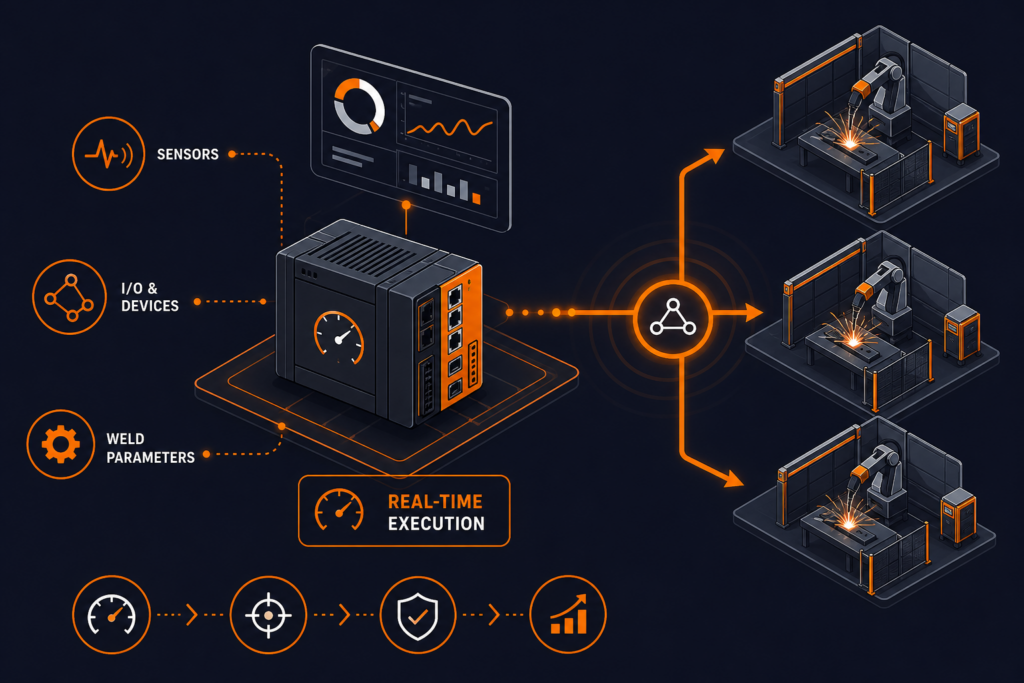
Real-time execution is moving to the center of industrial competitiveness, particularly where production conditions change faster than planning systems can react. In the original source article from The Robot Report, Daifuku’s Cecile Dick-Calmes argued that manufacturing success can no longer be judged only by automation density or equipment utilization. The more decisive factor is whether operations can sense disruptions, interpret them quickly, and adjust execution before delays, scrap, or missed deliveries accumulate. That argument is highly relevant to welding operations, where part variation, fixture condition, consumable wear, labor availability, and sequencing changes can all undermine output if the cell is optimized only for a static plan. The broader point made by The Robot Report is that competitive advantage is shifting from installed assets to operational agility. For manufacturers running robotic MIG, TIG, or spot welding, that means the value of a cell increasingly depends on how well it executes under real production conditions rather than how well it performs in a nominal cycle-time study.
Why the “reality gap” matters on the shop floor
The so-called reality gap is the difference between what planning systems assume will happen and what actually happens on the line. In welding, that gap can appear as late part arrivals, dimensional inconsistency from upstream cutting or forming, torch collision risk, spatter buildup, or a quality hold that forces resequencing. Traditional automation architectures often detect these issues too late, after throughput has already dropped. A more execution-focused model connects scheduling, machine state, robot status, quality data, and operator intervention in near real time so that the cell can be adjusted before disruption spreads. This is consistent with the manufacturing execution argument described by Eyelit Technologies, which highlights the competitive value of responding to production disruptions in real time rather than hours later. In practical terms, a welding line with live feedback from power source parameters, seam tracking, fixture sensors, and work-in-progress data can make better decisions about part routing, rework priority, and maintenance timing than a line managed mainly through end-of-shift reporting.
This shift also reflects how robotic welding is evolving from isolated automation islands into digitally supervised production assets. Major robot vendors including ABB, KUKA, FANUC, and Yaskawa already support increasingly rich data exchange through industrial Ethernet, fieldbus, and higher-level software interfaces. On the collaborative side, Universal Robots and Doosan are often selected where high-mix, lower-volume welding requires faster redeployment and simpler operator interaction. Yet hardware choice alone does not close the reality gap. The decisive layer is execution logic: how the cell uses live data to adapt weld programs, trigger inspections, pause for intervention, or reroute work. For example, if a cobot welding station detects repeated fit-up deviation on a batch of fabricated parts, the system should not simply continue producing nonconforming welds at high utilization. It should escalate, compensate where permitted, or divert the batch according to predefined quality rules.
From utilization metrics to adaptive performance
For many production managers, this changes the KPI discussion. High arc-on time remains valuable, but it is no longer sufficient if the cell is producing the wrong mix, welding parts with hidden defects, or waiting on manual decisions because systems are not synchronized. Real-time execution favors metrics such as schedule adherence under disruption, first-pass yield, mean time to recover, and the latency between event detection and corrective action. In welding cells, these indicators can be tied to digital weld records, robot alarms, torch cleaning intervals, gas flow monitoring, and part traceability. The growing use of AI-assisted welding tools also supports this direction. A recent article from Universal Robots describes how AI-enabled welding automation can reduce programming overhead, downtime, and defect rates by helping systems respond better to real material and process conditions. For B2B buyers, the lesson is not that AI replaces process engineering, but that adaptive software is becoming part of the execution stack that determines whether a robotic cell remains productive across variable demand and part families.
Standards and compliance remain central as this software-defined layer expands. Welding cell integrators still need to design around machinery and robot safety requirements such as ISO 10218 for industrial robots, ISO/TS 15066 for collaborative applications, and relevant IEC and EN electrical and machine safety frameworks, including EN ISO 13849 for safety-related control systems and IEC 60204-1 for electrical equipment of machines. Real-time execution should therefore be understood not as uncontrolled autonomy, but as controlled responsiveness within validated process and safety limits. A well-designed cell can adjust sequencing, speed, inspection frequency, or operator prompts while maintaining compliance, documented risk assessment, and repeatable weld quality.
What this means for welding cell integrators
For robotic welding and cobot welding integrators, the commercial implication is clear: cell design must increasingly account for execution architecture, not only robot reach, payload, and fixture layout. Integrators building systems around ABB, KUKA, FANUC, Yaskawa, Universal Robots, or Doosan platforms are being asked to deliver more than a stable weld path. Customers want cells that connect to MES and ERP layers, capture process data, support traceability, and handle product mix changes without lengthy downtime. In practice, that means specifying sensors, HMI logic, quality checkpoints, and data interfaces early in the project. It also means designing for exception handling: what happens when a part is out of tolerance, when a weld parameter drifts, when a torch consumable reaches end of life, or when upstream operations change batch priority. The integrator that can embed these responses into the cell will often create more value than one that offers only nominal cycle-time performance.
There is also a strong fit with small and mid-sized metal fabricators. High-mix manufacturers often hesitate to automate welding because they assume robots require stable, repetitive conditions. Real-time execution tools reduce that barrier by making cells more tolerant of variation and easier to reconfigure. That does not eliminate the need for disciplined fixturing, WPS control, or operator training, but it does make automation more practical in environments where product mix changes weekly rather than quarterly. For procurement teams and manufacturing engineers, the evaluation question is increasingly straightforward: can the proposed welding cell maintain output and quality when reality diverges from the plan?
Manufacturers reviewing new robotic welding cells or cobot welding stations may want to assess not only robot brand and weld process, but also the real-time execution layer behind the system. Companies that need support with welding cell design, integration, safety compliance, or data connectivity can request a quote to compare technical options for their production environment.
Related articles

Request a quote
Looking for a specific configuration, or want to discuss our current stock? Tell us about your project — we reply within 24 hours from our Bilbao office.