Charlie Kemp’s User-Centred Robotics Lessons for Welding
Charlie Kemp’s work in assistive robotics highlights a practical lesson for industrial automation: useful robots start with user needs, task design and safe human interaction.
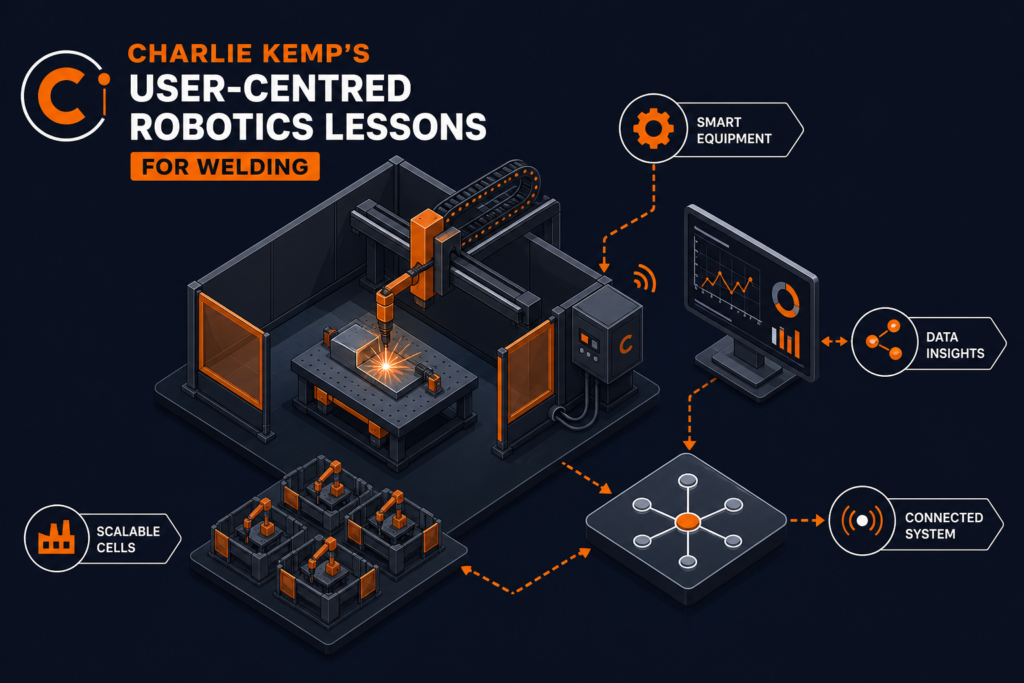
Charlie Kemp’s profile in IEEE Spectrum Robotics’ Robots Guide offers a perspective that reaches beyond assistive technology and into mainstream industrial automation. In the original source publication, Kemp describes a career shaped by artificial intelligence studies at MIT, academic work in healthcare robotics, and the development of Hello Robot’s Stretch mobile manipulator. The central theme is straightforward: useful robots are built by understanding the people who will use them and the environments in which they must operate. That principle is highly relevant for production managers and welding automation teams, where the technical success of a robotic cell depends not only on robot payload, reach, or arc-on time, but also on operator workflow, fixturing access, maintenance routines, and process variability.
Kemp’s background helps explain why this message carries weight. According to his personal site, he founded the Healthcare Robotics Lab at Georgia Tech and later co-founded Hello Robot in 2017 with Aaron Edsinger, after completing his PhD at MIT under Rod Brooks Charlie Kemp. His work has focused on mobile manipulation, human-robot interaction, and assistive systems intended to function in real homes and workplaces rather than tightly controlled laboratory settings. The Robots Guide profile similarly emphasizes that Stretch was developed to help people with everyday tasks and support independent living ROBOTS: Your Guide to the World of Robotics. For industrial readers, that trajectory matters because it reflects a design discipline increasingly visible in manufacturing: robots are no longer judged only by motion performance, but by how effectively they fit into mixed human-machine processes.
User-centred robotics beyond the lab
A user-centred approach has direct parallels in welding automation. In assistive robotics, the challenge is often uncertainty: cluttered spaces, changing object positions, and close interaction with non-expert users. In welding, the uncertainty is different but no less significant: part tolerances, tack variation, thermal distortion, torch wear, spatter accumulation, and operator-to-operator differences in loading and inspection. Kemp’s emphasis on observing real users and designing around practical constraints suggests a useful discipline for welding cell engineering. Instead of beginning with robot selection alone, integrators increasingly start with task mapping: where operators stand, how parts are presented, how often consumables are changed, how rework is handled, and which welds truly justify robotic execution.
This is particularly relevant as manufacturers evaluate both traditional six-axis robotic cells and collaborative welding systems. Large industrial robot suppliers such as ABB, KUKA, FANUC, and Yaskawa remain the default choice for high-duty-cycle arc welding, especially where payload, reach, and integration with positioners are critical. At the same time, cobot platforms from Universal Robots and Doosan are being assessed for lower-volume, higher-mix applications where ease of programming and operator proximity matter. Kemp’s experience in assistive robotics does not translate directly into welding process parameters, but it reinforces a broader engineering lesson: robot usefulness depends on the total system design, including interfaces, safety architecture, and adaptation to human work patterns.
Why practical observation matters in automation design
One of the strongest takeaways from Kemp’s career is that field exposure changes engineering priorities. Designing robots for people with disabilities requires attention to edge cases, accessibility, intuitive controls, and failure recovery. In manufacturing, similar thinking can improve deployment outcomes. A welding cell that looks efficient in simulation may underperform if fixture loading is awkward, if torch cleaning is difficult to access, or if the HMI is too complex for shift-level troubleshooting. Practical observation often reveals that downtime is driven less by robot motion and more by peripheral details such as cable routing, sensor contamination, poor part location, or inconsistent handoff between manual and automated steps.
That insight aligns with current industrial practice under European and international machinery and robot safety frameworks. Integrators working on robotic welding cells must account for standards such as ISO 10218 for industrial robot safety, ISO/TS 15066 where collaborative operation is relevant, and broader machinery requirements under IEC and EN standards for electrical systems, safeguarding, and risk assessment. In welding applications, process-specific considerations such as fume extraction, arc flash shielding, and safe maintenance access remain essential regardless of whether the robot brand is ABB, KUKA, FANUC, Yaskawa, Universal Robots, or Doosan. Kemp’s user-first mindset supports a more disciplined interpretation of these standards: compliance should not be treated as a paperwork exercise, but as part of designing a cell that people can operate consistently and safely.
What this means for welding cell integrators
For welding cell integrators, Kemp’s experience points to a practical shift in project definition. The most robust robotic welding and cobot welding systems are not specified solely around weld length per hour or robot cycle time. They are designed around the full operator journey: part loading, clamping, weld access, visual inspection, consumable replacement, and fault recovery. A user-centred method can improve fixture design, simplify torch approach angles, reduce the need for awkward manual intervention, and support better HMI layouts for production staff. It also encourages earlier conversations about whether a task is suitable for a fixed industrial robot, a collaborative cell, or a hybrid layout combining manual welding with automated sub-operations.
There is also a strategic implication for SMEs and Tier-1 suppliers facing labour constraints and product variation. Assistive robotics has advanced by making systems more approachable for non-specialists; welding automation is moving in a similar direction through offline programming tools, seam tracking, vision-assisted setup, and easier teach interfaces. Yet the underlying engineering discipline remains the same: understand the real task before selecting the technology. Kemp’s profile, supported by his published background in mobile manipulation and human-robot interaction Charlie Kemp, is a reminder that robotics succeeds when it solves concrete user problems rather than demonstrating isolated technical capability.
From assistive robotics to factory-floor decisions
For manufacturers planning new welding automation investments, the relevance of Kemp’s story is less about copying assistive robot hardware and more about adopting the same engineering posture. Useful robots emerge from close observation, iterative testing, and respect for the people who interact with the system every day. In welding cells, that means validating part variation, operator ergonomics, maintenance access, and safety functions as early as possible, then matching those realities to the right robot platform and process package. Companies reviewing a new robotic welding cell, a cobot welding station, or a retrofit of an existing line can use this perspective to sharpen specifications before procurement and reduce integration risk after installation.
Readers assessing how user-centred robotics principles could improve a welding cell project, from fixture layout to robot selection and safety design, can request a quote to discuss application requirements with a robotic welding integrator.
Related articles
Request a quote
Looking for a specific configuration, or want to discuss our current stock? Tell us about your project — we reply within 24 hours from our Bilbao office.