BMW and Embotech Hit 1 Million In-Plant Vehicle Moves
BMW Group and Embotech have moved 1 million vehicles with automated in-plant driving across four UK and German sites, highlighting scalable factory automation for automotive production.
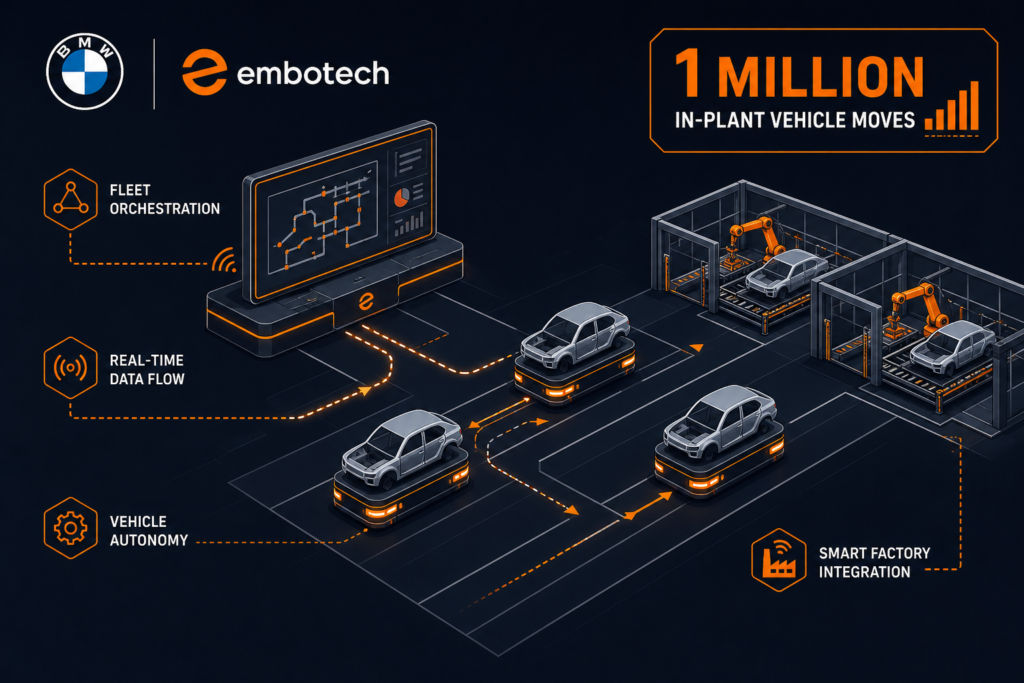
BMW Group and Embotech have reached a notable production automation milestone, reporting that 1 million vehicles have been moved using automated driving technology across four BMW production sites in Germany and the UK. The original report, published by Robotics & Automation News, frames the result as evidence that Automated Driving In-Plant is moving beyond pilot status and into repeatable industrial deployment. According to coverage by Robotics & Automation News and The Robot Report, the system has been used across different brands, vehicle types, and production and logistics processes. For automotive OEMs and Tier-1 suppliers, the significance is less about a headline number and more about what that number implies: validated uptime, process stability, and the ability to integrate software-defined transport into live manufacturing environments.
Automated vehicle movement inside factories addresses a long-standing inefficiency in automotive production: the transfer of completed or partially completed vehicles between assembly, testing, finishing, and logistics zones. Traditionally, these moves rely on human drivers, fixed conveyors, or combinations of tugger systems and manual handling. Embotech’s approach replaces part of that workflow with autonomous software capable of navigating vehicles through plant environments. As described by The Robot Report, BMW has scaled the technology across multiple sites, suggesting that the business case now extends beyond labor substitution to include throughput optimization, traceability, and more flexible plant layout planning. In practical terms, this kind of in-plant autonomy supports digital manufacturing strategies in which material flow, final assembly sequencing, and yard logistics are increasingly coordinated through software rather than fixed infrastructure alone.
Why the milestone matters for automotive manufacturing
The one-million-vehicle mark is relevant because automotive manufacturers have historically been cautious about introducing autonomous systems into mixed industrial environments where people, forklifts, AGVs, and high-value assets interact. Reaching this scale indicates that BMW and Embotech have managed not only navigation performance but also operational governance, safety validation, and plant-level integration. That matters to Tier-1 suppliers because OEM expectations tend to cascade through the supply chain. Once an OEM demonstrates measurable gains from autonomous in-plant movement, suppliers are more likely to evaluate similar technologies for body-in-white logistics, finished component transfer, and end-of-line handling. It also reinforces a broader trend in automotive production: automation is no longer limited to welding, painting, and assembly robots, but is extending into intralogistics and vehicle flow orchestration.
From a systems perspective, the development aligns with the wider convergence of robotics, machine vision, fleet management, and industrial software. While automated in-plant driving is distinct from robotic welding, both depend on robust cell or area design, deterministic communication, and compliance with machinery and functional safety requirements. Relevant frameworks may include ISO 12100 for machinery risk assessment, IEC 61508 and ISO 13849 for functional safety concepts, and applicable EN harmonized standards used in European machine integration. Where collaborative robotics or human-robot interaction is involved, integrators also commonly reference ISO 10218 and ISO/TS 15066. The lesson for manufacturing engineers is that scalable autonomy depends less on a single software feature and more on disciplined integration across sensors, controls, safety architecture, and plant operations.
Implications for equipment suppliers and integrators
For industrial automation vendors, BMW and Embotech’s milestone shows that OEMs are willing to scale solutions that reduce non-value-added movement and improve production continuity. That has implications for robot suppliers such as ABB, KUKA, FANUC, Yaskawa, Universal Robots, and Doosan, even when they are not directly supplying the autonomous driving platform. Automotive plants increasingly expect interoperability between robotic workcells, MES or plant IT layers, and internal logistics systems. A welding line, for example, may need to exchange status data with upstream body handling and downstream inspection or transport systems. Integrators that can connect robot controllers, safety PLCs, vision systems, and digital production management tools into a coherent architecture are likely to be better positioned as factories pursue end-to-end automation rather than isolated islands of robotics.
The milestone also highlights a procurement shift. Buyers are evaluating automation not only on cycle time and payload, but on how well a solution adapts to model mix, plant reconfiguration, and labor constraints. In automotive and metal fabrication, that favors modular systems, software-driven commissioning, and clearer lifecycle support. Whether the application is autonomous vehicle movement, robotic MIG/MAG welding, laser welding, or cobot tending, the same commercial question applies: can the system be deployed safely at scale while maintaining predictable output? The BMW-Embotech case suggests that the answer increasingly depends on integration maturity and operational data, not just hardware selection.
What this means for welding cell integrators
For welding cell integrators, the direct takeaway is that customers are becoming more comfortable with automation that spans beyond the weld arc itself. A robotic welding cell is no longer assessed only as a standalone asset with a robot, power source, positioner, and guarding. It is part of a wider production flow that may include autonomous transport, digital job tracking, machine vision, and coordinated handoff between manual and automated stations. Integrators designing cells around ABB, KUKA, FANUC, or Yaskawa industrial robots, or collaborative platforms from Universal Robots and Doosan, should expect more requests for interface readiness, safety zoning, and data exchange with plant logistics systems. In high-mix environments, cobot welding cells may also need to coexist with AGVs, AMRs, or autonomous vehicle movement corridors, which raises additional design considerations around access control, EN-compliant guarding strategies, and safe restart logic.
There is also a strategic message for smaller metalworking firms and Tier-1 suppliers. The BMW and Embotech deployment demonstrates that automation value can come from reducing transport friction and idle time, not only from increasing arc-on time. Welding cell projects that incorporate smarter part presentation, automated transfer between fixtures, or integration with internal logistics may therefore deliver stronger returns than cells optimized only for robot speed. As manufacturers review future investments, they may want to compare not just robot brands and welding process capability, but also how a proposed cell fits into broader factory automation plans.
Companies assessing robotic welding cells, cobot welding stations, or integrated production automation can request a quote to review layout options, safety requirements, and integration pathways aligned with current automotive and metal fabrication standards.
Related articles
Request a quote
Looking for a specific configuration, or want to discuss our current stock? Tell us about your project — we reply within 24 hours from our Bilbao office.