Light-Based AI Computing Could Reshape Welding Automation
Research into photonic computing points to faster, lower-energy AI processing, with potential implications for adaptive robotic welding cells, cobot control and real-time quality monitoring.
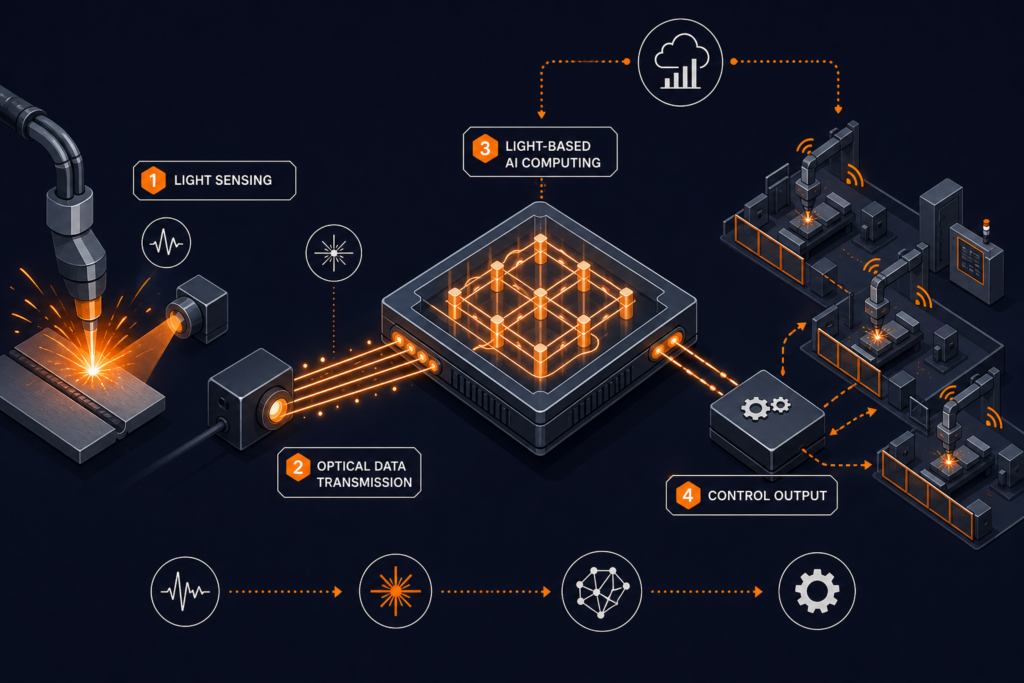
Research highlighted by Hackster.io points to a development that could eventually matter well beyond data centers: AI computation performed with light rather than only with conventional electronic circuits. The work, led by researchers at Koç University, explores photonic computing architectures designed to accelerate AI workloads while reducing energy consumption. For industrial automation, the relevance is straightforward. Robotic welding cells increasingly rely on AI-assisted functions for seam tracking, vision inspection, process optimization and predictive maintenance. If those workloads can be executed faster and with lower power draw, machine builders and end users could gain more responsive control systems, denser sensing and potentially lower operating costs at the edge.
Why photonic AI matters for industrial control
Conventional AI inference in manufacturing is usually handled by CPUs, GPUs or dedicated accelerators, all of which remain constrained by heat, latency and power budgets when deployed close to the process. Photonic computing aims to move some mathematical operations into the optical domain, where light can process information at very high speed and with different energy characteristics than transistor-based logic. For factory automation, that does not mean programmable logic controllers or robot controllers will suddenly become optical devices. A more realistic near-term scenario is that optical accelerators support specific AI tasks such as image classification, anomaly detection or high-speed sensor fusion, while standard industrial control layers continue to manage deterministic motion and safety functions.
That distinction matters in welding. Arc welding cells generate spatter, smoke, glare, vibration and thermal drift, all of which complicate sensing and closed-loop control. AI models can help interpret noisy camera feeds, estimate bead geometry and detect deviations in torch position or part fit-up. According to BlueBay Automation, machine learning in cobot welding can use real-time data to adjust parameters such as voltage, current and travel speed in response to changing conditions. That kind of adaptive behavior becomes more practical as compute latency falls. A photonic accelerator would not replace the welding power source or robot path planner, but it could shorten the time needed to interpret sensor data and issue process corrections.
Potential impact on robotic and cobot welding cells
The welding automation market already includes a broad mix of robot and cobot platforms from ABB, KUKA, FANUC, Yaskawa, Universal Robots and Doosan. Across these ecosystems, the technical challenge is similar: how to combine robot motion, welding process control, machine vision and quality analytics without creating excessive integration complexity. AI is increasingly used to reduce programming effort, improve first-pass yield and support high-mix, low-volume production. Universal Robots has argued that AI-enabled welding automation can cut downtime and defect rates by making collaborative systems easier to deploy and more adaptive on the shop floor, as described by Universal Robots.
Photonic AI could strengthen that trend if it matures into commercially deployable edge hardware. In practical terms, faster inference could improve seam finding before arc start, support live correction of torch orientation during welding and enable more detailed post-weld inspection without slowing takt time. It may also help integrators process larger volumes of data from thermal cameras, laser profilers, current and voltage traces, force sensors and environmental monitoring devices. For automotive Tier-1 suppliers and metal fabrication SMEs, the main value would not be “AI for its own sake” but better process stability under real production constraints: variable parts, shorter runs, tighter traceability and pressure to reduce energy use per welded assembly.
Limits, standards and integration realities
There is still a large gap between laboratory photonic computing research and validated industrial deployment. Welding cells operate in environments that demand ruggedization, electromagnetic compatibility, maintainability and predictable lifecycle support. Any future AI accelerator, optical or otherwise, would need to fit within established automation architectures and comply with relevant standards. Safety and machine integration remain governed by frameworks such as ISO 10218 for industrial robots, ISO/TS 15066 for collaborative robot applications, IEC 60204-1 for electrical equipment of machines, and applicable EN harmonized standards used in European machinery compliance. AI-assisted quality functions may also intersect with process qualification requirements and customer-specific validation protocols, especially in automotive and structural fabrication.
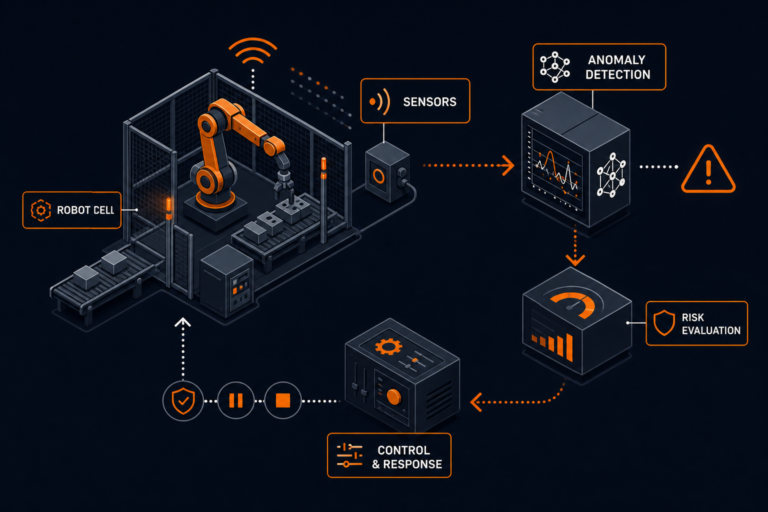
Another constraint is determinism. Real-time robot motion and welding process control require bounded response times, whereas many AI workloads are probabilistic and data-dependent. That means future photonic AI is more likely to augment supervisory and perception layers than to replace the deterministic control core. Manufacturing analysts have repeatedly emphasized that AI creates value when embedded into operational workflows rather than treated as a standalone technology project. Broader industrial AI adoption patterns described by McKinsey support that view, showing that successful deployments combine modular design, deployment tools and workforce enablement rather than relying on raw computing performance alone.
What this means for welding cell integrators
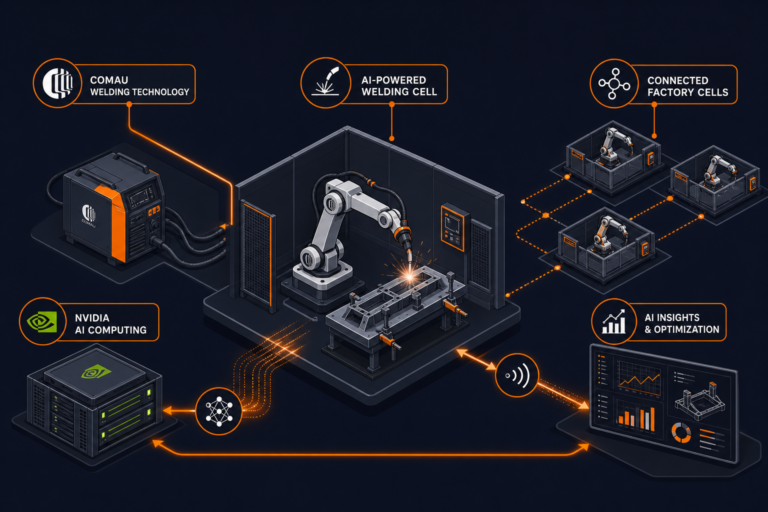
For welding cell integrators, the immediate takeaway is not to redesign systems around photonic processors today, but to prepare architectures that can absorb more capable AI hardware tomorrow. That means separating deterministic robot and safety functions from higher-level perception and optimization layers, using open industrial communication where possible, and planning compute resources for vision, data logging and analytics as distinct modules. Integrators building MIG/MAG, TIG or laser welding cells should also consider where faster AI could deliver measurable return: adaptive fixturing compensation, weld bead inspection, torch wear prediction, fume extraction monitoring or multi-robot coordination. In cobot welding, where ease of deployment and operator interaction are central, lower-latency AI could support more intuitive path generation and faster response to part variation without compromising collaborative risk assessments.
The broader message from the Koç University research is that AI hardware is still evolving, and manufacturing automation stands to benefit when that evolution reaches deployable form. Companies evaluating new robotic welding cells, retrofits or cobot welding stations may want to ask not only which robot brand is specified, but also how the cell’s control architecture can accommodate future AI acceleration, additional sensors and software updates over time.
For manufacturers planning robotic welding investments, this is a useful moment to review cell design choices with long-term compute, sensing and compliance requirements in mind. Readers who want to assess how adaptive AI functions could fit into a new or upgraded welding cell can request a quote for a technical evaluation.
Related articles

Request a quote
Looking for a specific configuration, or want to discuss our current stock? Tell us about your project — we reply within 24 hours from our Bilbao office.