
PLC and Robot Integration Gains Ground in Automation
Discussion around PLC and robot integration highlights a practical route to more accessible automation, with direct implications for welding cells, controls architecture, and safety design.
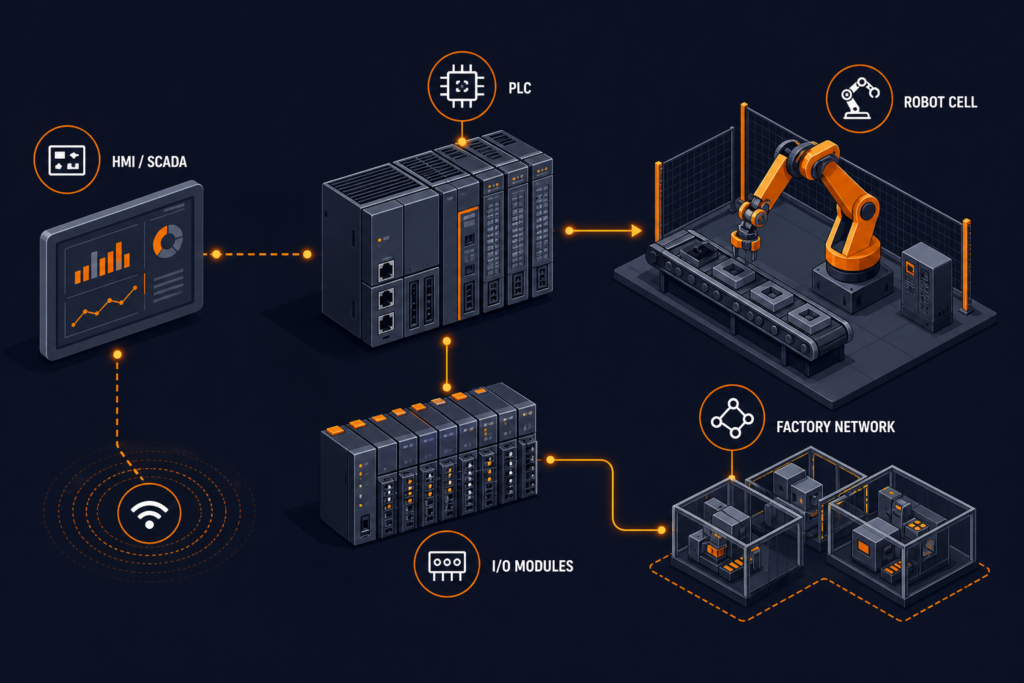
PLC-robot integration moves from niche engineering task to core automation strategy
A recent discussion with Yamaha Robotics Group North America’s Chris Elston, reported by The Robot Report, highlights a shift that many manufacturers are already seeing on the shop floor: tighter integration between programmable logic controllers and robot systems is becoming a central requirement for practical automation. Rather than treating the robot as a standalone island with its own programming environment, machine builders and end users increasingly want coordinated control architectures in which robot motion, peripheral devices, safety logic, HMIs, and production data are managed in a more unified way. That trend matters well beyond assembly applications. In welding, where cycle timing, fixture status, part presence, torch cleaning, gas flow, seam tracking, and quality interlocks all need to work together, PLC-robot integration directly affects uptime, repeatability, and maintainability.
Elston’s role at Yamaha Robotics Group focuses on helping machine builders and end users integrate robotics into PLC-driven manufacturing environments. Additional technical context from the Association for Advancing Automation shows how this approach is being productized: Yamaha has published add-on instructions for Allen-Bradley PLCs and function blocks for Siemens platforms to simplify robot integration into broader machine control schemes, according to Automate. The underlying message is familiar to manufacturing engineers: reducing the number of separate software layers and specialist interfaces can shorten commissioning time and make future support easier. That is especially relevant in plants where maintenance teams are comfortable with PLC diagnostics but may have limited access to proprietary robot programming tools or licenses.
Why unified controls matter in industrial production
For production managers, the practical value of PLC-robot integration lies in deterministic control and clearer ownership of machine logic. A PLC remains the natural coordinator for conveyors, clamps, sensors, weld positioners, part tracking, and line-level communication with MES or SCADA systems. The robot controller, by contrast, is optimized for motion planning, path execution, and process-specific functions. When the interface between the two is well designed, the result is not simply data exchange; it is a cleaner division of responsibilities. Start conditions, recipe selection, fault handling, and safe state transitions can be managed consistently across the cell, while the robot executes the programmed path and process sequence.
This architecture is now common across major robot brands, although implementation details differ. ABB, KUKA, FANUC, Yaskawa, Universal Robots, and Doosan all support industrial Ethernet and fieldbus options that allow PLCs to exchange commands, status bits, diagnostics, and production variables with robot controllers. In higher-specification cells, integrators may also map process data such as weld schedules, current setpoints, fixture IDs, and quality flags into the PLC layer for traceability. For mixed fleets, that interoperability becomes a procurement issue as much as an engineering one. Tier-1 automotive suppliers and metal fabrication groups often want controls standards that can be replicated across sites, regardless of whether a future cell uses a six-axis industrial robot, a collaborative robot, or a gantry-assisted welding system.
Standards, safety, and lifecycle support remain decisive
As integration becomes deeper, standards compliance becomes more critical. In robotic welding cells, the controls architecture must align with machinery and robot safety requirements such as ISO 10218 for industrial robot safety, ISO/TS 15066 where collaborative operation is relevant, and broader machinery safety frameworks under IEC and EN standards, including IEC 60204-1 for electrical equipment of machines and EN ISO 13849-1 for safety-related parts of control systems. Where welding hazards are present, integrators also need to account for arc radiation, fumes, hot surfaces, and spatter containment in the overall risk assessment. A PLC-centric design can support these requirements effectively, but only if safety functions, safe I/O, emergency stop behavior, and restart logic are engineered as part of the full cell concept rather than added late in the project.
The lifecycle argument is equally strong. One point associated with Elston’s commentary in publicly available background material is that machine logic often ends up trapped inside a controller selected for a narrow purpose years earlier, leaving manufacturers without the software access needed to modify or support their own equipment. That concern, reflected in Elston’s LinkedIn profile commentary, resonates with many end users managing aging automation assets. For welding operations, where product mix, jigs, and weld sequences frequently change, maintainability is not a secondary issue. A cell that can be diagnosed through familiar PLC tools, documented clearly, and integrated with standard HMI workflows is often easier to keep productive over a ten- to fifteen-year service life.
What this means for welding cell integrators
For robotic welding and cobot welding integrators, the broader lesson is that controls design should be treated as a strategic part of cell engineering, not just an interface task between robot and peripherals. A modern welding cell may combine a robot from ABB, KUKA, FANUC, or Yaskawa with a welding power source, servo positioner, fume extraction, seam finding sensors, barcode or RFID part identification, and plant-level production reporting. In collaborative applications, Universal Robots and Doosan platforms may also be considered where payload, reach, and risk assessment support a cobot approach. The commercial success of these cells increasingly depends on how smoothly all these subsystems are orchestrated through PLC logic, standardized communications, and robust fault recovery.
That has several implications for design. First, integrators should define early which functions remain in the robot controller and which are managed by the PLC, particularly for recipe handling, interlocks, and quality data capture. Second, they should specify open and supportable communications, avoiding unnecessary dependence on proprietary middleware where standard fieldbus or Ethernet-based integration is sufficient. Third, they should document safety and maintenance access from the outset, so end users can troubleshoot torch cleaning stations, wire feed alarms, fixture sensors, and robot status without relying on a single specialist. In welding, where downtime can quickly affect throughput and rework rates, these decisions have direct operational value.
Manufacturers reviewing a new robotic welding cell, a cobot welding station, or a retrofit of existing PLC-controlled equipment may want to assess the controls architecture as carefully as the robot brand or welding process itself. Companies seeking a turnkey solution can request a quote to evaluate how PLC-robot integration, safety compliance, and maintainable cell design can be aligned with their production targets.
Related articles
Request a quote
Looking for a specific configuration, or want to discuss our current stock? Tell us about your project — we reply within 24 hours from our Bilbao office.