Ency and Stäubli Partner to Simplify Robot Programming
Ency Software and Stäubli Robotics have signed a global agreement aimed at faster, more accessible robot programming, with clear implications for welding cell deployment and changeovers.
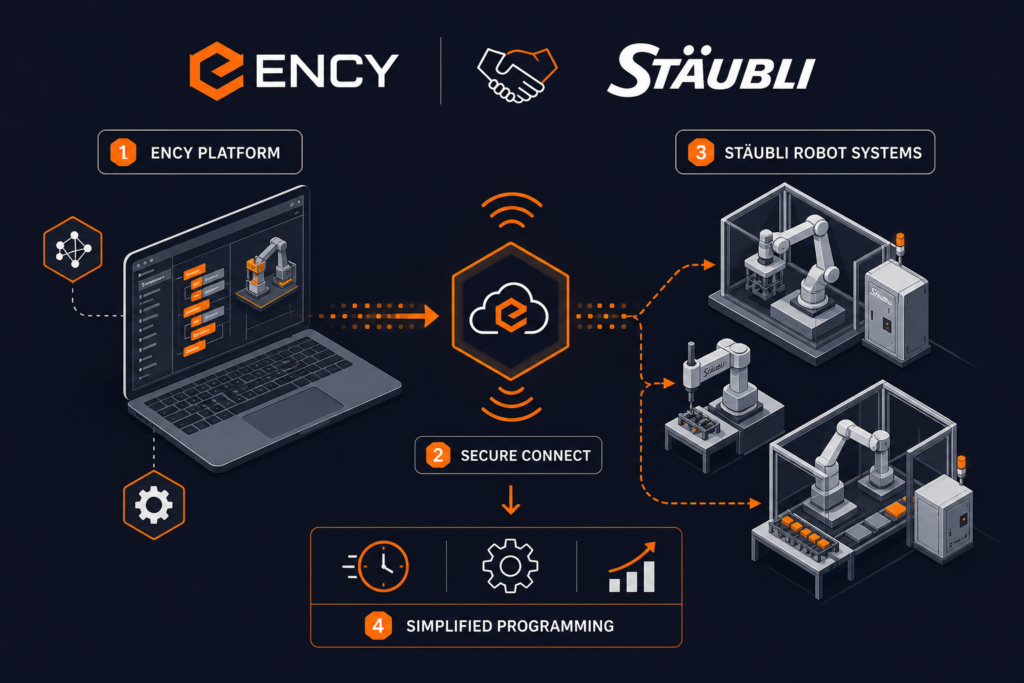
Ency Software and Stäubli Robotics have signed a global agreement intended to make industrial robot programming more intuitive, faster and easier to deploy across production environments. Reported first by Robotics & Automation News, the partnership combines Stäubli’s industrial robot portfolio with Ency Robot, a CAD/CAM-based platform for offline programming, simulation and trajectory generation. For manufacturers, the significance is less about a single software integration and more about a broader shift in how robotic applications are prepared, validated and transferred to the shop floor, especially where cycle time, repeatability and engineering capacity are under pressure.
Offline programming moves closer to mainstream deployment
The agreement addresses a persistent bottleneck in industrial automation: converting CAD geometry and process intent into robot motion without excessive manual teaching at the pendant. According to RoboticsTomorrow, the stated objective is to make advanced robotic applications easier to program, easier to deploy and easier to repeat globally. That matters in sectors such as fabricated metal, automotive components and general industrial manufacturing, where product mix is broad and engineering teams are expected to commission cells quickly while limiting downtime.
Offline robot programming is not new, but adoption has often been constrained by postprocessor complexity, robot-brand-specific workflows and the gap between simulation and real-world commissioning. Ency’s positioning is that a CAD/CAM-style environment can reduce that gap by generating trajectories directly from part geometry and simulating motion before the robot reaches production. A related case described by RoboticsTomorrow highlighted collision and singularity checks, predefined process templates and calibration functions as practical enablers for real cells rather than lab demonstrations. For end users, the value proposition is straightforward: fewer hours of online teaching, fewer commissioning iterations and better use of scarce robot programmers.
Why the agreement matters beyond one robot brand
Although the deal is centered on Stäubli, the wider relevance extends to the competitive landscape of industrial robotics. Production managers and integrators rarely standardize on one vendor forever; many sites run mixed fleets from ABB, KUKA, FANUC, Yaskawa and Stäubli, while collaborative applications may involve Universal Robots or Doosan. In that context, any software layer that reduces dependence on brand-specific programming logic can improve engineering portability and shorten the learning curve for new projects. That does not eliminate the need for vendor-native functions, safety configuration or process tuning, but it can reduce the amount of repetitive work required to get from CAD model to first acceptable part.
The timing also reflects broader market pressure for shorter product lifecycles and more frequent changeovers. As Engineering.com noted in its coverage of Ency Hyper, hybrid online/offline workflows are increasingly valued because they support commissioning adjustments, short runs and flexible production without excessive downtime. For manufacturers evaluating automation ROI, this is a critical point. The business case for a robotic cell is no longer based only on high-volume repetition; it increasingly depends on how efficiently a system can be reprogrammed for new parts, fixtures or weld paths. Software that compresses that engineering cycle can therefore influence total cost of ownership as much as robot hardware selection.
What this means for welding cell integrators
For robotic welding and cobot welding integrators, the agreement is particularly relevant because welding cells are highly sensitive to programming time and path quality. Arc start positions, torch angles, approach and retract moves, weave patterns, travel speed and collision avoidance all affect weld consistency and throughput. In many projects, the mechanical installation is relatively predictable while the programming and process validation phase determines whether the cell reaches target OEE on schedule. A CAD/CAM-based offline workflow can help integrators generate initial weld trajectories from part geometry, simulate reach and interference, and reduce the amount of manual touch-up required once the cell is powered up.
This does not remove the need for welding expertise. Integrators still need to manage torch cleaning, wire feed behavior, seam tracking options, fixture tolerances, distortion control and the interaction between robot motion and welding power source parameters. They must also design to applicable machinery and robot safety requirements, including ISO 10218 for industrial robot safety, ISO/TS 15066 where collaborative operation is relevant, and broader machinery compliance under IEC and EN frameworks such as EN ISO 12100 for risk assessment and IEC 60204-1 for electrical equipment of machines. Even so, better offline programming can reduce project risk in multi-station welding cells, positioner-based systems and compact cobot welding packages where floor space and commissioning windows are limited.
There is also a practical implication for cell architecture. If trajectory generation and simulation become more standardized, integrators can spend more engineering time on value-adding tasks such as fixture design, part presentation, fume extraction, positioner synchronization and quality assurance. That is especially useful in SME metal fabrication, where customers may not have in-house robot programmers and expect turnkey systems to be productive quickly. For larger automotive and Tier-1 environments, the same trend supports more repeatable deployment across plants, with less dependence on local programming practices.
A signal of where industrial automation is heading
The Ency-Stäubli agreement points to a broader direction in industrial automation: software abstraction is becoming a strategic lever for robot adoption. Hardware performance still matters, particularly in precision handling, harsh environments and high-duty-cycle welding, but deployment speed is increasingly decisive. Manufacturers want robot cells that can move from digital model to validated production asset with fewer handoffs between CAD, process engineering and controls teams. Partnerships between robot OEMs and software providers are one way to address that requirement without forcing users to build custom toolchains for every project.
For companies planning new welding automation investments, the development is a reminder to evaluate programming workflow alongside payload, reach and repeatability. The right question is not only which robot brand fits the application, but also how quickly the complete cell can be programmed, simulated, commissioned and changed over. Businesses reviewing robotic welding cells, cobot welding stations or offline programming strategies can use this moment to reassess their engineering workflow and supplier stack.
Companies that want to compare turnkey welding cell options, including offline programming capabilities and integration requirements, can request a quote for a tailored assessment of part mix, cycle time and cell design constraints.
Related articles
Request a quote
Looking for a specific configuration, or want to discuss our current stock? Tell us about your project — we reply within 24 hours from our Bilbao office.