Tate Expands Cobot Welding Network to 58 Systems
Tate has scaled from manual welding to a 58-unit cobot welding network across three plants, highlighting how connected automation can raise throughput, quality, and labor flexibility.
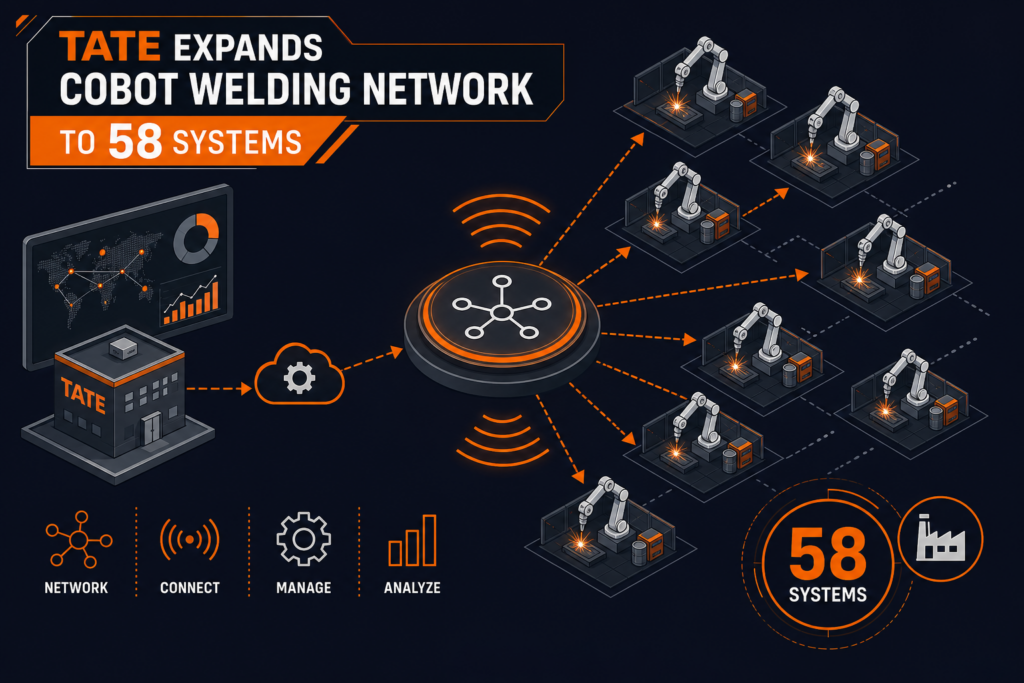
Tate scales collaborative welding across three plants
Tate, a manufacturer serving data center infrastructure programs, has expanded its move away from traditional hand welding by deploying 58 Hirebotics cobot welding systems across multiple U.S. facilities. The original report, published by The Robot Report, framed the project as a shift from manual welding toward an agile, cloud-connected automation network. Additional coverage indicates the rollout spans plants in Arkansas, Virginia, and Kentucky, with the company using the systems to standardize production while increasing output per welder. According to Robotics & Automation News and ManufacturingTomorrow, Tate reports a 12-fold increase in output per welder after scaling the fleet.
For manufacturing managers, the significance is less about the headline number of cobots and more about the operating model behind it. Tate appears to be treating welding automation as a distributed production resource rather than a small pilot cell or isolated capital project. That matters because many fabricators still deploy one or two cobot stations as stand-alone assets, often without integrating programming methods, fixture strategy, weld procedure control, or fleet-level data collection. A 58-system deployment suggests a more mature approach in which repeatable hardware, common software workflows, and centralized support become as important as the robot arm itself. In practice, that can reduce variation between shifts and sites, especially where weld quality depends heavily on operator technique.
Why the shift from manual welding matters
The labor dimension is central. Welding remains one of the hardest industrial skills to recruit and retain, particularly for repetitive fillet and structural work. Collaborative welding systems are increasingly used not to eliminate skilled welders, but to reallocate them toward fit-up, inspection, parameter optimization, and higher-complexity joints. In Tate’s case, the reported productivity gain suggests that a single welder can supervise more arc-on time than would be possible in a fully manual process. Cloud-connected systems also allow remote monitoring of uptime, consumables, and program usage, which can help maintenance and production teams identify bottlenecks faster than with conventional manual booths.
There is also a quality argument. Repetitive welds on frames, stiffeners, and similar assemblies benefit from consistent torch angle, travel speed, and path repeatability. Collaborative systems do not remove the need for welding procedure qualification, fixture accuracy, or distortion control, but they can reduce operator-to-operator variability. This is especially relevant in sectors where downstream assembly tolerances are tightening. The broader market has already shown that collaborative welding is becoming a standard option alongside traditional industrial robot cells from ABB, KUKA, FANUC, and Yaskawa, as well as cobot platforms from Universal Robots and Doosan. The choice between a cobot and a fenced six-axis robot still depends on part mix, deposition rate, duty cycle, and required positioning accuracy, but Tate’s deployment indicates that cobots are now credible for multi-site production scaling, not just entry-level automation.
Cloud connectivity and flexible cell design
One notable aspect of the Tate project is the emphasis on networked deployment. Hirebotics has positioned its welding systems around connected operation, and that aligns with a wider manufacturing trend: welding cells are increasingly expected to generate usable production data, not just weld parts. For plant engineers, this means the business case can extend beyond labor savings into traceability, maintenance planning, and standardized work instructions. A connected fleet can also support faster replication across sites, because proven weld programs, user permissions, and process settings can be rolled out with less local engineering effort. Coverage from Hirebotics highlights another practical advantage of collaborative welding: one cobot can be moved between stations and part families when demand changes, provided fixturing and risk assessment are designed accordingly.
That flexibility does not remove compliance obligations. Welding cobot deployments in Europe typically need to be assessed against machinery and robot safety requirements including ISO 10218, ISO/TS 15066 for collaborative applications, and relevant IEC and EN electrical and functional safety standards. Arc welding itself introduces hazards that remain outside the collaborative envelope, such as fume extraction, UV radiation, hot spatter, and fire risk. Integrators therefore still need to evaluate guarding, screens, interlocks, extraction systems, and safe operating modes on a case-by-case basis. In many applications, a “cobot welder” may still require partial enclosure or controlled access, even if the robot platform is collaborative by design. That distinction is often overlooked by buyers comparing cobots with conventional robotic welding cells.
What this means for welding cell integrators
What this means for welding cell integrators is that customer demand is shifting from single-station automation toward scalable welding architectures. Integrators designing robotic welding cells or cobot welding stations should expect more requests for repeatable templates that can be duplicated across plants, with common HMIs, standardized torch packages, and shared spare-parts strategies. The Tate example shows that value increasingly comes from deployment methodology: fixture modularity, offline and teach-by-demonstration programming balance, weld sequence control, and data visibility across dozens of assets. For high-mix manufacturers, integrators may need to combine mobile or semi-mobile cobot stations with dedicated fixtures and quick-change tables. For higher-volume work, a conventional cell from ABB, KUKA, FANUC, or Yaskawa may still offer better arc-on performance, but cobots from Universal Robots, Doosan, and specialist welding packages can lower the barrier to rollout where floor space, staffing, and product variation are the main constraints.
Procurement teams should also read this deployment as a reminder that automation ROI is increasingly tied to implementation speed and workforce adoption. A cobot welding project succeeds when welders trust the process, supervisors can schedule it effectively, and maintenance teams can support it without excessive vendor dependence. That makes training, consumable management, and process documentation just as critical as robot selection. Companies evaluating similar projects may want to compare whether a turnkey welding cell, a collaborative welding package, or a hybrid line architecture best matches their throughput targets, part sizes, and compliance requirements.
For manufacturers planning to move from manual welding to robotic or collaborative welding, Robotic Welding Cells can assess part mix, safety requirements, and expected arc-on time, then propose a suitable turnkey cell. Readers who want to benchmark a cobot station against a conventional robotic welding cell can request a quote for a project review.
Related articles
Request a quote
Looking for a specific configuration, or want to discuss our current stock? Tell us about your project — we reply within 24 hours from our Bilbao office.