Context Platforms Move Industrial AI Toward Factory Use
Context platforms are emerging as a governed layer that helps industrial AI agents work safely and reliably in production, with clear implications for robotic welding cells and cobot deployment.
Why context platforms are gaining attention in manufacturing
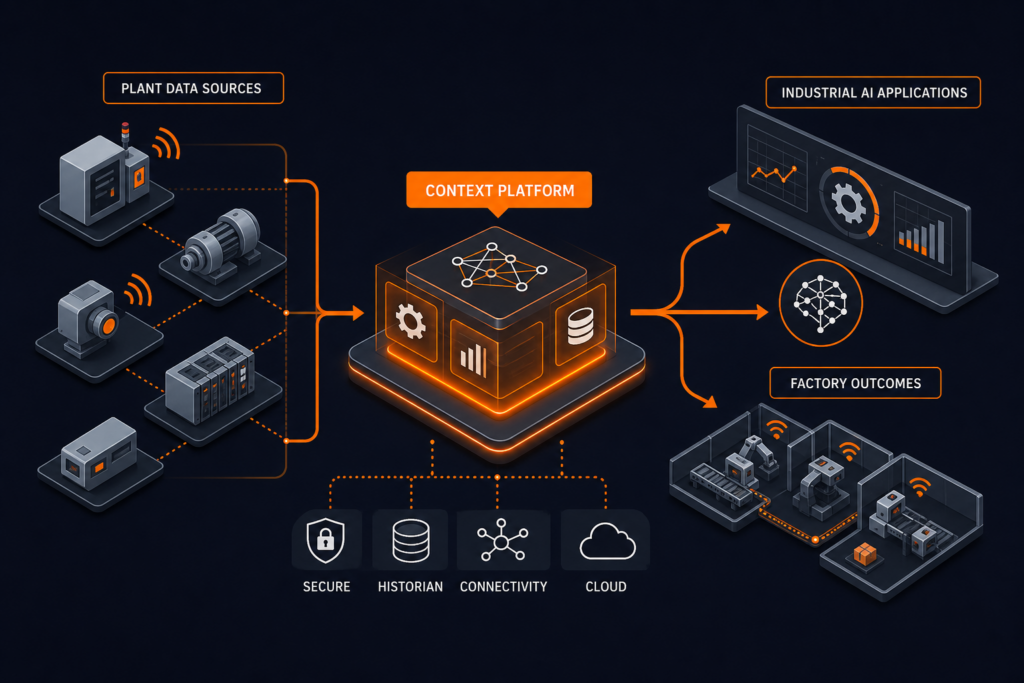
Industrial companies are moving beyond pilot projects for AI agents and asking a harder question: what makes an agent usable on the shop floor rather than only in a demo? According to the original report in Robotics & Automation News, the answer increasingly lies in a context platform, a governed layer that stores metadata, operating procedures, business rules, documentation and access policies so an AI system can act with traceability and control. In a factory environment, that distinction matters because an agent advising on machine settings, maintenance actions or welding sequence changes must work from approved information, not generic internet-scale assumptions. For production managers and manufacturing engineers, the practical value is straightforward: context reduces the risk that an AI assistant will generate technically plausible but operationally unsafe recommendations. It also creates a more auditable path for using AI in environments where quality records, operator permissions and process discipline are already tightly managed.
The broader manufacturing discussion is moving in the same direction. Machine Design highlights how contextualized data helps AI agents produce more relevant actions inside industrial automation, while RoboticsTomorrow describes agentic AI as a layer that can ingest manuals, work procedures and technical instructions to create operational playbooks. That is particularly relevant in metal fabrication and welding, where process knowledge is fragmented across WPS documents, fixture drawings, robot programs, torch maintenance instructions and quality procedures. A context platform can unify those sources and present them to an AI agent under governance rules, making the agent more useful for setup support, troubleshooting and production changeovers.
From generic AI to governed industrial decision support
The industrial challenge is not simply data volume; it is data meaning. A welding cell may already generate robot logs, arc data, PLC states, HMI alarms, vision measurements and MES records, but an AI agent still needs to know which values are authoritative, which procedures apply to a given part family, and which users are allowed to request or approve changes. In practice, a context platform can connect documentation and live production data with role-based access, revision control and audit trails. That is the difference between an agent saying “increase travel speed” and an agent saying “for this qualified mild-steel fillet weld, under the approved procedure revision, the current speed range is X to Y; any deviation requires engineering approval.” For regulated sectors and Tier-1 suppliers, that level of governance aligns better with existing quality systems and with standards-driven operations.
This also fits the way industrial robotics is evolving. Major robot and cobot suppliers including ABB, KUKA, FANUC, Yaskawa, Universal Robots and Doosan already support increasingly data-rich environments through offline programming, simulation, condition monitoring and connected control architectures. Yet those vendor ecosystems do not remove the need for plant-specific context. A welding engineer still has to reconcile robot reach studies, torch angles, seam tracking limits, fixture tolerances, part variants and operator safety procedures. A governed context layer can sit above these systems and help AI agents interpret plant-specific constraints without bypassing existing controls. For factories working under ISO 10218 for industrial robot safety, ISO/TS 15066 for collaborative applications, and machinery-related IEC and EN requirements such as EN ISO 13849 for safety-related control systems, that governance model is more compatible with real deployment than open-ended conversational AI.
Implications for robotic welding and cobot welding workflows
Welding is a strong use case because it combines repeatable automation with high process sensitivity. Small changes in joint fit-up, consumables, torch wear, shielding gas flow or part presentation can affect quality, cycle time and rework. AI agents can help only if they understand the production context around those variables. The International Federation of Robotics points to AI-assisted robotic welding programming that can generate welding positions and transitions from 3D CAD data, reducing manual programming effort in metalworking environments, as described by IFR. That capability becomes more production-ready when linked to a context platform containing approved weld procedures, part revision history, fixture setup instructions and robot-specific constraints. Instead of treating programming as a standalone automation task, the AI layer can place it inside a governed manufacturing workflow.
For cobot welding, the same principle applies at a different scale. SMEs often rely on collaborative systems because they need flexible automation without the footprint or complexity of a fully fenced line. But flexibility can create inconsistency if setup knowledge remains informal. BlueBay Automation notes that AI and machine learning can support cobot welding through simulation and training, including digital-twin-based preparation. A context platform extends that value by ensuring the AI assistant references the correct torch package, approved weld sequence, operator guidance and maintenance intervals for the exact cell configuration. That is useful when a shop runs mixed production and needs faster onboarding of operators without losing process discipline.
What this means for welding cell integrators
For welding cell integrators, context platforms point to a design shift. The deliverable is no longer only a robot, positioner, power source, guarding package and PLC logic; it may also include a structured knowledge layer that an AI agent can use safely. Integrators designing cells around ABB, KUKA, FANUC or Yaskawa robots, or collaborative platforms from Universal Robots and Doosan, may need to think about how documentation is tagged, how WPS and maintenance records are linked to part numbers, and how operator permissions are enforced across HMI, MES and AI interfaces. This has consequences for commissioning, too. If the AI layer is expected to assist with fault diagnosis, parameter recommendations or changeover guidance, then the integrator must define data ownership, revision workflows and escalation rules from the start. In other words, AI readiness becomes part of welding cell architecture, not an afterthought added after FAT and SAT are complete.
For manufacturers, the near-term opportunity is operational rather than speculative. A governed context platform can help reduce programming delays, improve troubleshooting consistency, support training and make AI outputs more auditable in production. That does not remove the need for qualified welding engineers, robot programmers or safety validation, but it can make their expertise easier to scale across shifts and sites. Companies evaluating new robotic welding cells or cobot welding stations may therefore want to assess not only payload, reach, duty cycle and arc performance, but also how process knowledge will be structured for future AI-assisted operation.
Companies reviewing robotic welding, cobot welding or turnkey cell upgrades can request a quote to assess how governed data, standards compliance and AI-ready architecture could be incorporated into a practical production system.
Related articles
Request a quote
Looking for a specific configuration, or want to discuss our current stock? Tell us about your project — we reply within 24 hours from our Bilbao office.