ExRobotics Debuts UL-Certified Robot for Hazardous Areas
ExRobotics has introduced a UL-certified inspection robot for explosive environments, highlighting how certified mobile robotics could improve safety, uptime, and process visibility in industry.
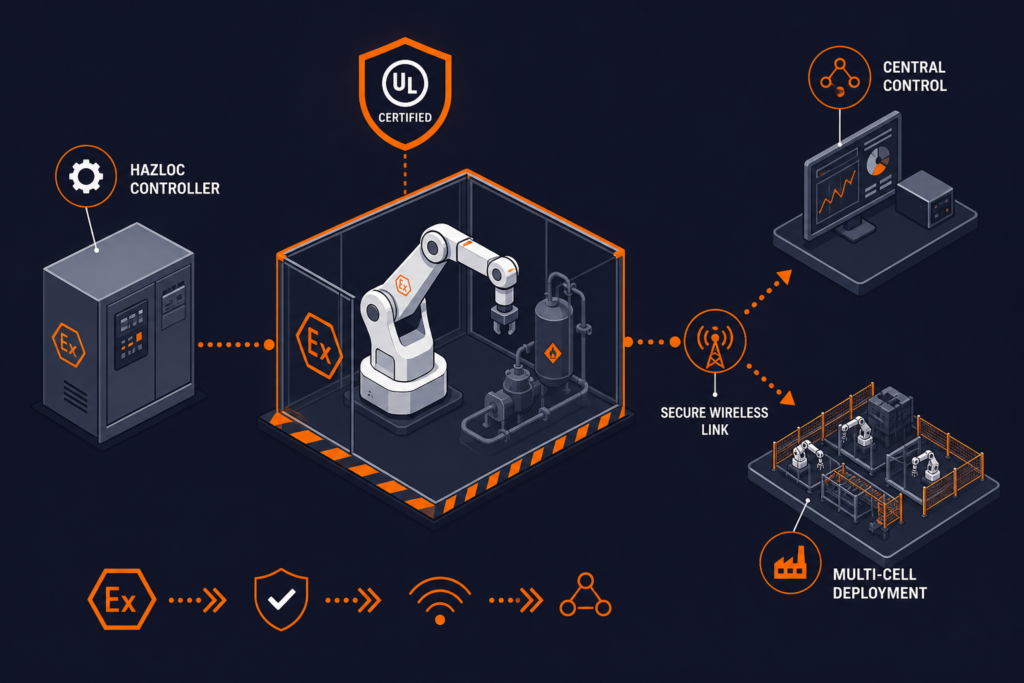
ExRobotics has introduced the ExR-2.5, an inspection robot certified for operation in hazardous environments in North America, marking a notable step for mobile robotics in sectors where explosive gases, vapors, or combustible dusts can be present. Reported by The Robot Report, the launch addresses a long-standing barrier in process industries: how to automate inspection tasks in classified areas without creating a new ignition risk. For manufacturers, plant operators, and engineering teams, the development is less about a single robot model and more about the emergence of a recognized compliance pathway for robotic systems intended to work in hazardous locations.
UL 6260 creates a clearer route for hazardous-area robotics
The ExR-2.5 is described as the first remotely operated robot to receive certification under UL 6260, a standard that establishes a framework for evaluating robotic inspection systems used in explosive atmospheres. According to coverage citing UL Solutions, the certification process assessed risks including fire, explosion, electric shock, and mechanical hazards, with testing covering batteries, electrical systems, and mechanical components under both normal and fault conditions, as outlined by Bastille Post. That matters because hazardous-area compliance for robots is more complex than standard industrial machinery approval: it requires the full system architecture, energy storage, enclosure design, and failure modes to be considered in relation to ignition sources.
In practical terms, this positions UL 6260 as a North American reference point similar in strategic importance to how IEC and EN frameworks shape machine safety decisions in Europe. Integrators and end users already work with standards such as ISO 12100 for risk assessment, ISO 10218 for industrial robot safety, ISO/TS 15066 for collaborative applications, and IEC 60204-1 for electrical equipment of machines. In hazardous locations, those baseline machine-safety requirements do not disappear; they are layered with area-classification and explosion-protection requirements. For multinational manufacturers, that means any future deployment strategy for inspection robots may need to align UL certification in North America with IECEx or ATEX-related expectations and relevant EN harmonized standards in Europe.
Why safe inspection automation matters in industrial plants
Inspection rounds in oil and gas, chemicals, tank storage, and other process-heavy sectors still depend heavily on personnel entering potentially dangerous areas to collect visual, thermal, acoustic, or gauge-based information. A certified mobile robot changes the risk profile by moving routine data capture away from direct human exposure. The value proposition is operational rather than promotional: fewer manual entries into hazardous zones, more frequent inspection cycles, better traceability of readings, and potentially faster identification of leaks, abnormal temperatures, or equipment degradation. UL Solutions said the certification helps support the shift of high-risk inspections from people to robots, according to reporting by The Joplin Globe.
For production environments, the broader implication is that robotics is expanding beyond fenced automation islands and into plant-wide operational technology workflows. That trend is already visible in mainstream manufacturing, where vendors such as ABB, KUKA, FANUC, Yaskawa, Universal Robots, and Doosan are increasingly connected to MES, quality systems, and condition-monitoring platforms. While those suppliers are better known for articulated robots and cobots in assembly, handling, and welding, the ExRobotics case shows that mobile and inspection robotics are beginning to face the same procurement questions that industrial robot buyers already ask: What standards apply? How is risk assessed? Can the system be integrated into existing safety and maintenance procedures? And what evidence exists that the robot can operate reliably in the intended environment?
What this means for welding cell integrators
For welding cell integrators, the ExR-2.5 launch is relevant even though it is not a welding robot. Robotic welding cells increasingly include adjacent processes such as fume extraction monitoring, gas supply supervision, thermal inspection, and remote diagnostics. In heavy fabrication, energy, offshore, and pressure-equipment manufacturing, some of these tasks may occur in areas where flammable atmospheres are possible or where safety zoning affects equipment selection. Integrators designing robotic welding or cobot welding systems therefore need to think beyond arc performance and cycle time. Cell layout, cable routing, ventilation, enclosure design, sensor selection, and maintenance access all interact with applicable ISO, IEC, and EN requirements, especially when welding cells are installed near classified process areas.
The lesson is not that every welding cell requires hazardous-location certification, but that compliance is becoming more application-specific. A standard collaborative welding station using a Universal Robots or Doosan cobot, or a high-throughput arc cell built around ABB, KUKA, FANUC, or Yaskawa hardware, may still need additional engineering controls if installed in a mixed-risk facility. Integrators may also see new opportunities to combine fixed welding automation with certified mobile inspection platforms for pre-shift checks, utility monitoring, or post-process verification in difficult-to-access zones. As customers ask for more connected and autonomous production systems, the ability to document conformity, perform structured risk assessments, and separate ordinary industrial areas from hazardous ones will become a stronger differentiator in project execution.
Certification is becoming a procurement issue, not just an engineering one
The ExRobotics announcement also signals a shift in how buyers evaluate robotics for industrial operations. Certification is increasingly a procurement gate, particularly for Tier-1 suppliers, EPC contractors, and multinational manufacturers that must satisfy insurer, corporate EHS, and site-compliance requirements before deployment. A robot may be technically capable, but without recognized third-party certification, adoption in hazardous locations can stall. That is why the ExR-2.5 milestone matters beyond its immediate application: it gives purchasing teams and plant engineers a clearer reference when comparing robotic inspection options for regulated environments.
For companies planning new automation projects, the takeaway is to involve safety, compliance, and integration stakeholders early, whether the application is inspection, handling, or robotic welding. Matching the robot architecture to the site classification, validating conformity to relevant ISO, IEC, UL, and EN requirements, and defining interfaces with existing plant systems can reduce redesign risk later in the project.
Manufacturers and integrators assessing robotic welding cells, cobot welding stations, or automation layouts near higher-risk process areas can request a quote to review technical feasibility, safety architecture, and standards alignment for their specific production environment.
Related articles
Request a quote
Looking for a specific configuration, or want to discuss our current stock? Tell us about your project — we reply within 24 hours from our Bilbao office.