Defense Robotics Push Highlights Manufacturing Labor Gap
GrayMatter Robotics says autonomous finishing can help address defense manufacturing labor shortages, a signal for integrators designing traceable, flexible robotic cells.
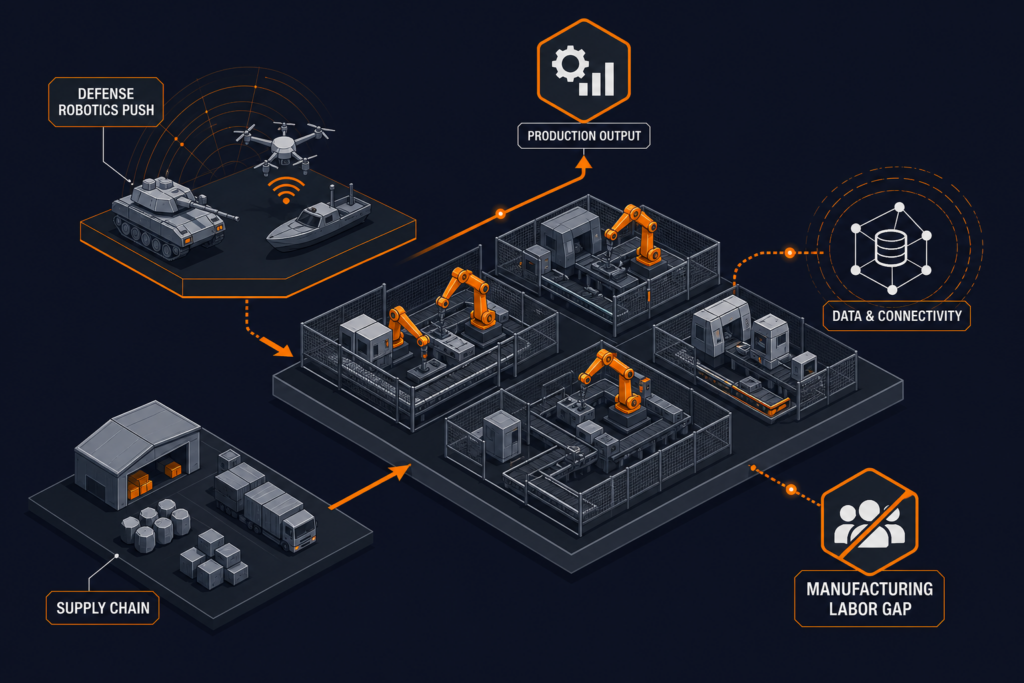
Defense capacity is increasingly tied to automation
Defense manufacturing readiness is being framed less as a pure procurement issue and more as a production-capacity problem, with labor availability now a central constraint. According to reporting from The Robot Report, GrayMatter Robotics argues that autonomous finishing and surface-preparation systems can help offset a projected shortage of 174,000 workers identified in the U.S. Navy’s 2024 industrial base review. The company’s position is that bottlenecks in sanding, grinding, deburring, coating preparation, and related manual processes are limiting throughput at depots and supplier facilities, particularly where skilled trades are aging out faster than replacements are trained. That matters beyond defense alone, because the same labor dynamics are visible across heavy fabrication, aerospace structures, shipbuilding, and metalworking environments where robotic welding cells are already being evaluated as a way to stabilize output.
The underlying argument is operational rather than promotional: if manufacturers cannot recruit and retain enough people for repetitive, ergonomically difficult, or hazardous finishing tasks, then readiness targets become dependent on automation architectures that can be deployed quickly and run with limited reprogramming. Additional coverage and company statements reproduced by robot.tv News and GlobeNewswire emphasize requirements such as no external data routing, minimal part-to-part reprogramming, and full traceability of processed surfaces. Those requirements align with broader industrial trends toward edge computing, closed-network cell control, and digital production records. For defense suppliers, the issue is not simply whether a robot can move a toolpath, but whether the complete cell can satisfy security, repeatability, and documentation requirements under real production conditions.
Why autonomous finishing matters to fabrication workflows
Surface preparation is often treated as a secondary process compared with cutting, forming, machining, or welding, yet it has a direct effect on downstream quality. In welded assemblies, inconsistent edge condition, mill scale removal, oxide cleaning, or post-weld finishing can affect fit-up, weld appearance, coating adhesion, and inspection outcomes. This is where the GrayMatter discussion becomes relevant to a wider manufacturing audience: autonomous finishing is part of the same automation stack that many plants are building around robotic welding, inspection, and material handling. A production line that automates welding but leaves grinding, weld dressing, or pre-paint preparation entirely manual can still face throughput instability, variable cycle times, and labor exposure in the least desirable tasks.
For integrators, the technical challenge is to combine robot motion, force control, sensing, and process traceability in a way that handles part variation without excessive engineering hours. That applies whether the robot platform comes from ABB, KUKA, FANUC, Yaskawa, Universal Robots, or Doosan. In heavy-duty finishing cells, six-axis industrial robots remain common because of payload, reach, and stiffness requirements. In lower-force applications or mixed-volume workshops, cobots may be considered where risk assessment supports collaborative operation, although real finishing and welding deployments still frequently require guarding, fume extraction, and controlled access zones. The standards framework is also familiar: machine builders and end users typically need to address ISO 10218 for industrial robot safety, ISO/TS 15066 for collaborative applications, IEC 60204-1 for electrical equipment of machines, and relevant EN harmonized standards in the European market. Where welding is involved, ISO 3834 quality requirements and process-specific compliance can also shape cell design and documentation.
Traceability, security, and low-reprogramming cells
The defense angle adds another layer that many commercial fabricators are beginning to recognize: automation projects are no longer judged only on cycle time and labor savings. They are increasingly assessed on data governance, process traceability, and the ability to switch between part families without lengthy offline programming. GrayMatter’s emphasis on edge-deployed systems and no external data routing reflects a procurement environment where cybersecurity and operational isolation may be mandatory. Similar concerns are now appearing in civilian sectors with sensitive intellectual property, including aerospace, energy, and rail. For robot cell suppliers, this shifts value toward architectures that keep vision processing, path adaptation, and quality records inside the plant network while still offering auditable logs for each component processed.
That requirement has practical implications for hardware and software selection. A welding or finishing cell designed for high-mix production may need 3D scanning, adaptive path generation, force-torque sensing, and integrated MES or quality-system interfaces, but it must do so without creating fragile dependencies on cloud connectivity. Integrators working with ABB, KUKA, FANUC, or Yaskawa controllers, or with cobot ecosystems from Universal Robots and Doosan, are therefore under pressure to prove not just robot compatibility but also deterministic behavior, maintainable software, and documented safety functions. In Europe, conformity with the Machinery framework, applicable EN standards, and customer-specific validation protocols remains essential, especially when cells are exported or replicated across multiple sites.
What this means for welding cell integrators
For welding cell integrators, the GrayMatter Robotics message is a useful signal that buyers are looking beyond arc-on time. The next wave of projects is likely to bundle welding, pre-weld cleaning, interpass handling, post-weld finishing, and inspection into more unified cells or linked workstations. That creates opportunities for turnkey suppliers that can design around labor scarcity rather than around a single process step. A fabricator serving defense, shipbuilding, or heavy equipment may ask for robotic MIG/MAG or TIG welding together with automated grinding, seam cleanup, or coating preparation, all under one traceable control architecture. Integrators that can combine fixturing, positioners, fume extraction, safety PLCs, vision, and adaptive robotics into a validated package will be better placed than suppliers offering only a standalone robot arm.
The commercial implication is that automation demand may increasingly come from workforce risk and production resilience, not only from classic ROI calculations. Where skilled welders and finishers are difficult to hire, a well-designed robotic or cobot welding cell can protect throughput, improve repeatability, and reduce ergonomic exposure. Companies evaluating these investments will still need realistic feasibility studies, part-family analysis, and compliance planning, but the direction is clear: labor shortages are accelerating interest in integrated robotic fabrication systems. Readers assessing new welding, finishing, or hybrid robotic cells can request a quote to compare technical options, safety architecture, and integration scope for their production environment.
Manufacturers and system buyers that need a robotic welding cell, cobot welding station, or integrated finishing-and-welding solution can request a quote for a project review based on part geometry, throughput targets, and compliance requirements.
Related articles
Request a quote
Looking for a specific configuration, or want to discuss our current stock? Tell us about your project — we reply within 24 hours from our Bilbao office.