Industrial Robotics Adoption Remains Essential for Growth

Industrial robotics is increasingly seen as necessary for productivity, resilience, and welding automation, but adoption still depends on economics, skills, safety, and integration choices.
Industrial robotics is increasingly seen as necessary for productivity, resilience, and welding automation, but adoption still depends on economics, skills, safety, and integration choices.

RF connectors are emerging as a reliability bottleneck in robotic vision, sensor communication and automated inspection, with direct implications for welding cells.

Nvidia’s new Factory Operations Blueprint aims to centralize factory monitoring and optimization, a development with clear implications for robotic welding cells and cobot integration.

Theker’s $85 million funding round highlights growing interest in reconfigurable industrial robots that can shift between tasks, with implications for welding cell flexibility.

Güdel’s new vertical and horizontal motion concept expands robotic grinding reach for large fabrications, with implications for welding cell design, part handling and process consistency.

Güdel’s new grinding concept combines vertical lift and floor-mounted linear motion so one robot can cover larger parts, reducing repositioning, cycle time and process variation.

AGIBOT’s World Challenge 2026 highlights a shift from simulation scores to physical robot testing, a change that could improve reliability for AI-driven industrial automation and welding cells.

A growing body of evidence shows robots can augment manufacturing teams through safer workflows, reskilling and better task allocation, with clear implications for welding cells.
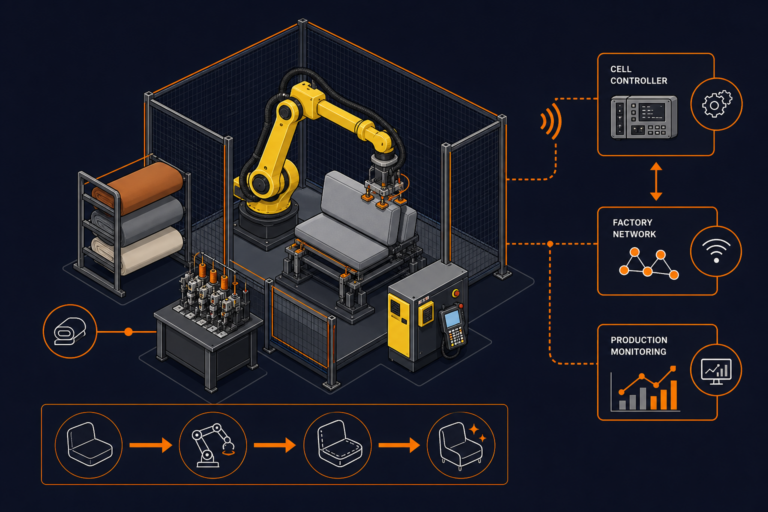
A Canadian furniture manufacturer has automated a labor-intensive upholstery process with a FANUC-based robotic cell, highlighting wider lessons for industrial cell design and welding automation.

FANUC has introduced the 11 kg CRX-3iA in Europe, a compact collaborative robot aimed at welding in tight spaces, with 3 kg payload and ±0.02 mm repeatability.