AGIBOT World Challenge 2026 Puts AI Models on Real Robots
AGIBOT’s World Challenge 2026 highlights a shift from simulation scores to physical robot testing, a change that could improve reliability for AI-driven industrial automation and welding cells.
From benchmark scores to physical validation
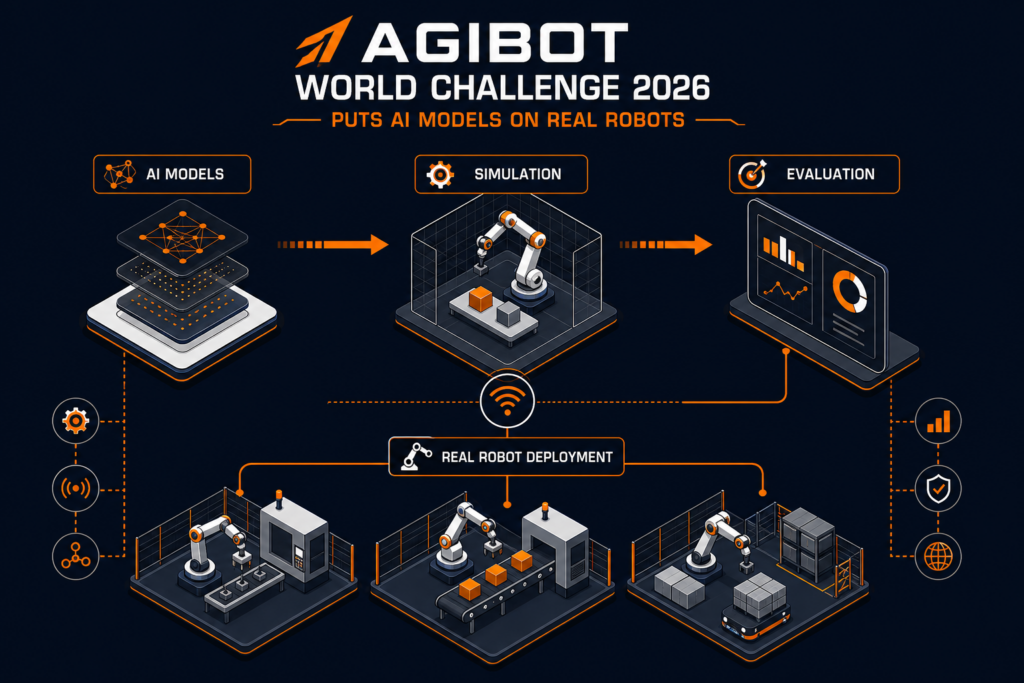
AGIBOT’s World Challenge 2026 signals a broader change in how embodied AI is being assessed: less emphasis on simulation-only leaderboards and more focus on whether models can execute tasks reliably on physical machines. According to the original report by The Robot Report, the competition was designed to examine how AI models perform in closed-loop testing on real robots handling real tasks. That distinction matters for industrial users, because many automation projects still face a gap between promising lab results and stable deployment on the shop floor. In practical terms, AGIBOT is arguing that evaluation should include robot stability, adaptability to physical variation, and the ability to complete longer task sequences under real-world constraints, not just produce high scores in synthetic environments.
Additional event details reinforce that point. AGIBOT said its EWMBench and Genie Sim Benchmark were intended to provide standardized metrics, automated evaluation, and comparable results across simulation and physical testing, while addressing inconsistent evaluation criteria across the sector, according to AGIBOT. Separate coverage from Humanoids Daily reported that the challenge at ICRA in Vienna involved 526 teams from 27 countries. That scale suggests growing industry and research interest in moving embodied AI evaluation closer to deployment conditions. For manufacturers, the message is straightforward: AI models should be judged not only by perception or planning quality in simulation, but by repeatability, fault recovery, cycle robustness, and safe interaction with hardware, fixtures, sensors, and operators.
Why real-world testing matters in manufacturing
For industrial automation, simulation remains useful for path planning, collision checking, offline programming, and early process validation. Welding cell designers already use digital tools to model torch reach, part positioning, and robot access around jigs and safety fencing. However, real production introduces variables that are difficult to model completely: part tolerances, thermal distortion, cable drag, spatter accumulation, changing surface conditions, and inconsistent upstream handling. AI systems that appear capable in a virtual benchmark can degrade quickly when exposed to these factors. This is why physical validation is increasingly relevant not only for humanoid robotics but also for fixed industrial robots and collaborative systems from ABB, KUKA, FANUC, Yaskawa, Universal Robots, and Doosan.
In welding applications, the reliability threshold is particularly high. A model guiding seam finding, adaptive torch positioning, or workpiece handling must cope with reflective surfaces, smoke, tack-weld variation, and changing gap geometry. If AI is used to optimize weld parameter selection or adjust trajectories in real time, the consequences of error are not limited to a failed demo; they can include scrap, rework, downtime, or non-compliance with customer quality requirements. That is why the move toward real-task evaluation aligns with established industrial engineering practice. Manufacturers generally expect validation against process capability, repeatability, and safety requirements under recognized frameworks such as ISO 10218 for industrial robot safety, ISO/TS 15066 for collaborative operation, and relevant IEC and EN electrical and machinery safety standards used in Europe. AI may add adaptability, but it does not remove the need for deterministic safeguards, traceability, and documented acceptance testing.
What this means for welding cell integrators
For robotic welding cell integrators, the AGIBOT approach is a useful reminder that AI features should be qualified on hardware in conditions that resemble production as closely as possible. This applies whether the project uses a six-axis industrial robot for MIG/MAG welding, a cobot for low-volume TIG applications, or a hybrid cell combining machine vision, positioners, and adaptive software. Integrators evaluating AI-based seam tracking, part localization, or task planning should look beyond vendor demos and ask how the model behaves over repeated cycles, across part families, and after disturbances such as fixture shifts or sensor noise. Closed-loop testing on real robots can reveal issues that simulation may hide, including latency, calibration drift, singularity handling, and recovery after interrupted welds.
This also affects procurement and system architecture. Tier-1 automotive suppliers and metal fabrication SMEs increasingly want flexible cells that can handle product variation without extensive reprogramming. AI can support that goal, but only if it is integrated into a robust controls stack with clear interfaces to the robot controller, welding power source, safety PLC, and quality monitoring systems. In practice, that means combining adaptive software with proven industrial components and standards-based design. A welding cell using ABB, KUKA, FANUC, or Yaskawa robots, or collaborative platforms from Universal Robots or Doosan, still needs validated risk assessment, functional safety design, and process qualification. Real-world testing should therefore include not just task completion, but weld quality outcomes, cycle time consistency, operator interaction, and maintainability. The same logic applies to AI-assisted offline programming and digital twins: they are valuable tools, but they should feed into physical commissioning rather than replace it.
A more credible path for AI adoption on the shop floor
The broader significance of AGIBOT’s challenge is that it frames AI maturity in operational terms. Manufacturers are more likely to adopt AI when evidence is tied to measurable production outcomes rather than abstract benchmark performance. Coverage from eWeek similarly highlighted AGIBOT’s push to move embodied AI evaluation beyond virtual environments and into real-world testing. For production managers, that approach is easier to map onto familiar acceptance criteria: uptime, first-pass yield, repeatability, and safe operation over time. For engineering teams, it supports a phased deployment model in which AI is first validated on bounded tasks, then expanded as confidence grows.
That is particularly relevant in welding, where AI is often discussed as a route to compensate for skills shortages, reduce programming effort, and improve consistency on variable parts. Those benefits remain plausible, but they depend on disciplined implementation. Real-robot trials, standardized metrics, and reproducible test methods can help separate useful industrial capabilities from experimental features that are not yet ready for production. For companies planning new robotic welding cells or retrofits, the practical takeaway is to evaluate AI in the same way they evaluate any other process-critical technology: under load, on real hardware, with production-like parts and documented criteria.
Companies assessing AI-enabled robotic welding, cobot welding, or flexible cell upgrades can request a quote to compare architectures, safety concepts, and validation methods suited to their production requirements.
Related articles
Request a quote
Looking for a specific configuration, or want to discuss our current stock? Tell us about your project — we reply within 24 hours from our Bilbao office.