Robotiq IQ Targets Faster, More Predictable Palletizing
Robotiq has introduced IQ, an AI-enabled platform designed to simplify palletizing automation assessment and deployment, with implications for integrators, cell design, and project predictability.
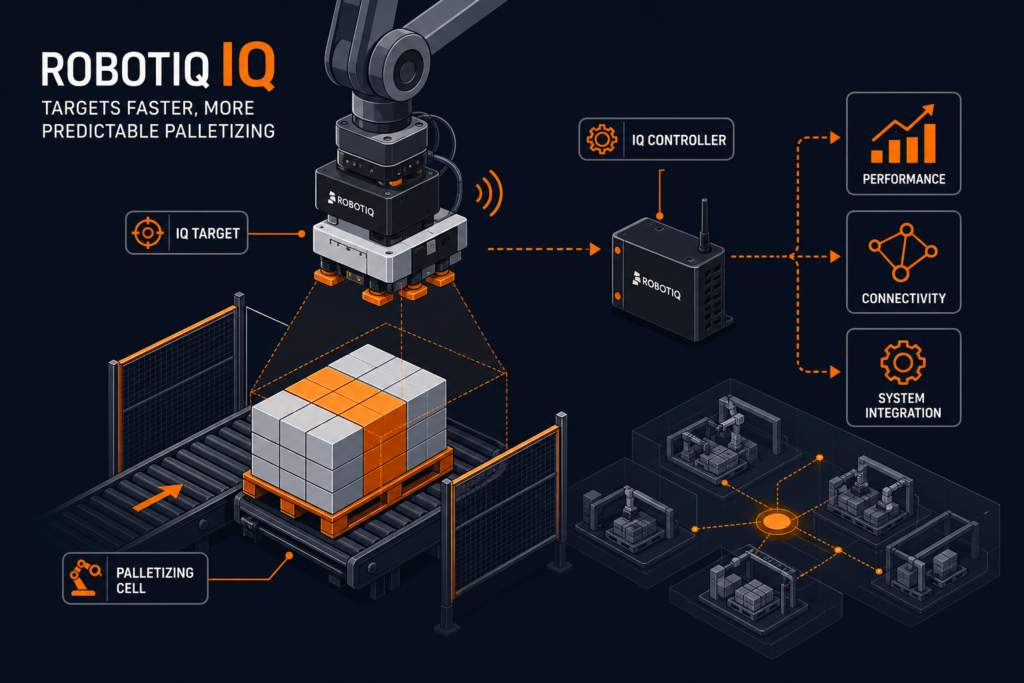
Robotiq introduces a digital front end for palletizing projects
Robotiq has launched IQ, an AI-enabled platform intended to reduce the uncertainty that often slows palletizing automation projects at the earliest stage. According to the original report from the Robotiq Blog, the system is designed to give manufacturers a faster indication of whether a palletizing application is feasible, what configuration may be required, and how quickly a project could move toward implementation. The stated objective is to replace weeks of preliminary exchanges, engineering estimates, and site visits with a more structured digital qualification process, beginning with a short “Fit Check.” For production managers and system integrators, that signals a broader shift in how standard robotic cells may be specified: less dependence on manual pre-sales engineering and more reliance on software-guided assessment, reusable design rules, and standardized workcell architectures.
Palletizing is a logical entry point for this model because the application is repetitive, physically demanding, and often constrained by a manageable set of variables such as box dimensions, pallet patterns, throughput, available floor space, and end-of-line layout. Robotiq has built much of its collaborative automation portfolio around these repeatable use cases, particularly with UR-based palletizing cells. The company’s wider positioning around configurable palletizing systems and standard modules is also visible through partner channels such as NEFF Automation, which describes Robotiq palletizing offerings as configurable systems based on standard models and modules. That modular approach matters in B2B automation because it can shorten design cycles, reduce custom engineering effort, and improve consistency in commissioning, documentation, and support.
Why predictability matters in industrial automation procurement
For manufacturers evaluating automation, the most difficult questions are usually not about the robot brand itself but about project fit, integration scope, and delivery risk. A palletizing cell may look straightforward, yet the commercial and technical variables quickly multiply: product mix, infeed orientation, pallet handling, guarding, operator access, line balancing, and software interfaces with upstream equipment. Procurement teams in automotive Tier-1, metal fabrication, food, and general manufacturing increasingly want earlier clarity on total installed cost and implementation time. A digital qualification platform such as IQ addresses that demand by attempting to front-load feasibility analysis and standardize the handoff between sales, application engineering, and integration partners.
Additional reporting by RoboticsTomorrow indicates that the platform combines AI-enabled project coordination with simulation and design validation, including the conversion of 3D environment scans into digital twin models. If that workflow performs as described, it could help reduce one of the most persistent inefficiencies in automation projects: repeated redesign caused by incomplete site data or unrealistic assumptions at quotation stage. In practical terms, digital twin validation can improve confidence in reach studies, cycle-time estimates, collision checks, and floor-space allocation before hardware is ordered. That is relevant not only for collaborative palletizers using Universal Robots or Doosan cobots, but also for larger industrial robot cells from ABB, KUKA, FANUC, and Yaskawa where payload, speed, and guarding requirements are more demanding.
Implications for standards, safety, and cell architecture
Any move toward faster deployment still has to operate within established machinery and robot safety frameworks. In Europe, palletizing and handling cells must be assessed against applicable ISO, IEC, and EN requirements, including machinery risk assessment under ISO 12100, robot safety under ISO 10218, and, where collaborative operation is involved, ISO/TS 15066. Electrical design and integration practices also intersect with IEC and EN standards for machine control systems, emergency stops, safeguarding, and functional safety. A digital pre-assessment tool can accelerate concept validation, but it does not remove the need for formal risk assessment, safeguarding design, payload verification, and application-specific validation on site.
That distinction is especially relevant when manufacturers compare cobot palletizers with conventional industrial robot cells. Collaborative systems can simplify deployment in some layouts, but they are not automatically guard-free, particularly when payloads, tool geometry, pallet heights, or line speeds exceed collaborative limits. Integrators still need to determine whether the application is best served by a cobot from Universal Robots or Doosan, or by a higher-throughput articulated robot from ABB, KUKA, FANUC, or Yaskawa. The value of a platform like IQ is therefore less about replacing engineering judgment and more about structuring the early decision process so that the right architecture is selected sooner, with fewer iterations.
What this means for welding cell integrators
Although Robotiq IQ is aimed at palletizing automation, the underlying approach has clear relevance for robotic welding and cobot welding projects. Welding cell integrators face many of the same bottlenecks during pre-sales and concept design: uncertainty around part families, fixture strategy, torch access, cycle time, floor space, fume extraction, and operator interaction. A software-led qualification workflow that uses standardized rules, digital models, and early feasibility checks could help integrators quote welding cells more consistently and reduce engineering hours spent on low-probability opportunities. For SMEs in metal fabrication, that could make it easier to compare a compact cobot welding cell with a more traditional robotic welding cell using ABB, KUKA, FANUC, or Yaskawa platforms.
There is also a broader lesson for turnkey cell design. As more automation suppliers productize common applications, integrators may increasingly separate projects into two layers: a standardized base cell and a smaller set of customer-specific adaptations. In welding, that could mean standard robot, positioner, safety, and HMI modules combined with configurable fixturing, seam tracking, or offline programming options. The commercial advantage is improved predictability; the technical advantage is that validated modules can be reused across projects while still meeting ISO, IEC, and EN compliance requirements. For buyers, this can translate into shorter lead times and clearer scope definition. For integrators, it can improve margin protection by reducing the amount of bespoke engineering hidden inside early quotations.
Manufacturers and integrators reviewing palletizing, robotic welding, or cobot welding investments may see Robotiq’s IQ launch as another sign that automation projects are becoming more software-defined from the first customer interaction. Companies planning a new cell or a line upgrade can request a quote to compare standardized and custom integration options against their throughput, safety, and floor-space requirements.
Related articles
Request a quote
Looking for a specific configuration, or want to discuss our current stock? Tell us about your project — we reply within 24 hours from our Bilbao office.