Gravis Robotics Secures $200M for Construction Autonomy
Gravis Robotics has raised $200 million from SoftBank to expand autonomous heavy machinery in construction, highlighting broader investment momentum in field robotics and adjacent industrial automation.
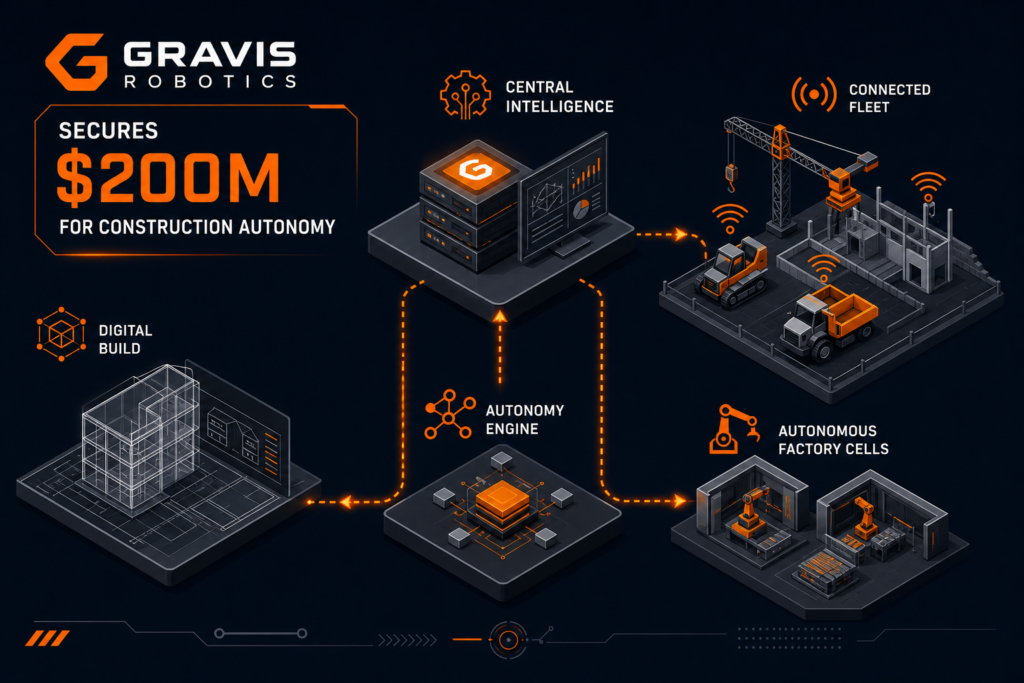
Gravis Robotics has secured a $200 million Series A investment from SoftBank to expand its autonomous heavy machinery technology across construction sites worldwide, a move that underlines how strongly capital markets now view automation for physically demanding, labour-constrained industries. The funding round, reported by Robotics & Automation News, comes as contractors face sustained pressure from infrastructure demand, skills shortages and productivity constraints. According to the company’s own announcement, SoftBank’s investment is being described as the largest Series A in construction robotics history, intended to scale autonomous heavy equipment deployment across jobsites globally, as noted by Gravis Robotics. For industrial automation observers, the significance goes beyond construction: it signals that robotics investment is moving deeper into outdoor, variable and safety-critical operating environments that have traditionally been harder to automate than factory floors.
Construction robotics moves into a new investment phase
The strategic logic behind the deal is relatively clear. Construction remains one of the least automated major industries despite chronic labour shortages, increasing project complexity and growing demand tied to energy networks, data centres, housing, transport and climate-resilient infrastructure. Gravis Robotics is positioning autonomy as a way to improve equipment utilisation, reduce idle time and support operators on repetitive or hazardous tasks. Coverage from Engineering News-Record indicates the company plans to use the capital to expand engineering capacity and accelerate deployment of Gravis-powered autonomy on heavy equipment. That matters because large funding rounds of this type typically do more than support one vendor’s growth; they also strengthen the broader ecosystem of sensors, machine control, fleet software, remote supervision and functional safety engineering needed to make field robotics commercially viable.
From a technology standpoint, construction autonomy presents a different challenge set from fixed industrial robotics. A robotic welding cell in a factory usually operates in a bounded workspace with known part geometries, controlled lighting, repeatable fixturing and stable process parameters. By contrast, autonomous earthmoving or site machinery must cope with changing terrain, weather, mixed traffic, uncertain obstacles and less predictable human interaction. That makes perception, localisation, fail-safe behaviour and supervisory control central design issues. The standards landscape is also more fragmented. While industrial robot and collaborative robot deployments often reference ISO 10218, ISO/TS 15066, IEC 60204-1 and relevant EN harmonised machinery requirements, mobile and off-road autonomous systems may need a broader safety case combining machinery, control system and site risk assessment principles. For manufacturing companies watching this sector, the takeaway is that autonomy is maturing not only in structured production cells but also in dynamic environments once considered too variable for reliable robotic operation.
Why this matters beyond the jobsite
The relevance for manufacturing is not that construction robots will directly replace factory automation, but that they are accelerating adjacent technology stacks. Investment in autonomous heavy machinery tends to drive improvements in ruggedised perception, AI-based path planning, teleoperation, edge computing and machine health monitoring. Those capabilities can cross over into fabrication, steel processing and modular construction workflows where welding, cutting and material handling intersect. In sectors such as structural steel, shipbuilding, off-highway equipment and prefabricated building modules, the boundary between workshop automation and field installation is already narrowing. As a result, production managers may increasingly evaluate automation architectures that connect shop-floor robots with digital planning tools used on site.
This is also relevant for robot vendor strategy. Established industrial suppliers such as ABB, KUKA, FANUC and Yaskawa have long focused on high-duty-cycle manufacturing applications including arc welding, handling and machine tending, while collaborative robot suppliers such as Universal Robots and Doosan have expanded access to lower-volume and mixed-model production. If construction robotics continues to attract large-scale funding, these vendors and their integration partners may see new demand for hybrid solutions: prefabrication cells that feed automated construction workflows, mobile welding support systems, or inspection and material transfer platforms that bridge indoor and outdoor operations. The commercial opportunity is therefore not limited to autonomous excavators or site machinery; it may extend to the upstream fabrication systems that supply increasingly industrialised construction methods.
What this means for welding cell integrators
For welding cell integrators, the Gravis Robotics funding round is a useful signal that customers in construction-linked industries may soon expect higher levels of automation continuity from fabrication shop to installation site. Steel fabricators serving infrastructure, transit, energy and data centre projects are already under pressure to shorten lead times while maintaining weld quality and traceability. That creates a stronger case for robotic welding cells, cobot welding stations and digitally connected fixtures that can support repeatable production of beams, frames, brackets, skids and modular assemblies. Integrators designing these systems should pay particular attention to interoperability, offline programming, weld data capture and part variation management, because project-driven sectors rarely offer the same consistency as automotive body-in-white production.
There is also a safety and compliance dimension. As customers move toward more flexible production and potentially more mobile automation concepts, integrators will need to align cell design with applicable ISO, IEC and EN requirements covering robot safety, electrical equipment, guarding, emergency stops and risk assessment. In practical terms, that means balancing throughput with maintainability and operator access, especially when specifying arc welding systems from ABB, KUKA, FANUC or Yaskawa, or collaborative welding packages built around Universal Robots or Doosan platforms. The lesson from construction autonomy is that automation value increasingly depends on system-level engineering rather than robot selection alone: sensing, software, supervision, safety logic and workflow integration are becoming decisive factors in project ROI.
Capital flows point to broader industrial automation demand
SoftBank’s backing of Gravis Robotics suggests investors see a substantial market for robotics in sectors shaped by labour scarcity and infrastructure expansion. That thesis aligns with wider industrial trends across Europe and North America, where manufacturers and contractors alike are trying to increase output without proportionally increasing headcount. For companies involved in metal fabrication, structural components or modular construction, the development is worth tracking because it may accelerate demand for automated upstream production capacity, including robotic arc welding, part handling and inspection. Readers assessing how these shifts could affect future welding cell requirements, capacity planning or cobot deployment strategies can request a quote to discuss suitable automation concepts for their production environment.
Related articles
Request a quote
Looking for a specific configuration, or want to discuss our current stock? Tell us about your project — we reply within 24 hours from our Bilbao office.