GMSL Vision Ecosystems Gain Ground in Robotic Welding
Robotic vision is moving from optional add-on to core automation layer. GMSL-based camera ecosystems could simplify deployment, improve weld quality, and support faster welding cell integration.
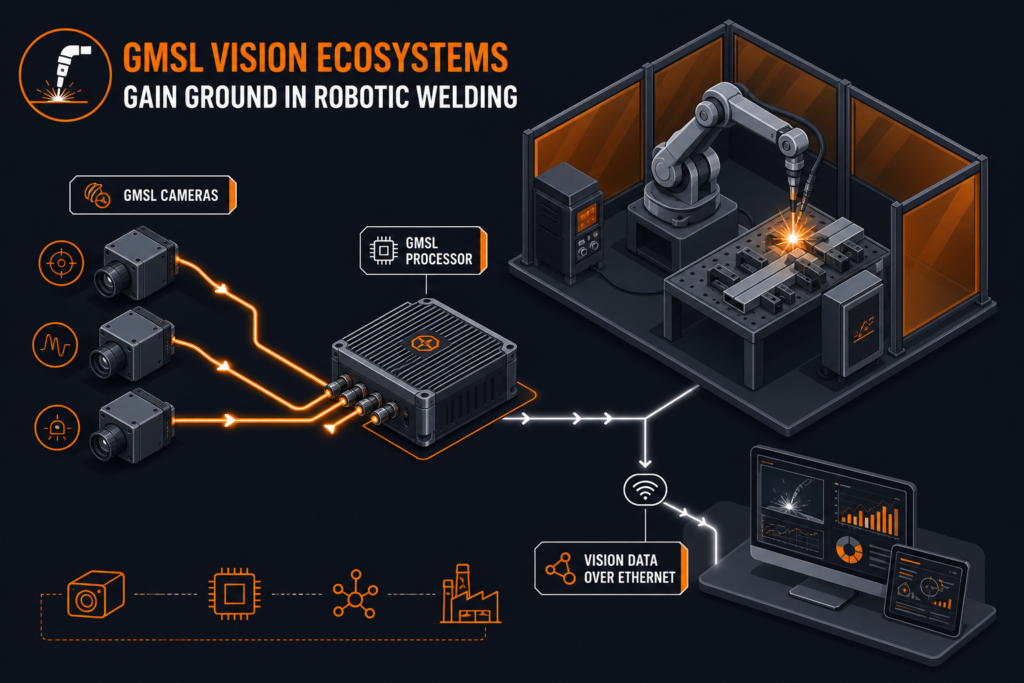
Robotic vision is becoming a core enabling technology for industrial automation, particularly where robots must operate in dynamic, high-mix production environments. The original article published by The Robot Report highlights how GMSL, or Gigabit Multimedia Serial Link, is gaining traction as a practical way to connect cameras and processing hardware in robotics. That shift matters for manufacturing because vision is no longer limited to simple presence detection or fixed-position inspection. In welding cells, vision increasingly supports part localization, seam tracking, torch guidance, fixture verification, post-weld inspection, and safer human-robot collaboration. As manufacturers push for shorter changeovers and better traceability, the quality of the camera interface and the maturity of the surrounding ecosystem can directly affect deployment time, reliability, and total system cost.
Why GMSL is attracting attention in robotics
GMSL was developed for high-speed camera and display links, initially in automotive applications, but it is now being adapted to robotics and industrial systems. According to Analog Devices, the approach can reduce development effort by giving robotics teams access to pre-validated camera modules, adapters, and software support packages rather than requiring custom low-level integration for each sensor. EDN also notes that this ecosystem model can shorten development cycles and lower the barrier between prototype and production deployment. For industrial users, that is relevant because machine vision projects often fail not on image quality alone, but on cable robustness, synchronization, latency, electromagnetic compatibility, and software integration with robot controllers and PLCs.
In practical terms, a robust high-bandwidth camera link can help support multiple synchronized sensors, longer cable runs, and compact edge processing architectures. These are useful characteristics in robotic welding, where cameras may be mounted on the arm, near the torch, or around the cell perimeter for inspection and safety-related monitoring. Welding environments are especially demanding because of arc glare, spatter, smoke, vibration, and reflective metal surfaces. Vision hardware therefore needs not only sufficient data throughput, but also predictable performance under industrial conditions. For integrators working with ABB, KUKA, FANUC, Yaskawa, Universal Robots, or Doosan platforms, the value of a broader vision ecosystem lies in reducing the amount of custom engineering required to make sensors, compute hardware, fieldbus communication, and robot motion work together consistently.
From point-to-point motion to adaptive manufacturing
The broader trend behind the GMSL discussion is that robots are being asked to do more than repeat fixed trajectories. Manufacturers increasingly expect robotic systems to identify part variation, compensate for fixture tolerances, and maintain process quality without extensive manual intervention. In welding, this translates into applications such as locating stamped or machined parts before tack welding, adjusting paths for dimensional drift, and inspecting bead geometry after the process. These capabilities are particularly relevant in automotive Tier-1 production, general metal fabrication, and SME workshops handling mixed batches. Vision can also support digital quality records by linking images or measurement data to part IDs, which is useful for compliance and customer audits.
This evolution aligns with wider industrial requirements around safety and machine design. Vision-equipped robotic cells still need to be engineered within the framework of applicable standards, including ISO 10218 for industrial robot safety, ISO/TS 15066 for collaborative robot applications, and machinery safety requirements under the IEC and EN families such as IEC 60204-1 and EN ISO 13849-1 where control system performance levels are relevant. When vision is used for guidance, inspection, or collaborative operation, integrators must distinguish clearly between process vision and safety-rated sensing. A high-performance camera link can improve process control, but it does not automatically make a system safety compliant. That distinction is critical in welding cells where arc hazards, fume extraction, guarding, and operator access all need coordinated design decisions.
What this means for welding cell integrators
For welding cell integrators, the growing ecosystem around robotic vision suggests a more modular path to deploying adaptive automation. Instead of treating vision as a bespoke subsystem added late in the project, integrators can increasingly specify it as part of the base architecture of the cell. In robotic MIG/MAG, TIG, laser, or spot welding applications, that can mean combining 2D or 3D cameras with seam finding, part presence checks, and quality inspection in a single engineering workflow. A more standardized camera ecosystem may also simplify support for multiple robot brands, especially in facilities that operate mixed fleets from ABB, KUKA, FANUC, Yaskawa, Universal Robots, and Doosan. For system builders, this can reduce commissioning risk and make spare parts, software maintenance, and future upgrades easier to manage.
The implications are strongest in high-mix, low-volume production, where conventional hard automation struggles to absorb part variation economically. Cobot welding cells, in particular, can benefit from easier-to-integrate vision because they are often deployed in SMEs without large in-house automation teams. If camera modules, compute platforms, and drivers are already validated within a known ecosystem, engineering resources can shift toward process optimization, weld parameter development, and fixture design rather than basic sensor integration. That does not remove the need for application expertise: weld pool behavior, joint accessibility, cycle time constraints, and shielding gas management still determine whether a vision-guided concept will deliver stable production. But it does improve the odds that vision can be deployed repeatably across multiple cells and sites.
Industrial adoption will depend on integration discipline
Even with a stronger ecosystem, adoption in welding and metal fabrication will depend on disciplined implementation. Camera placement, lens protection, lighting strategy, and data processing must be matched to the welding process and the expected part tolerances. Integrators also need to consider network architecture, edge computing load, and interoperability with MES or quality systems. The appeal of GMSL-based vision is not simply higher bandwidth; it is the possibility of building repeatable, supportable machine architectures that move faster from concept to production. For production managers and procurement teams, that can translate into shorter commissioning schedules and more predictable lifecycle costs when specifying new welding cells or retrofits.
Companies assessing robotic welding, cobot welding, or vision-guided cell upgrades may want to review how camera architecture, standards compliance, and robot brand compatibility are addressed at the design stage. Readers planning a new welding cell or retrofit can request a quote to evaluate the technical and economic fit for their application.
Related articles
Request a quote
Looking for a specific configuration, or want to discuss our current stock? Tell us about your project — we reply within 24 hours from our Bilbao office.