G2 Nano 1GHz Board Targets Faster Industrial Robotics
The G2 Nano development board combines a 1GHz processor with Arduino-style accessibility, highlighting how easier embedded platforms could speed industrial robotics and automation prototyping.
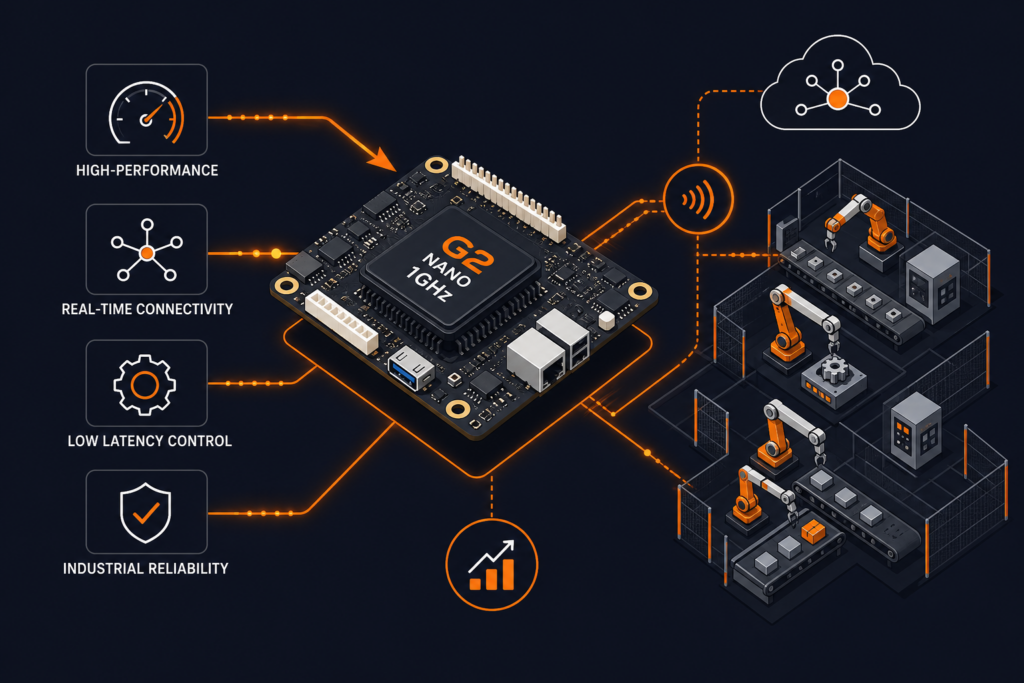
G2 Nano points to a lower barrier for industrial robotics prototyping
A new embedded platform highlighted by Hackster.io is drawing attention because it combines two attributes that are not always found together in industrial development hardware: relatively high compute performance and a familiar, accessible programming model. The G2 Nano is presented as a 1GHz development board designed for industrial robotics, with an ease-of-use approach aligned with the Arduino ecosystem. For manufacturing engineers and automation teams, that combination matters because many proof-of-concept projects fail not on hardware capability alone, but on the time required to move from evaluation to a stable prototype. A board that can support more demanding edge tasks while remaining approachable for controls, sensing, and motion experimentation may shorten that cycle.
The significance is less about replacing industrial robot controllers from ABB, KUKA, FANUC, Yaskawa, Universal Robots, or Doosan, and more about what sits around them. Modern automation projects increasingly depend on auxiliary computing at the cell level: sensor fusion, local HMI functions, data logging, protocol conversion, vision pre-processing, and custom end-of-arm tooling logic. In many factories, these functions are still handled through a mix of PLC add-ons, IPCs, and bespoke electronics. A compact board with a 1GHz CPU can potentially cover part of that gap during development, especially where teams need to test robotic peripherals or cobot accessories before committing to production-grade hardware. The wider interest visible through social reposts and references on Threads suggests the board is resonating with developers looking for a bridge between maker-style simplicity and industrial use cases.
Why easier embedded tools matter in manufacturing engineering
For B2B users, the practical question is not whether a development board is powerful in abstract terms, but whether it can reduce engineering hours. In industrial automation, early-stage development often involves validating I/O behavior, integrating sensors, testing communication stacks, and building deterministic enough logic to support a machine concept. If a board can be programmed quickly by engineers already familiar with Arduino-style workflows, it may help SMEs and system integrators prototype faster without immediately assigning scarce PLC or industrial PC resources. This is particularly relevant in metal fabrication and general manufacturing, where custom fixtures, part-present detection, weld seam tracking, torch cleaning routines, and operator interface concepts are frequently developed under time pressure.
That said, there is a clear distinction between a development platform and a production-certified control architecture. Industrial deployment still requires compliance with machine safety and electrical standards such as ISO 10218 for industrial robot safety, ISO/TS 15066 for collaborative robot applications, IEC 60204-1 for electrical equipment of machines, and relevant EN harmonized standards used in the European market. Where welding is involved, integrators must also consider arc welding equipment requirements and functional safety architecture, especially if the board interfaces with safety PLCs, scanners, interlocks, or emergency stop circuits. A 1GHz board may be suitable for non-safety control, monitoring, or edge analytics, but it does not remove the need for validated safety functions, EMC design, and robust enclosure engineering expected in industrial cells.
What this means for welding cell integrators
For robotic welding and cobot welding projects, platforms such as the G2 Nano are most relevant at the subsystem level. Welding cell integrators routinely need custom logic between the robot controller and peripheral devices: wire feeders, seam finding sensors, fume extraction status monitoring, part clamping confirmation, torch maintenance stations, barcode readers, and quality data capture. In a conventional architecture, these tasks may be split across a PLC, a small HMI, and dedicated interface modules. A capable development board can help teams prototype these interactions earlier, especially during feasibility studies or pilot cells. It may also support rapid testing of edge functions such as local data buffering, simple machine vision preprocessing, or protocol translation between legacy equipment and newer software layers.
This has particular relevance in mixed fleets where welding cells combine robots from ABB, KUKA, FANUC, or Yaskawa with cobots from Universal Robots or Doosan for handling, tack welding, or secondary operations. Integrators increasingly need modular electronics that can sit outside the core robot controller while remaining flexible enough to adapt to different customer specifications. A fast, easy-to-program board can accelerate bench testing of custom grippers, rotary positioners, weld parameter logging, and operator-assist devices. The constraint is that any migration from prototype to production must be managed carefully. Welding environments impose heat, spatter, vibration, grounding, and electromagnetic noise challenges that are far more severe than those seen in lab setups. For that reason, development boards are best viewed as enablers for concept validation and pre-engineering, not as a direct substitute for hardened industrial control hardware.
From prototype speed to production discipline
The broader lesson from the G2 Nano story is that industrial automation adoption is influenced not only by robot prices or labor availability, but also by the availability of practical development tools. When embedded platforms become easier to use without sacrificing too much processing headroom, more manufacturers can trial automation ideas internally before issuing a full machine specification. That can be valuable for Tier-1 automotive suppliers, contract manufacturers, and metalworking SMEs that need to de-risk projects before capital approval. It also aligns with a wider trend toward distributed intelligence in cells, where some functions are handled at the edge rather than entirely inside the robot or PLC environment.
For decision-makers, the key evaluation criteria remain familiar: communication compatibility, lifecycle support, documentation quality, environmental robustness, and the path from prototype code to maintainable industrial software. Boards like the G2 Nano may help engineering teams move faster at the front end of a project, but successful deployment still depends on disciplined system design, standards compliance, and clear separation between experimental and safety-critical functions. Companies assessing new robotic welding or cobot welding concepts may find value in using such platforms during feasibility and subsystem development, then transitioning validated functions into production-ready architectures.
Manufacturers and integrators reviewing new welding cell concepts, peripheral control strategies, or cobot-assisted welding workflows can request a quote to discuss how prototype-friendly technologies translate into robust industrial cell design.
Related articles
Request a quote
Looking for a specific configuration, or want to discuss our current stock? Tell us about your project — we reply within 24 hours from our Bilbao office.