Flex Interview Signals Broader Shift to Scaled Factory Automation
An interview with Flex highlights how automation is moving from pilots to scaled deployment, with cobots, AMRs and AI helping manufacturers raise productivity and manage complexity.
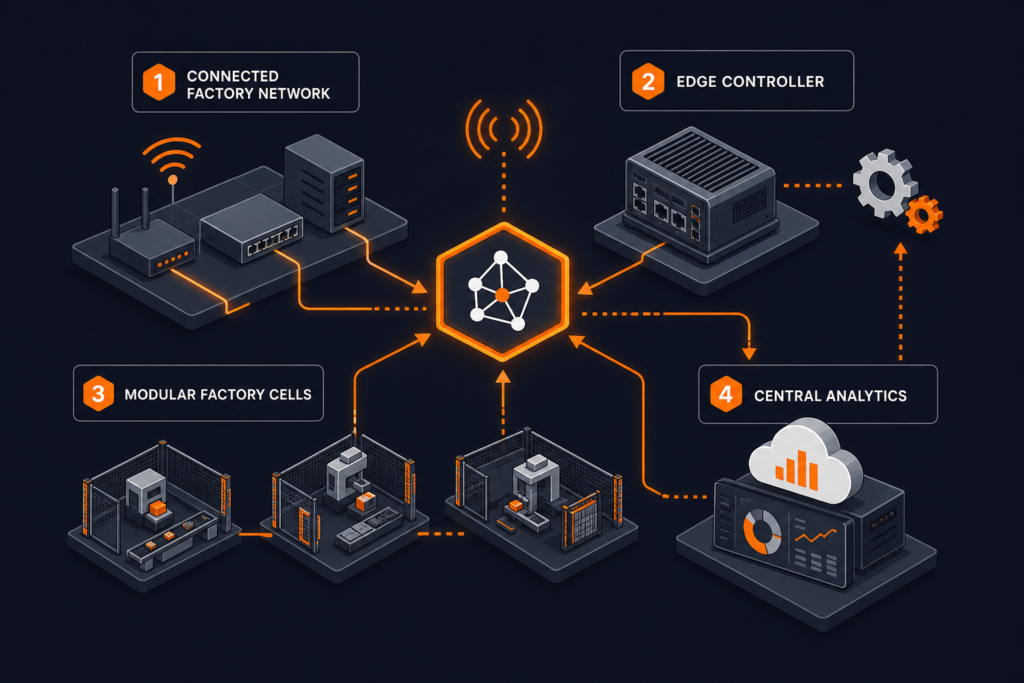
Automation moves from isolated pilots to factory-wide deployment
Automation is becoming a core operating model in modern manufacturing rather than a stand-alone improvement project. That is the central message emerging from an interview with Rodrigo DallOglio of Flex, published by Robotics & Automation News. The discussion reflects a wider industrial trend: manufacturers are under pressure to raise throughput, improve quality, absorb product variation and strengthen resilience, while labor constraints and cost volatility continue to affect operations. In that environment, collaborative robots, autonomous mobile robots and more advanced AI-enabled systems are increasingly being evaluated not as experimental technologies, but as practical tools for standard production environments.
For contract manufacturers, the challenge is especially acute because they must support multiple customers, frequent engineering changes and a broad mix of products on shared production assets. That makes scalability more valuable than isolated automation wins. A robot cell that works for one SKU but cannot be redeployed quickly offers limited strategic value. By contrast, modular automation architectures, standardized interfaces and repeatable safety validation can be rolled out across sites and programs. This is one reason the market is seeing sustained interest in platforms from ABB, KUKA, FANUC and Yaskawa for industrial robot applications, alongside collaborative systems from Universal Robots and Doosan where lower payloads, operator interaction and faster changeovers are priorities.
Why contract manufacturing is a demanding test case for robotics
Flex operates in sectors where complexity is high and production requirements can shift quickly, including electronics, industrial equipment and data center infrastructure. That context matters because it shows where automation must prove itself: not only in high-volume, low-mix lines, but also in environments where traceability, uptime and process consistency are critical. Additional reporting on the company’s expanded work with Teradyne Robotics indicates that Flex is looking to scale intelligent automation globally, with DallOglio stating that the partnership supports increasingly complex manufacturing environments across several industrial sectors, according to Robotics & Automation News. A parallel report by RoboticsTomorrow points to the same strategic objective: using automation to support flexibility at global scale rather than only reducing direct labor in a single process step.
That distinction is relevant for industrial decision-makers. Scaled automation in contract manufacturing depends on more than robot arm selection. It requires digital work instructions, machine vision, part presentation, fixture strategy, quality data capture, maintenance planning and robust handoff between manual and automated stations. It also requires compliance with machinery and robot safety frameworks such as ISO 10218 for industrial robots, ISO/TS 15066 for collaborative applications, IEC 60204-1 for electrical equipment of machines, and relevant EN harmonized standards used in European machine integration. Where welding, cutting or fume extraction are involved, integrators must also consider process-specific risk assessment, guarding, arc flash exposure, ventilation and CE-related documentation for the complete cell.
From cobots and AMRs to physical AI and adaptive production
The interview also points to a broader technology stack now entering production. Cobots can support repetitive assembly, handling and inspection tasks where human-robot collaboration offers layout or staffing advantages. AMRs can reduce non-value-added internal transport and improve line-side material flow. Emerging physical AI applications may help with dynamic path planning, object recognition, anomaly detection and adaptation to variable inputs. For manufacturers, the practical question is not whether these technologies are available, but where they can deliver stable cycle times and measurable return under real production constraints.
That is where engineering discipline remains decisive. AI does not remove the need for process capability, fixture repeatability or validated safety functions. In fact, as automation becomes more adaptive, the need for structured cell design often increases. Integrators must define the boundaries between deterministic control and AI-assisted decision-making, especially in regulated or quality-critical sectors. This is already visible in advanced robotic applications where vision-guided picking, weld seam tracking and in-process inspection are being combined with conventional PLC control, safety relays or safety PLCs, and industrial communication protocols. The result is a more flexible production system, but one that still depends on rigorous commissioning, operator training and lifecycle support.
What this means for welding cell integrators
For welding cell integrators, the Flex discussion reinforces a familiar lesson: customers increasingly want automation that can scale across product families, plants and labor models. In robotic arc welding, that means cells should be designed for redeployment, recipe management and traceable quality control rather than for a single fixed part. Integrators working with ABB, KUKA, FANUC or Yaskawa platforms may see continued demand for higher-duty-cycle welding cells with positioners, seam tracking and offline programming. At the same time, cobot welding packages based on Universal Robots or Doosan can remain relevant for SMEs, prototype work and medium-mix production where floor space, ease of use and lower initial complexity matter.
The technical implications are significant. A scalable welding cell needs more than a robot and power source. It needs fixture concepts that tolerate part variation, torch cleaning, wire management, fume extraction, guarded or collaborative risk reduction measures, and software structures that simplify changeover. Integrators also need to align with ISO 3834 quality requirements where applicable, welding procedure control, and the machine safety obligations that come with complete system delivery under IEC, ISO and EN frameworks. As more manufacturers seek resilience and labor efficiency, demand is likely to shift toward cells that can be standardized across sites while still accommodating local product variation. That favors modular welding cell design, digital commissioning and service models that support replication.
For production teams assessing robotic welding, cobot welding or broader factory automation, the current direction of travel is clear: scalable, standards-based systems are gaining priority over isolated pilot projects. Companies reviewing new cell investments or retrofit opportunities can request a quote to compare technical options, integration scope and deployment models for their specific production mix.
Related articles
Request a quote
Looking for a specific configuration, or want to discuss our current stock? Tell us about your project — we reply within 24 hours from our Bilbao office.