FANUC Robotic Cell Automates Complex Furniture Upholstery
A Canadian furniture manufacturer has automated a labor-intensive upholstery process with a FANUC-based robotic cell, highlighting wider lessons for industrial cell design and welding automation.
Furniture automation moves beyond simple handling
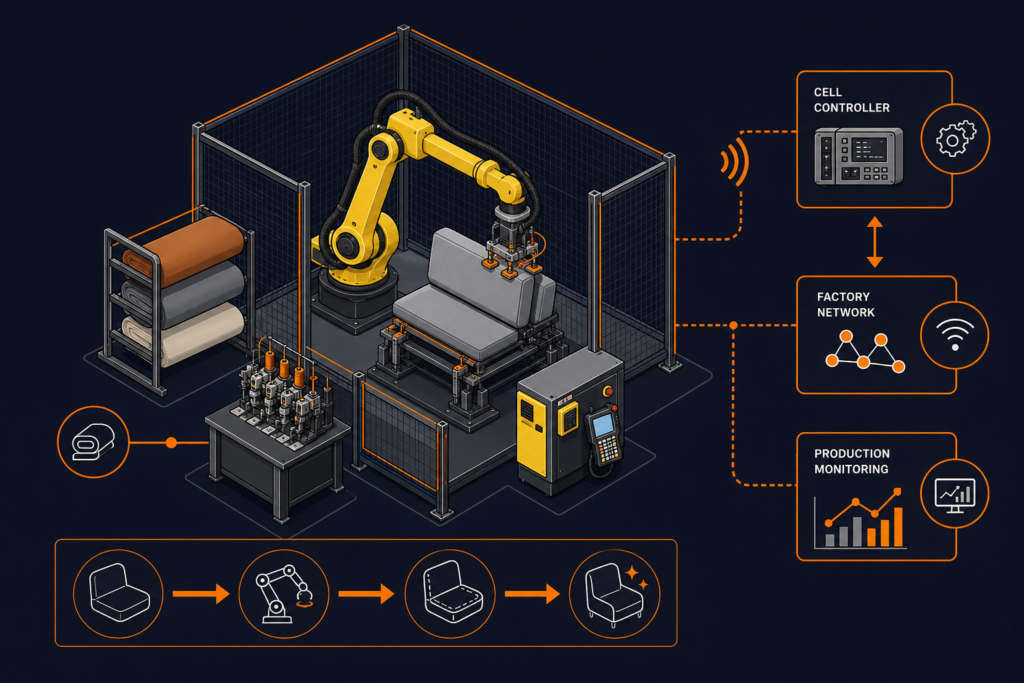
A Canadian furniture manufacturer has deployed a robotic work cell to automate one of the most labor-intensive stages of upholstered seating production: preparing and finishing chair seat linings. Reported by Robotics & Automation News, the system was developed by FANUC Authorized System Integrator Dvolu around a FANUC M-710iC industrial robot. The cell performs fabric stretching, stapling, trimming and palletizing, tasks that have traditionally depended on skilled manual operators because of material variability, awkward part handling and the need for repeatable finishing quality. While upholstery is far removed from arc welding in process terms, the engineering challenge is familiar to manufacturers across metalworking: how to automate a sequence that combines variable inputs, force-sensitive manipulation and downstream quality requirements without creating a brittle production system.
The case is notable because it shows robotics moving deeper into operations that were long considered resistant to automation. Furniture production has historically adopted robots more slowly than automotive body-in-white or high-volume metal fabrication, largely because soft materials, changing product mixes and manual craftsmanship complicate standard robot programming. A six-axis robot such as the M-710iC brings payload, reach and path control that can support multi-step workcells, but the broader value lies in the integration layer: end-of-arm tooling, fixtures, sensors, safety architecture and material flow. That pattern is equally visible in other industrial sectors. Whether the robot brand is FANUC, ABB, KUKA, Yaskawa, Universal Robots or Doosan, the differentiator in difficult applications is rarely the arm alone; it is the cell design and process engineering wrapped around it.
Why this project matters for industrial production engineering
From a manufacturing engineering perspective, the upholstery cell reflects a wider shift toward automating tasks once grouped under “manual finishing” or “operator-dependent assembly.” These are often the least standardized parts of a factory, yet they can constrain throughput, create ergonomic risk and make output quality dependent on labor availability. In Europe and North America, persistent shortages of skilled operators have pushed manufacturers to revisit such processes with better grippers, vision systems, force control and simulation tools. FANUC itself has continued to position robots across a broad range of applications, from handling and assembly to welding and inspection, while also expanding its collaborative portfolio. A recent product update reported by PR Newswire highlighted the company’s CRX cobot line for tasks including welding, part handling and tool positioning, underlining how suppliers are targeting lower-complexity automation entry points as well as fully enclosed industrial cells.
For plant managers, the practical significance is not limited to labor substitution. Cells like this can improve takt consistency, reduce rework caused by uneven manual execution and make output planning more predictable. They also create digital process data that can be linked to maintenance and quality systems. That is relevant in sectors where traceability expectations are increasing, even outside regulated industries. The same logic has driven adoption in welding, where robot cells are expected not only to move a torch but also to support parameter control, fixture repeatability, part identification and operator-safe loading. In both upholstery and welding, automation succeeds when the process is decomposed into stable, measurable steps and when variability is managed through tooling and sensing rather than left entirely to operator skill.
What this means for welding cell integrators
For robotic welding and cobot welding integrators, the furniture example offers a useful reminder that difficult automation projects are usually won or lost at the process interface. In welding cells, that interface includes part presentation, gap variation, spatter management, torch access, fume extraction and post-weld handling. In upholstery, it is fabric tension, staple placement and trim accuracy. The common lesson is that integrators should focus on the full sequence, not just the robot motion. A welding cell designed around ABB, KUKA, FANUC or Yaskawa hardware still needs robust fixtures, coordinated positioners, suitable safety zoning and a realistic maintenance concept. Where collaborative systems from Universal Robots or Doosan are considered, cycle time, payload, reach and residual risk assessment must be weighed carefully against the benefits of easier deployment and operator proximity.
Standards remain central to that design work. Industrial robot cells in Europe are typically engineered with reference to ISO 10218 for robot safety, while collaborative applications are commonly assessed against ISO/TS 15066. Electrical equipment design often aligns with IEC 60204-1, and machine risk assessment with EN ISO 12100. For welding-specific installations, integrators also need to account for arc-related hazards, guarding, extraction and relevant electrical and EMC requirements. The upholstery project is not a welding cell, but it reinforces a principle familiar to welding automation specialists: when a process has historically depended on human dexterity, successful robotization requires a disciplined combination of tooling, controls, safety and application know-how rather than a simple robot retrofit.
Broader implications for SMEs and mixed-model factories
The project also has relevance for small and mid-sized manufacturers that assume robotics only fits high-volume, highly standardized production. Mixed-model factories increasingly need cells that can absorb variation without excessive reprogramming downtime. That is why integrators are seeing demand for modular fixtures, recipe-driven changeovers, offline programming and sensor-assisted correction. In welding, these same requirements appear in contract manufacturing, agricultural equipment, metal furniture and Tier-2 automotive supply, where batch sizes may be moderate but quality and delivery pressure remain high. A well-designed cell can automate a narrow but labor-intensive bottleneck first, then expand later with conveyors, palletizing, machine tending or inspection modules. The Canadian upholstery installation illustrates that manufacturers do not need to automate an entire plant at once to achieve measurable operational gains.
For companies evaluating robotic welding cells, cobot welding stations or other turnkey automation projects, the main takeaway is to start with the process bottleneck and engineer the cell around it. Readers who are reviewing a new line, replacing manual welding capacity or comparing robot platforms can request a quote to assess feasibility, safety requirements and expected throughput for their specific application.
Related articles
Request a quote
Looking for a specific configuration, or want to discuss our current stock? Tell us about your project — we reply within 24 hours from our Bilbao office.