
FANUC and Google Push Physical AI for Factory Robots
FANUC’s collaboration with Google signals a new phase for physical AI in industrial robotics, with potential effects on adaptive automation, welding cells and cobot deployment.
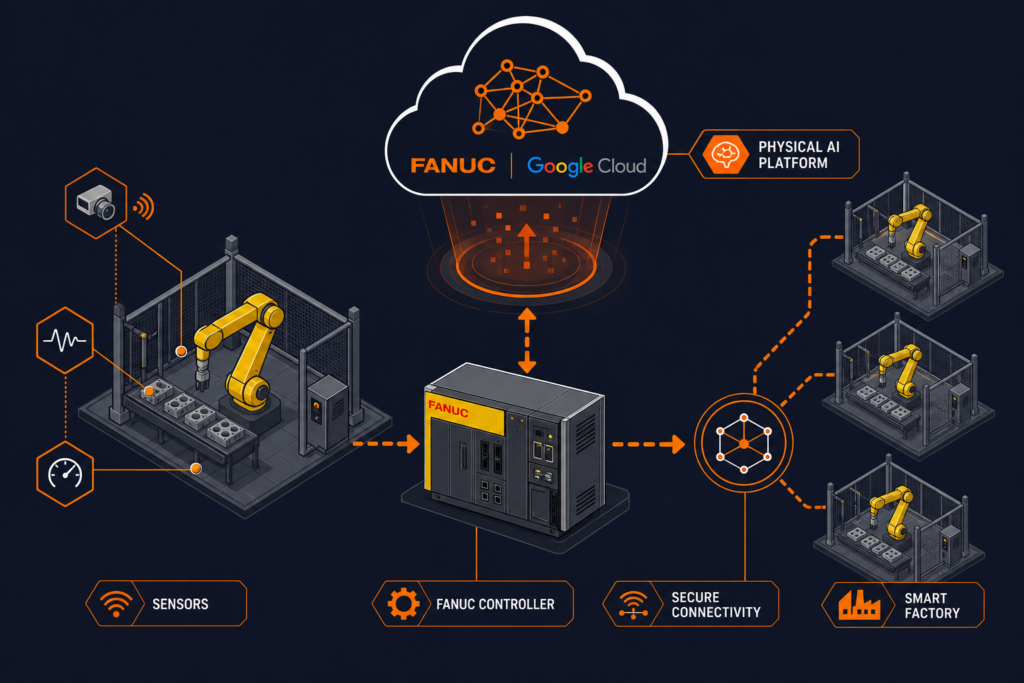
FANUC has announced a collaboration with Google to advance what it describes as physical AI in industrial robotics, a move that could have practical implications for manufacturers seeking more adaptive automation on the factory floor. Reported first by The Robot Report, the partnership follows FANUC’s recent presentation of its physical AI system at IREX in Tokyo and comes amid growing interest in applying large-scale AI models to real production tasks rather than purely digital workflows. According to The Robot Report, FANUC is also working with NVIDIA, indicating that the company is building an ecosystem around AI-enabled robot control, simulation and deployment rather than treating AI as a standalone software feature.
From software AI to motion in industrial robotics
The significance of the FANUC-Google collaboration lies in the shift from generative AI as an office productivity tool to AI that can influence physical motion, process adaptation and machine interaction. Coverage from The Next Web framed the development as an extension of Google’s Gemini strategy into industrial environments, where the output is no longer text or code but robot movement. For manufacturing users, that distinction matters. Industrial robots used for arc welding, spot welding, handling and assembly already operate with high repeatability, but variable production conditions still require programming effort, fixturing discipline and process engineering. Physical AI could help robots interpret more context, adapt to part variation and support faster changeovers, provided these capabilities are integrated within the constraints of industrial safety, cycle time and quality control.
FANUC’s installed base gives this announcement additional weight. The company is one of the largest industrial robot suppliers globally, alongside ABB, KUKA, Yaskawa and, in collaborative robotics, vendors such as Universal Robots and Doosan. In sectors such as automotive body-in-white, metal fabrication and general industrial manufacturing, FANUC robots are already widely used in welding cells. If AI-enhanced control becomes available across a broad installed fleet, manufacturers may gain access to more flexible automation without replacing entire cell architectures. That said, production managers will still evaluate any AI layer against familiar metrics: uptime, repeatability, weld quality, traceability, maintenance burden and integration with PLC, vision and MES environments.
Why manufacturers are paying attention
The broader manufacturing context helps explain the timing. As described by RoboticsTomorrow, FANUC is positioning the collaboration around more flexible and adaptive automation for North American manufacturers. This aligns with a wider industry need: many factories are no longer asking whether AI has a role in automation, but where it can reduce engineering effort and improve resilience in mixed-model production. For welding applications, the challenge is especially clear. Weld seams can vary, part presentation is not always perfect, and SMEs often need to automate short runs or high-mix work that has historically been difficult to justify with conventional robot programming alone.
Physical AI may support several layers of improvement in these environments. At the planning level, AI could help generate or refine robot paths from CAD and sensor data. At the execution level, it could improve adaptation to tolerances, torch approach angles or workpiece positioning when combined with machine vision and seam tracking. At the operational level, it may assist operators and maintenance teams with setup guidance, diagnostics and process optimization. None of this removes the need for validated welding procedures, power source integration or metallurgical control. Instead, it suggests a future in which robot intelligence complements established automation engineering. For regulated industrial environments, this will also need to remain aligned with standards and machine safety requirements, including ISO 10218 for industrial robot safety, ISO/TS 15066 for collaborative robot applications, and relevant IEC and EN machinery and electrical safety frameworks.
What this means for welding cell integrators
For robotic welding cell builders and system integrators, the FANUC-Google collaboration is less about headline AI branding and more about how future projects may be specified, engineered and supported. If physical AI tools mature, integrators could see reduced commissioning time for complex weldments, more robust handling of part variability and easier deployment of semi-structured applications that today sit at the edge of economic feasibility. This is particularly relevant in cobot welding and compact robotic welding cells used by metalworking SMEs, where programming simplicity and operator accessibility are often decisive. Integrators working with FANUC, ABB, KUKA, Yaskawa, Universal Robots or Doosan will likely monitor how AI capabilities affect offline programming, digital twin workflows, vision calibration and human-machine interfaces.
There are also design implications. Welding cells may need tighter data architectures to support AI-assisted functions, including better sensor fusion, cleaner process data and more structured interfaces between robot controller, welding power source, safety PLC and supervisory software. Integrators will still need to engineer around spatter, heat, electromagnetic interference and fixture repeatability; AI does not remove these realities. In collaborative welding cells, any increase in autonomy must be balanced with risk assessment, speed-and-separation monitoring, safeguarded tool access and compliance with applicable ISO, IEC and EN standards. Procurement teams in automotive Tier 1 and general fabrication should therefore view physical AI as an enabling layer that may improve flexibility, but not as a substitute for sound cell design, process validation and maintainable automation architecture.
Strategic implications for automation investment
The partnership also signals a competitive direction for the robotics market. Major vendors are increasingly expected to combine mechanical reliability with software ecosystems that include AI, simulation and cloud-connected development tools. For end users, this may influence future sourcing decisions as much as payload, reach or repeatability. A robot platform that can support adaptive programming, AI-assisted diagnostics and faster deployment could become more attractive in sectors facing labor shortages, product variation and pressure to localize production. At the same time, manufacturers will want clarity on data governance, cybersecurity, model validation and lifecycle support before scaling AI-enabled robotics across multiple plants.
For companies planning new welding automation projects, the development is worth tracking closely. It suggests that next-generation robotic welding cells may become easier to deploy in variable production environments while preserving the industrial robustness expected from established robot brands. Businesses evaluating turnkey robotic welding cells, cobot welding stations or retrofit opportunities can use this moment to review how AI readiness, standards compliance and integration strategy fit into their automation roadmap.
Companies assessing robotic welding or cobot welding investments can request a quote to compare cell concepts, integration options and safety architectures for their specific production requirements.
Related articles
Request a quote
Looking for a specific configuration, or want to discuss our current stock? Tell us about your project — we reply within 24 hours from our Bilbao office.