Cobots Become Essential in Metal Fabrication Welding
Cobots are moving from pilot projects to essential equipment in metal fabrication and construction, driven by labor shortages, welding demand, and safer human-robot collaboration.
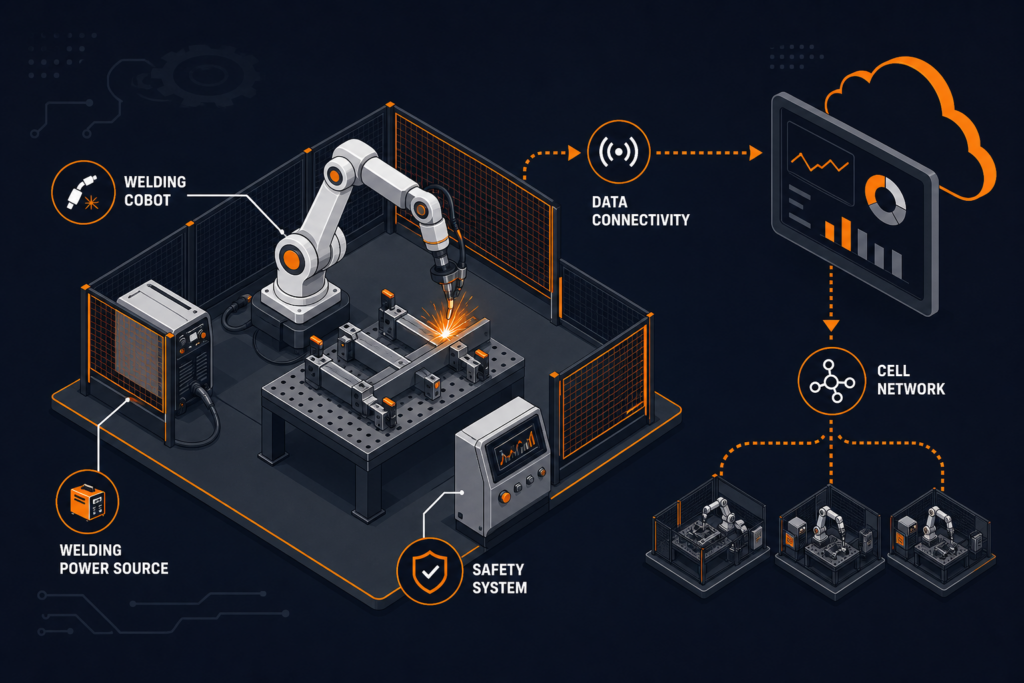
Cobots are moving from optional automation projects to core production assets in metal fabrication and construction, particularly where welding capacity is constrained by labor shortages, variable order mix, and pressure for repeatable quality. In a recent interview published by The Robot Report, Hirebotics CEO Matt Bush argued that collaborative robots are increasingly becoming a necessity for manufacturers and welders rather than a novelty. That assessment reflects a broader industrial trend: fabricators are using force- and power-limited robot arms not only for machine tending and palletizing, but also for welding, coating, and other tasks that are difficult to staff consistently. For production managers, the significance is less about the novelty of human-robot collaboration and more about deployment speed, lower floor-space requirements, and the ability to automate short- to medium-run work without the full complexity of a traditional high-volume robotic line.
Why cobot welding is accelerating
The strongest driver remains labor availability. Many metalworking companies can still win orders, but struggle to secure enough qualified welders to maintain throughput. Cobot welding addresses this by shifting skilled personnel from repetitive torch time toward higher-value activities such as fixture setup, weld qualification, parameter optimization, and inspection. The American Welding Society notes that gas metal arc welding has become a particularly suitable process for cobot deployment because of its flexibility and the rapid expansion of compatible interfaces across major welding power sources and wire feeders since the first wave of GMAW cobot systems emerged in 2017, according to American Welding Society. This matters in fabrication environments where product variation is high and programming must be accessible to operators who are not robotics specialists. The result is a practical automation model: one experienced welder can teach and supervise multiple jobs while less specialized operators load parts and run validated programs.
The technology has also matured beyond the early perception that cobots were suitable only for light-duty or simple applications. As The Fabricator has reported, the industry view has shifted as collaborative systems began handling more complex fabrication sequences and welding tasks. In welding, this evolution includes better seam tracking options, easier waypoint teaching, improved user interfaces, and tighter integration between robot arm, welding package, and cloud-based job management. While payload, reach, and duty cycle still limit cobots compared with conventional six-axis industrial robots, the gap has narrowed enough that many SMEs now evaluate cobots first for mixed-part production, tack-and-finish sequences, and repetitive fillet or lap welds.
From pilot cells to production assets
The operational case for cobots is strongest where manufacturers need flexibility more than maximum arc-on time. Traditional robotic welding cells built around industrial robots from ABB, KUKA, FANUC, or Yaskawa remain the preferred option for heavy parts, multi-station layouts, high deposition rates, and demanding takt times. However, collaborative platforms from Universal Robots, Doosan, and other suppliers have expanded the range of applications that can be automated with lower integration overhead. For many fabricators, the decision is no longer robot versus cobot in absolute terms, but which architecture best matches part mix, fixture complexity, and operator skill profile. A cobot can often be redeployed between product families faster than a conventional cell, especially when paired with modular tables, quick-change tooling, and simplified HMI workflows.
Safety and compliance remain central to that decision. Collaborative operation does not remove the need for formal risk assessment; it changes how risk is mitigated. Integrators and end users still need to evaluate pinch points, hot work exposure, spatter, fumes, sharp edges, and part handling hazards under applicable machinery and robot safety frameworks. Relevant references typically include ISO 10218 for industrial robot safety, ISO/TS 15066 for collaborative robot applications, IEC 60204-1 for electrical equipment of machines, and EN standards adopted within the European machinery framework. In welding cells, additional controls such as arc flash shielding, fume extraction, interlocked screens, and safe speed or monitored stop functions are often required even when the robot arm itself is collaborative. This is one reason many practical cobot welding installations operate in a semi-collaborative mode rather than with unrestricted human proximity during active welding.
What this means for welding cell integrators
For welding cell integrators, the rise of cobots changes project design priorities. The challenge is no longer simply to add a smaller robot to a welding package, but to engineer a cell that balances usability, weld quality, and compliance. That means selecting the right process package, torch cleaning strategy, wire management, fixturing repeatability, and software workflow for operators who may switch between manual and automated welding in the same shift. Integrators also need to define where cobots fit relative to conventional robotic cells: collaborative systems are well suited to high-mix, lower-volume work, prototype-to-production transitions, overflow capacity, and SMEs taking a first step into automation. By contrast, larger robotic welding cells with ABB, KUKA, FANUC, or Yaskawa arms still offer advantages in reach, stiffness, multi-axis coordination, and throughput for automotive Tier suppliers and heavy fabrication.
There is also a commercial implication. Buyers increasingly expect turnkey packages with documented risk assessment, CE-oriented design practices, qualified welding procedures, and support for digital performance monitoring. Integrators that can combine cobot ease of use with industrial-grade cell engineering will be better positioned in sectors such as structural steel, trailers, agricultural equipment, and construction assemblies. In these markets, the winning solution is often not the most collaborative system on paper, but the one that delivers stable arc starts, repeatable part location, acceptable cycle time, and maintainable safety architecture over several product revisions.
Adoption is becoming a capacity strategy
The broader message from the market is that cobots are no longer evaluated only as labor-saving devices. They are becoming part of capacity planning, quality control, and workforce strategy. Manufacturers use them to stabilize output when recruitment is difficult, to reduce weld variation between shifts, and to keep experienced welders focused on tasks where human judgment still matters most. That does not eliminate the role of manual welding or conventional robot cells; it creates a more segmented automation landscape in which each technology serves a defined production need. For companies assessing their next welding investment, the practical question is whether a collaborative cell can remove a bottleneck faster and with less disruption than a fully bespoke robotic installation.
For fabricators, OEMs, and integrators reviewing robotic welding or cobot welding options, this is a useful moment to compare cell architecture, safety requirements, and expected throughput before committing to equipment. Companies that need a tailored welding cell for mixed production, scalable automation, or a first cobot deployment can request a quote to evaluate the most suitable configuration.
Related articles
Request a quote
Looking for a specific configuration, or want to discuss our current stock? Tell us about your project — we reply within 24 hours from our Bilbao office.