AI-Enabled Machines Reshape Industrial Automation Strategy
A new industrial AI shift is moving from software and humanoids to task-specific machines, with direct implications for robotic welding cells, cobot deployment, and factory competitiveness.
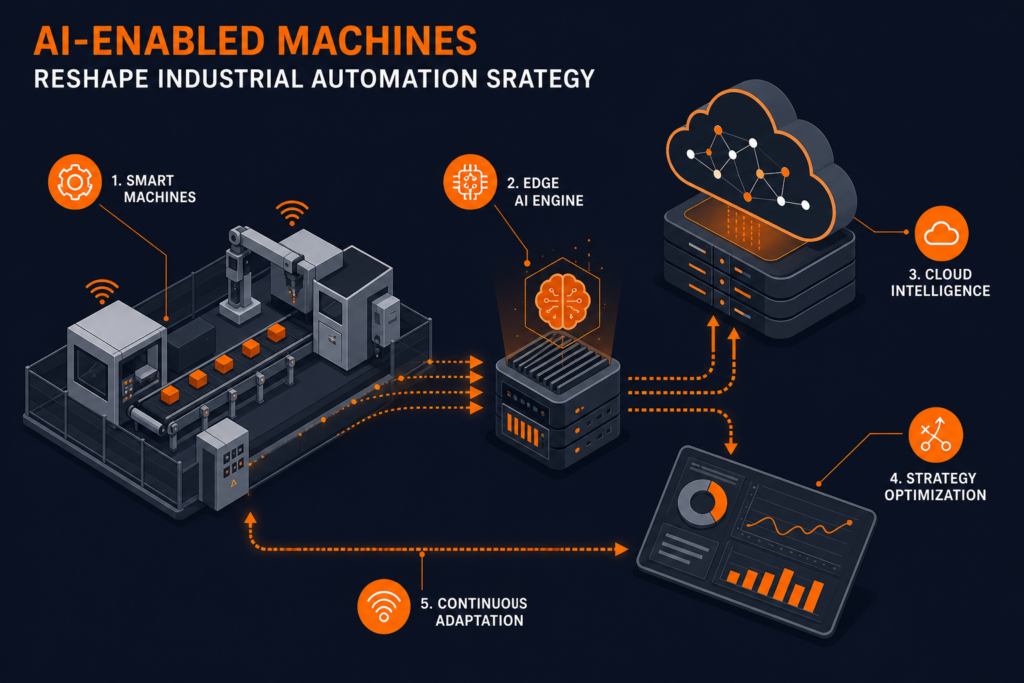
AI moves from software into industrial equipment
The latest discussion around industrial automation is shifting away from consumer AI applications and headline-grabbing humanoid robots toward a more practical category: machines that combine sensing, software intelligence, and physical work capability. That is the central argument highlighted by The Robot Report, which points to a growing need for equipment makers to embed AI directly into working machines as labour availability tightens and customers demand higher productivity. While the original article focuses on sectors such as agriculture and construction, the same logic is increasingly relevant in manufacturing, where machine builders, robot OEMs, and integrators are under pressure to deliver systems that can adapt to variable parts, changing production schedules, and skilled-worker shortages.
For industrial users, this is less about replacing conventional automation than about extending it. Traditional robotic systems from vendors such as ABB, KUKA, FANUC, Yaskawa, Universal Robots, and Doosan already provide repeatability, payload handling, and established safety functions. The next layer is AI-driven perception, process optimisation, and easier human-machine interaction. In practical terms, that can mean machine vision that identifies part variation before welding, adaptive path correction during a cycle, or software that reduces the programming burden for low-volume, high-mix production. The broader concept is often described as “physical AI,” where intelligence is embedded in equipment that performs real-world tasks rather than only generating digital outputs.
Why manufacturers are prioritising task-specific physical AI
The industrial case for AI-enabled machinery is being shaped by economics as much as by technology. Manufacturers are dealing with persistent recruitment challenges, pressure to improve OEE, and a need to make automation viable beyond high-volume lines. According to the World Economic Forum, physical AI is gaining traction because it can help factories respond to labour shortages, productivity demands, and more volatile market conditions. That framing aligns with what many production managers already see on the shop floor: the value of automation increasingly depends on flexibility, not just speed.
This is one reason task-specific systems are attracting more attention than general-purpose humanoids. A welding cell, press tending station, or palletising line does not need a human form factor to create value; it needs robust process control, dependable uptime, and integration with existing production assets. AI can support these goals by improving seam tracking, parameter selection, quality monitoring, and exception handling. The result is not a fully autonomous factory overnight, but a gradual increase in machine capability. For metal fabrication and Tier-1 automotive suppliers, that progression is more actionable than waiting for a universal robot platform to mature commercially and meet industrial ROI thresholds.
Implications for robotic welding and cobot deployment
Welding is one of the clearest examples of where AI can add operational value without changing the basic architecture of the cell. Robotic welding already relies on structured motion control, power source integration, fixturing, and safety engineering. AI enters where variability creates cost: inconsistent fit-up, changing joint geometry, mixed-part batches, and dependence on specialist programmers. A recent example cited by Fabricating & Metalworking describes how AI-assisted welding cobots can simplify robot programming and help operators manage repetitive welding tasks while preserving human oversight for process expertise. That model is particularly relevant for SMEs that cannot justify a large offline programming team but still need repeatable weld quality.
Collaborative systems are part of this trend, though they are not automatically the right answer for every application. Universal Robots and Doosan have both helped expand access to cobot welding, especially for smaller batch production and faster deployment scenarios. However, collaborative operation must still be assessed against real process risks, including arc radiation, spatter, sharp edges, and part handling. In many welding applications, a guarded cell remains the correct design choice even when a cobot arm is used. Integrators therefore need to distinguish between collaborative robot hardware and a fully collaborative welding process. Compliance with applicable standards remains essential, including ISO 10218 for industrial robot safety, ISO/TS 15066 for collaborative applications, and relevant IEC and EN electrical and machinery safety requirements such as IEC 60204-1 and EN ISO 13849 for control system safety performance.
What this means for welding cell integrators
For welding cell integrators, the rise of AI-enabled machinery changes system design priorities in several ways. First, sensor fusion is becoming more central. Vision systems, laser seam tracking, through-arc sensing, and data capture from the welding power source are no longer optional add-ons in many projects; they are becoming part of the core value proposition. Second, software architecture matters more. Integrators need to connect robot controllers, HMIs, PLCs, quality data, and sometimes cloud-based analytics in a way that remains maintainable for the end user. Third, project success increasingly depends on usability. If AI reduces programming complexity but creates a black-box system that maintenance teams cannot troubleshoot, adoption will stall.
This creates opportunities for both established industrial robot brands and specialist welding automation suppliers. ABB, KUKA, FANUC, and Yaskawa remain strong choices for high-duty robotic welding cells where cycle time, payload, and integration depth are critical. Universal Robots and Doosan can be appropriate where floor space, operator accessibility, and lower-volume flexibility are priorities. Across all of these platforms, the differentiator is likely to be how effectively integrators combine robot hardware with AI-supported sensing, process knowledge, and standards-compliant cell design. Buyers will increasingly ask not only whether a robot can weld a part, but whether the system can handle variation, support less experienced operators, and provide traceable production data.
The wider message from the current AI debate is that industrial competitiveness will depend less on adopting AI as a standalone technology and more on embedding it into productive assets. For manufacturers evaluating new welding capacity, that means looking beyond robot arm specifications to the intelligence built around the process. Companies planning a new robotic welding cell or cobot welding station can use this moment to review where adaptive sensing, easier programming, and data-driven quality control would deliver measurable value. Readers assessing these requirements for upcoming automation projects are invited to request a quote for a welding cell concept tailored to their production mix, throughput targets, and compliance needs.
Related articles
Request a quote
Looking for a specific configuration, or want to discuss our current stock? Tell us about your project — we reply within 24 hours from our Bilbao office.