Why Network Security Matters More in Robotic Welding
As industrial robots and cobots become more connected, network security is becoming a core requirement for welding cells, remote support, uptime and safe production.
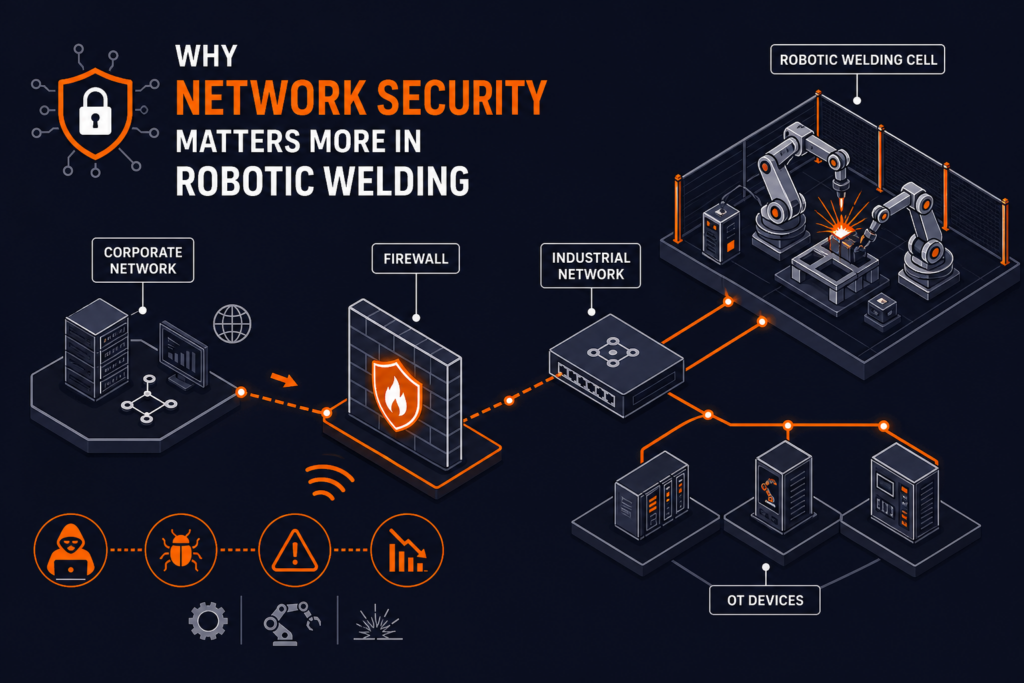
Network security has moved from an IT back-office concern to an operational requirement for modern factories. The original article published by Robotics & Automation News argues that industrial networks now carry commands that move physical assets, not just office traffic. That shift is especially relevant in robotic welding, where industrial robots, cobots, welding power sources, vision systems, HMIs, PLCs and plant MES connections increasingly share data across Ethernet-based architectures. In a welding cell, a compromised remote session, poorly segmented network or unpatched edge device can affect more than data confidentiality; it can interrupt production, alter process parameters, trigger unsafe machine states or delay maintenance response. For manufacturers under pressure to improve OEE, traceability and labor efficiency, cybersecurity is becoming part of basic production engineering rather than a separate compliance exercise.
Connected automation expands the attack surface
The practical issue is that automation systems are now highly connected by design. Robot controllers from ABB, KUKA, FANUC and Yaskawa routinely exchange data with PLCs, safety controllers, weld process equipment and supervisory software. Collaborative applications using Universal Robots or Doosan cobots often add tablets, remote dashboards and cloud-linked service tools. These links support diagnostics, recipe management, quality logging and predictive maintenance, but they also create more entry points. As Robotics & Automation News highlights, remote vendor access is one of the most common weak points because it is useful, routine and often trusted. If credentials are stolen or remote access tools are poorly governed, an attacker may appear to be a legitimate technician. In industrial settings, that can mean unauthorized changes to robot jobs, motion limits, I/O mapping or production schedules.
This risk is not theoretical. Academic and industry sources increasingly frame robotics cybersecurity as a systems issue involving communication security, authentication and access control. A recent overview in ScienceDirect notes that secure communication protocols, authenticated access and regular security audits are central to protecting robotic environments from unauthorized interaction. The same logic applies on the shop floor: a welding cell is not only a robot and a torch, but a networked system of controllers, sensors, safety devices and software interfaces. Once that system is connected to enterprise networks or external support channels, cybersecurity and machine availability become tightly linked.
Cybersecurity is now tied to safety and uptime
For production managers, the most immediate concern is often downtime rather than data theft. A ransomware event, denial-of-service condition or unauthorized configuration change can stop a line just as effectively as a mechanical fault. In robotic welding, where takt time, fixture repeatability and weld quality windows are tightly controlled, even small disruptions can create scrap, rework or missed deliveries. There is also a safety dimension. Industrial robot cells are designed around risk reduction measures defined through standards and validated operating modes. If network compromise affects controller behavior, user permissions or safety-related communications, the result can undermine assumptions made during the original risk assessment.
That is why cybersecurity is increasingly discussed alongside functional safety. Automation Alley points to frameworks such as IEC 62443 and the NIST Cybersecurity Framework as practical references for protecting connected robotic systems. For European machine builders and end users, this sits alongside established machinery and robot safety requirements such as ISO 10218 for industrial robots, ISO/TS 15066 for collaborative robot applications, and relevant EN harmonized standards used in CE-marked systems. The point is not that cybersecurity replaces safety engineering, but that it now influences whether safety assumptions remain valid over the life of the cell. Network segmentation, role-based access, encrypted remote connections, patch governance and event logging are becoming part of maintaining safe operation.
What this means for welding cell integrators
For welding cell integrators, cybersecurity needs to be addressed at design stage rather than added after commissioning. A turnkey robotic welding cell typically combines robot controller, welding package, positioners, scanners, fume extraction interfaces, safety PLCs, HMI panels and remote support pathways. Each interface should be documented and justified. Integrators should define which devices require external connectivity, separate OT traffic from general IT traffic where possible, and restrict remote access to approved methods with time-limited permissions and multi-factor authentication. Default passwords, open service ports and unmanaged laptops used during commissioning remain common but avoidable weaknesses.
There is also a commercial implication. Tier-1 automotive buyers and larger industrial groups increasingly ask suppliers to demonstrate cybersecurity governance as part of machine acceptance. That can include user management policies, backup and recovery procedures, patch plans, network diagrams and alignment with IEC 62443 concepts for industrial automation and control systems. For cobot welding cells, the issue can be even more visible because these systems are often deployed in flexible production areas with easier physical access, more frequent job changes and stronger reliance on simple user interfaces. Integrators working with ABB, KUKA, FANUC, Yaskawa, Universal Robots or Doosan platforms therefore need to evaluate not only robot performance and arc quality, but also how each architecture handles remote diagnostics, software updates, user roles and secure communications.
From optional IT task to core engineering discipline
The broader lesson for manufacturers is that network security now belongs in the same conversation as cycle time, weld consistency and maintainability. A secure welding cell is not defined by a single firewall or antivirus package; it depends on layered controls, disciplined change management and clear ownership between IT, OT, maintenance and external vendors. As the installed base of connected robots grows, the factories that treat cybersecurity as part of engineering practice are likely to be better positioned to protect uptime, preserve traceability and reduce operational surprises. That applies equally to high-volume automotive body welding and to SME fabrication shops adopting their first cobot welding station.
Companies planning a new robotic welding cell or upgrading an existing automated welding line can benefit from reviewing network architecture, remote access policy and standards alignment at the specification stage. Readers who want to assess cybersecurity requirements alongside robot selection, cell layout and welding process integration can request a quote for a tailored solution.
Related articles
Request a quote
Looking for a specific configuration, or want to discuss our current stock? Tell us about your project — we reply within 24 hours from our Bilbao office.