Kawasaki Highlights Physical AI and Smart Welding at Automate
Kawasaki Robotics used Automate 2026 to show how Physical AI, 8-axis robot kinematics, vision and weld inspection could reshape industrial automation and welding cell design.
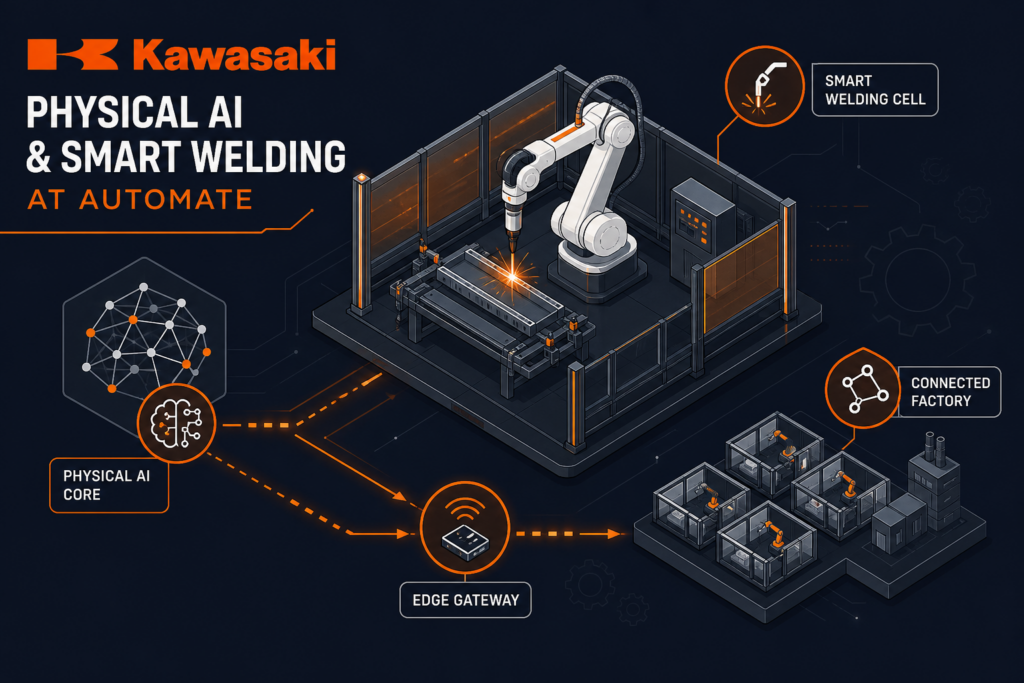
Kawasaki puts Physical AI at the centre of Automate 2026
Kawasaki Robotics used Automate 2026 in Chicago to present a broad automation portfolio built around robotics, machine vision, machine learning and real-time control. The original report from Robotics & Automation News highlighted the debut of the company’s new RL030N, an 8 Degree of Freedom robot platform positioned for “Physical AI” applications, alongside weld inspection and additional industrial robot launches. For manufacturing decision-makers, the significance is less about exhibition theatre and more about the direction of travel: robot suppliers are increasingly combining mechanical dexterity, sensor fusion and software orchestration to address variable, high-mix production tasks that were previously difficult to automate reliably.
The RL030N appears to be designed around that shift. According to coverage by Machine Tool News, the robot combines an 8-axis architecture with lightweight construction, high-speed movement and external orchestration for dynamic environments. Separate reporting by Automation Fair describes the platform as intended for confined workspaces where additional dexterity can reduce the need for complex fixturing or repeated part repositioning. In practical terms, an extra axis can help maintain tool orientation, avoid singularities and improve access around obstacles, all of which matter in fabrication lines where parts are large, geometrically inconsistent or presented with limited clearance.
Why 8-axis kinematics matter in industrial production
For production managers and integrators, the technical relevance of an 8-axis robot lies in path planning and process stability rather than novelty alone. Conventional 6-axis industrial robots from suppliers such as ABB, KUKA, FANUC and Yaskawa already cover most arc welding, handling and machine tending tasks. However, when a process requires the robot to work around clamps, enter deep assemblies, maintain torch angle through a compound seam or coordinate with a positioner and linear track, extra degrees of freedom can improve reachability and reduce cycle penalties. That can be especially useful in automotive subassemblies, structural steel fabrications and heavy equipment components where weld accessibility often drives fixture complexity and manual rework.
The wider trend is that robot mechanics are being paired with more adaptive control layers. “Physical AI” in this context generally refers to systems that combine robot motion with perception, learned behaviours and rapid response to changing conditions. That does not remove the need for deterministic industrial controls; rather, it adds a supervisory layer that can help the robot interpret part variation, locate features or adjust trajectories. In safety-critical production, these capabilities still need to sit within established frameworks such as ISO 10218 for industrial robot safety, ISO/TS 15066 for collaborative applications, and electrical and machine safety requirements under relevant IEC and EN standards, including EN ISO 13849 and IEC 60204-1 where applicable. As more AI-enabled functions enter cells, validation, traceability and risk assessment remain central engineering tasks.
Weld inspection and data feedback move closer to the process
Another notable element of Kawasaki’s Automate presentation was its patented Pulseboard weld inspection technology, referenced in both the event coverage and supporting reports. For welding operations, this is arguably as consequential as the new robot platform. Inline or near-inline weld quality monitoring can help manufacturers detect process drift earlier, reduce destructive testing loads and build a more complete digital record of production quality. In sectors with strict documentation requirements, such as automotive, transport equipment and pressure-related fabrications, the ability to correlate weld signatures with robot parameters, consumables and part IDs can support both compliance and root-cause analysis.
This reflects a wider market movement. Robot and cobot suppliers including Universal Robots and Doosan are pushing easier deployment and sensor integration, while traditional industrial vendors such as ABB, KUKA, FANUC and Yaskawa continue to expand software ecosystems around vision, seam tracking and offline programming. The competitive difference is increasingly found in how well hardware, controls and inspection data are integrated into a usable production system. A robot that can execute a weld path is no longer enough; manufacturers want cells that can verify the result, flag anomalies and feed actionable data into MES or quality systems. For SMEs as well as Tier-1 plants, that can translate into lower scrap, faster troubleshooting and better utilisation of skilled welders and technicians.
What this means for welding cell integrators
For robotic welding cell builders and system integrators, Kawasaki’s Automate 2026 message points to three design implications. First, greater robot dexterity can simplify access to difficult joints, but it also raises the bar for simulation, collision checking and offline programming. Integrators will need digital tools that can model 8-axis motion accurately and verify cable routing, torch package limits and coordinated movement with positioners or external axes. Second, AI-assisted perception and real-time control are likely to increase demand for more flexible cells that can tolerate part variation without excessive hard tooling. That is relevant for both high-volume robotic welding and lower-volume cobot welding, where setup time and fixture cost often determine project viability. Third, inspection technologies such as Pulseboard suggest a stronger shift toward closed-loop welding cells in which process monitoring is designed in from the start rather than added later as a quality patch.
That does not mean every welding application needs an 8-axis robot or AI layer. Many arc welding cells remain well served by established 6-axis platforms and proven process packages. The engineering question is where added dexterity and intelligence deliver measurable value: reduced fixture count, improved first-pass yield, shorter changeovers or better traceability. In that sense, Kawasaki’s showcase is less a single-product announcement than a signal of how future welding cells may be specified, especially where manufacturers are balancing labour shortages, mixed-model production and tighter quality expectations.
Companies reviewing robotic welding, cobot welding or intelligent inspection upgrades can use developments like these as a benchmark when defining their next cell. For a practical assessment of robot selection, welding process integration, safety architecture and quality monitoring, readers can request a quote for a tailored welding cell study.
Related articles
Request a quote
Looking for a specific configuration, or want to discuss our current stock? Tell us about your project — we reply within 24 hours from our Bilbao office.