How Robots Can Support Manufacturing Workers, Not Replace Them
A growing body of evidence shows robots can augment manufacturing teams through safer workflows, reskilling and better task allocation, with clear implications for welding cells.
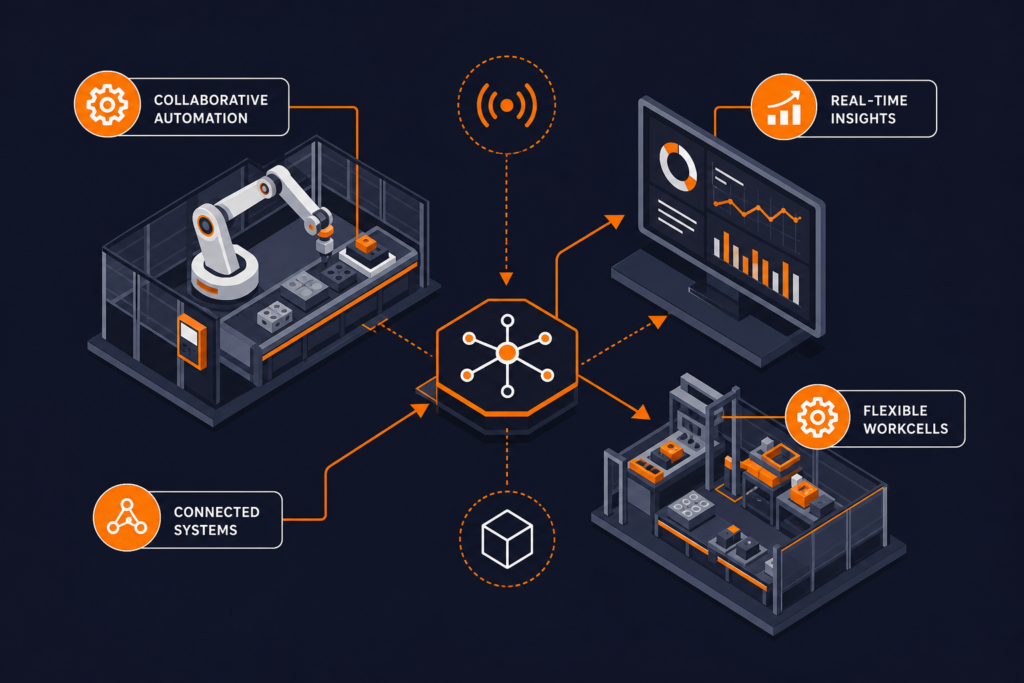
The debate around automation in manufacturing is often framed as a choice between labor and machines, but recent industry commentary points to a more practical reality: robots are increasingly being deployed to support workers, not simply displace them. The original article from The Robot Report highlights how AI, teleoperation and appropriate safeguards can expand access to manufacturing work, including for people who may not fit conventional shop-floor roles. For production managers and manufacturing engineers, the message is less about ideology and more about system design. Where automation projects are structured around augmentation, companies can reassign repetitive, ergonomically difficult and quality-sensitive tasks to robots while retaining human oversight, process knowledge and decision-making on the line.
Augmentation depends on task design, not slogans
In practical terms, augmentation means dividing work according to the strengths of each resource. Robots are well suited to repeatable motion, controlled path execution, high duty cycles and operation in hot, fume-heavy or otherwise uncomfortable environments. Human operators remain stronger in exception handling, fit-up assessment, part variation management, root-cause analysis and cross-process coordination. This distinction is especially relevant in fabrication and welding, where part tolerances, tack quality, fixture condition and upstream variability can still challenge fully autonomous operation. A broader manufacturing overview from NetSuite similarly notes that robotics adoption is typically driven by quality, productivity and labor constraints rather than by a simple one-for-one labor replacement model.
Collaborative robotics has reinforced this shift. Unlike traditional industrial robots that usually operate behind guarding, cobots are designed for monitored interaction with people under defined risk conditions. Research referenced by ScienceDirect describes collaborative robots in welding and additive manufacturing as systems intended to complement human skills rather than replace workers entirely. That distinction matters because many manufacturers are not looking for lights-out autonomy across the whole process. They are looking for stable arc time, reduced rework, better traceability and a way to make welding roles more sustainable when skilled labor is difficult to recruit and retain.
Why this matters on the factory floor
For manufacturers, the workforce question is increasingly tied to demographics and job quality. Repetitive manual welding, part handling and finishing operations can create fatigue, exposure to fumes and inconsistent output across shifts. Robotic systems can absorb the most physically demanding and repetitive elements of the job while operators move toward programming, fixture loading, inspection, parameter verification and cell supervision. In welding, that often means the robot handles long seams, repeat batches or positional work, while experienced welders focus on complex joints, first-off validation and process optimization. A market-oriented welding overview from Vention makes a similar point: robotic welding systems can offload tedious arc-on time and amplify human expertise rather than eliminate it.
This operating model also affects training. Integrators and end users increasingly need technicians who can manage robot teach pendants, welding power source interfaces, seam tracking, torch cleaning stations and basic fault recovery. That applies across major robot ecosystems including ABB, KUKA, FANUC, Yaskawa, Universal Robots and Doosan. The vendor mix may differ by payload, reach, software preference and local service availability, but the implementation challenge is consistent: companies need structured reskilling so operators can transition from purely manual tasks to hybrid production roles. In many plants, the barrier to adoption is not whether the robot can weld; it is whether the organization can redesign jobs, training and maintenance responsibilities around the new cell.
Safety, standards and human-robot collaboration
Any claim that robots support workers rather than replace them depends on safe deployment. In Europe, welding cell design must align with machinery safety principles and risk assessment requirements under relevant ISO, IEC and EN frameworks. For collaborative applications, ISO 10218 for industrial robots and ISO/TS 15066 for collaborative operation are central references, while electrical safety and control system requirements may involve IEC and EN harmonized standards depending on the machine architecture. For robotic welding specifically, integrators must also consider fume extraction, arc flash shielding, functional safety, emergency stop design, interlocked access, safe speed monitoring where applicable, and the limits of collaborative operation in the presence of welding hazards. A cobot arm does not automatically make a welding process collaborative in the regulatory sense.
This is where the augmentation narrative becomes concrete. A well-engineered system does not merely place a robot next to a person; it defines who does what, under which safeguards, and with what recovery procedures. In some cases, a conventional industrial robot from ABB, FANUC, KUKA or Yaskawa inside a guarded cell may be the best way to improve worker conditions by removing exposure to heat and repetitive motion. In other cases, a cobot from Universal Robots or Doosan may fit low-volume, high-mix welding where direct operator involvement in loading, teaching and changeover is essential. The correct choice depends on risk, throughput, weld quality requirements and part variation, not on a generic preference for either collaborative or non-collaborative hardware.
What this means for welding cell integrators
For welding cell integrators, the main implication is that project success should be measured by workforce fit as much as by cycle time. Cells designed around augmentation typically need easier programming workflows, clearer HMI design, robust fixturing, accessible maintenance points and training packages that help welders become robot operators. Integrators should expect customers to ask how robotic welding or cobot welding will affect staffing, not just output. A credible answer links automation to reduced ergonomic strain, more consistent weld quality, better use of scarce welding expertise and a pathway for upskilling existing personnel. It also means specifying the right level of sensing, seam finding and process monitoring so operators can manage variation without excessive downtime. In short, welding cell design is moving toward human-centered automation: the robot executes repeatable weld paths, while people manage quality, exceptions and continuous improvement.
For manufacturers evaluating robotic welding cells or cobot welding stations, the key question is no longer whether robots replace people, but how they can be integrated to strengthen production teams. Companies planning new welding automation projects can request a quote to assess cell layout, robot brand options, safety architecture and operator workflow for their specific parts and production volumes.
Related articles
Request a quote
Looking for a specific configuration, or want to discuss our current stock? Tell us about your project — we reply within 24 hours from our Bilbao office.