FANUC Debuts 11 kg CRX-3iA Cobot for Welding Cells
FANUC has introduced the 11 kg CRX-3iA in Europe, a compact collaborative robot aimed at welding in tight spaces, with 3 kg payload and ±0.02 mm repeatability.
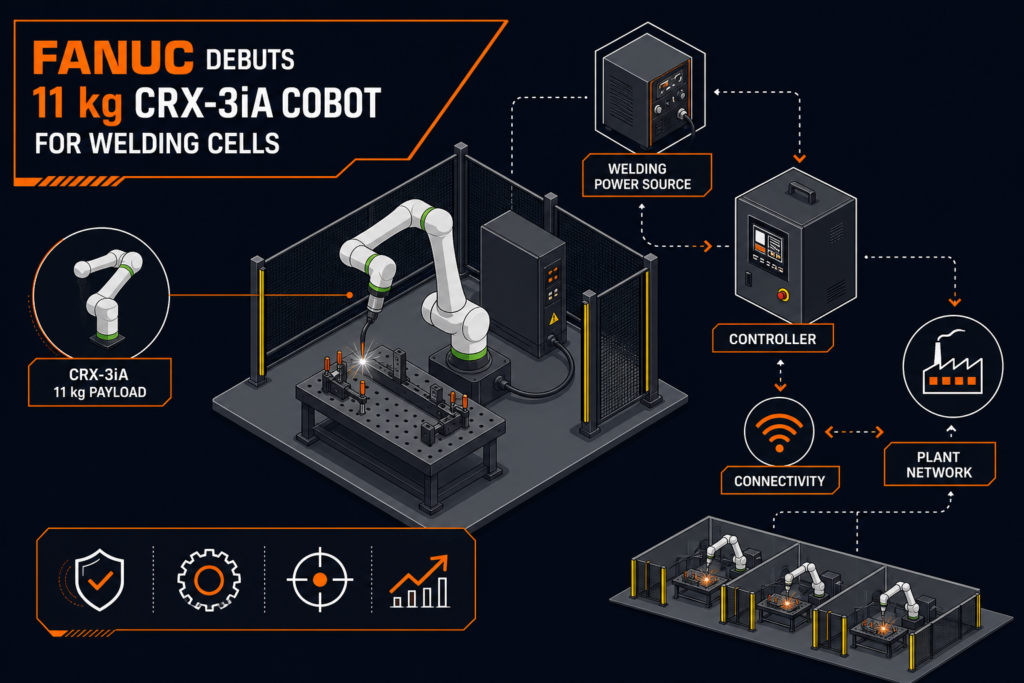
FANUC adds a lighter collaborative option for welding
FANUC has introduced the CRX-3iA in Europe, described as the lightest and smallest model in its CRX collaborative robot range. According to the original report in Robotics & Automation News, the new unit weighs 11 kg and is positioned for welding, intralogistics, mobile automation and training use cases. For welding applications, the headline specification is not only low mass but the combination of compact form factor, 3 kg payload and stated repeatability of ±0.02 mm, which gives integrators a clearer view of where the robot fits: light torch packages, smaller fixtures and installations where floor space, repositioning time or operator access are constrained.
Additional trade coverage from Machinery and PECM indicates that the CRX-3iA is intended to answer demand from sectors such as steel fabrication and shipbuilding, where labor shortages, variable batch sizes and difficult working environments continue to push manufacturers toward flexible automation. A lightweight cobot does not replace a high-payload arc welding robot on heavy structures, but it can lower the threshold for automating repetitive welds, tack operations, small assemblies and rework stations. In practical terms, a robot that can be moved more easily between benches or mounted on compact frames can help SMEs and Tier suppliers test automation without committing immediately to a large fenced cell.
Why the specifications matter in real production settings
The CRX-3iA’s 3 kg payload is modest compared with conventional six-axis arc welding robots from FANUC, ABB, KUKA or Yaskawa, yet it is aligned with many modern MIG and TIG torch packages when paired with lightweight dress packs and compact seam-tracking sensors. The reported ability to handle a torch and sensor simultaneously is relevant because weld quality in collaborative applications often depends less on raw payload than on cable management, path stability and process feedback. Repeatability of ±0.02 mm is also notable for a cobot in this class, especially where thin-gauge parts, short seams or cosmetic welds require consistent torch positioning. For production managers, that means the robot is better evaluated as a precision handling platform for controlled welding tasks rather than as a universal replacement for larger arc welding arms.
The low robot weight also has implications for deployment engineering. Integrators can design smaller pedestals, mobile carts or bench-mounted cells with lower structural demands, provided that dynamic loads, torch reaction forces and workpiece access are still validated. This can reduce installation complexity in workshops where reinforced foundations or large guarding layouts are not feasible. However, collaborative classification should not be confused with plug-and-play safety. Welding introduces arc radiation, hot spatter, fumes and fire risk, so a cobot welding station still requires a documented risk assessment under ISO 12100 and collaborative operation analysis under ISO 10218 and ISO/TS 15066 where applicable. Electrical and control system design must also align with relevant IEC and EN requirements, including machine electrical equipment and functional safety principles. In many welding scenarios, local shielding, extraction and perimeter protection remain necessary even when the manipulator itself is collaborative.
Competitive context in the collaborative welding market
FANUC’s move reflects a broader trend among robot suppliers toward smaller, easier-to-deploy platforms for welding automation. Universal Robots and Doosan have built strong visibility in cobot welding packages, often through ecosystem partnerships with welding source suppliers and software developers. ABB and KUKA continue to address both collaborative and industrial robot segments, while Yaskawa remains a reference point in dedicated arc welding robotics. The competitive difference is increasingly not just robot hardware, but how quickly an end user can move from manual welding to a validated process with offline programming, touch sensing, seam finding and operator-friendly HMI workflows.
For European buyers, the practical question is whether a lightweight cobot can maintain process consistency across mixed production. That depends on more than robot mass. Wire feeder placement, torch neck geometry, anti-collision devices, power source integration, fixture repeatability and fume extraction all affect cycle time and weld quality. A compact robot can be a strong fit for high-mix, low-volume work, prototype lines, educational cells and secondary welding operations, but less suitable for large parts requiring long reach, heavy torches or aggressive deposition rates. Procurement teams comparing FANUC with ABB, KUKA, Yaskawa, Universal Robots or Doosan will therefore need to assess total cell architecture rather than headline robot weight alone.
What this means for welding cell integrators
For welding cell integrators, the CRX-3iA expands the design space for compact robotic welding and cobot welding systems. A robot weighing 11 kg can support modular cell concepts that are easier to transport, install and redeploy across multiple production areas. That is particularly relevant for SMEs introducing automation in constrained workshops, and for Tier suppliers that need temporary capacity cells during model changeovers or launch phases. Integrators can potentially pair this class of robot with smaller positioners, modular tables and enclosed compact cells for MIG, TIG or tack welding, while preserving easier operator access for loading and inspection.
At the same time, successful integration will depend on disciplined application engineering. Welding cobots still need validated torch angles, cable routing, TCP stability, spatter protection and maintenance access. If collaborative operation is claimed, the complete cell must be assessed as a system, not just by the robot’s native safety functions. Integrators should review ISO, IEC and EN compliance early, especially for guarding strategy, emergency stops, extraction, arc flash shielding and safe speed or separation monitoring where human interaction is expected. In many cases, the best outcome may be a compact automated welding cell that uses a collaborative robot but operates in a semi-enclosed or fully enclosed mode for process safety and throughput. That approach can combine the programming simplicity associated with cobots and the process discipline expected in industrial welding.
Manufacturers evaluating compact robotic welding cells can use launches such as the FANUC CRX-3iA as a benchmark for footprint, payload and precision. Companies planning a new welding automation project, or comparing FANUC with ABB, KUKA, Yaskawa, Universal Robots or Doosan, can request a quote to assess the most suitable cell architecture for their parts, weld process and compliance requirements.
Related articles
Request a quote
Looking for a specific configuration, or want to discuss our current stock? Tell us about your project — we reply within 24 hours from our Bilbao office.