Nvidia FOX Targets Real-Time AI Factory Coordination
Nvidia’s new Factory Operations Blueprint aims to centralize factory monitoring and optimization, a development with clear implications for robotic welding cells and cobot integration.
Nvidia introduces a centralized AI layer for factory operations
Nvidia has presented a new software reference design intended to give manufacturers a centralized AI system for supervising and improving plant operations in real time. Announced at GTC Taipei during Computex and reported by Robotics & Automation News, the Factory Operations Blueprint, or FOX, is positioned as a framework for building an autonomous factory manager agent rather than as a single finished application. According to Robotics & Automation News, the concept is to coordinate robots, inspection systems, material handling assets and production workflows through one AI-driven operational layer. Nvidia describes the blueprint as a way to connect industrial equipment and software systems, automate AI model training and manage intelligent workflows across a manufacturing site.
The broader significance for industrial users is that FOX addresses a familiar problem in automated production: data exists in many places, but decisions are still fragmented. Welding lines, machine tending cells, automated inspection stations, AGVs, PLC networks, MES platforms and quality systems often operate with separate dashboards and separate logic. Nvidia says in its own technical positioning that FOX is designed to provide total factory visibility and support faster decision-making by orchestrating specialized industrial AI agents for quality, material transport and worker safety, as outlined by the NVIDIA Blog. For production managers, that suggests a move beyond isolated analytics toward a supervisory layer that can correlate cycle times, downtime events, quality drift and logistics bottlenecks in one environment.
Why the blueprint matters in automated manufacturing
Manufacturers have been building digitalization stacks for years, but many still struggle to turn machine data into coordinated action. A robotic welding cell may already expose signals for arc-on time, torch cleaning intervals, wire consumption, fixture status and robot alarms, while upstream systems track part genealogy and downstream systems record dimensional inspection results. The challenge is not collecting data; it is contextualizing it quickly enough to improve throughput and quality. FOX appears aimed at that gap by serving as a reference architecture for centralized AI management, including links to Nvidia Omniverse-based digital twins for simulation and operational analysis. That digital twin angle is relevant because it allows manufacturers to test scheduling changes, robot path adjustments, buffer sizing or material flow scenarios before applying them on the shop floor.
For large plants and Tier-1 suppliers, the practical value may lie in cross-domain orchestration. A body-in-white line or chassis fabrication area can contain ABB, KUKA, FANUC or Yaskawa robots alongside vision systems, safety PLCs and conveyors from other vendors. In mixed environments, the bottleneck is often interoperability rather than robot capability. If a centralized AI manager can normalize data from these assets and trigger workflow responses, it could reduce the lag between a detected problem and a corrective action. That said, deployment will depend on how well such a blueprint interfaces with established industrial protocols, cybersecurity requirements and existing software layers such as SCADA, MES and ERP. In Europe, any implementation touching machine control, collaborative operation or functional safety would still need to align with applicable IEC, ISO and EN standards, including frameworks such as ISO 10218 for industrial robot safety, ISO/TS 15066 for collaborative applications, IEC 61508 for functional safety and EN ISO 13849 for safety-related control systems.
What this means for welding cell integrators
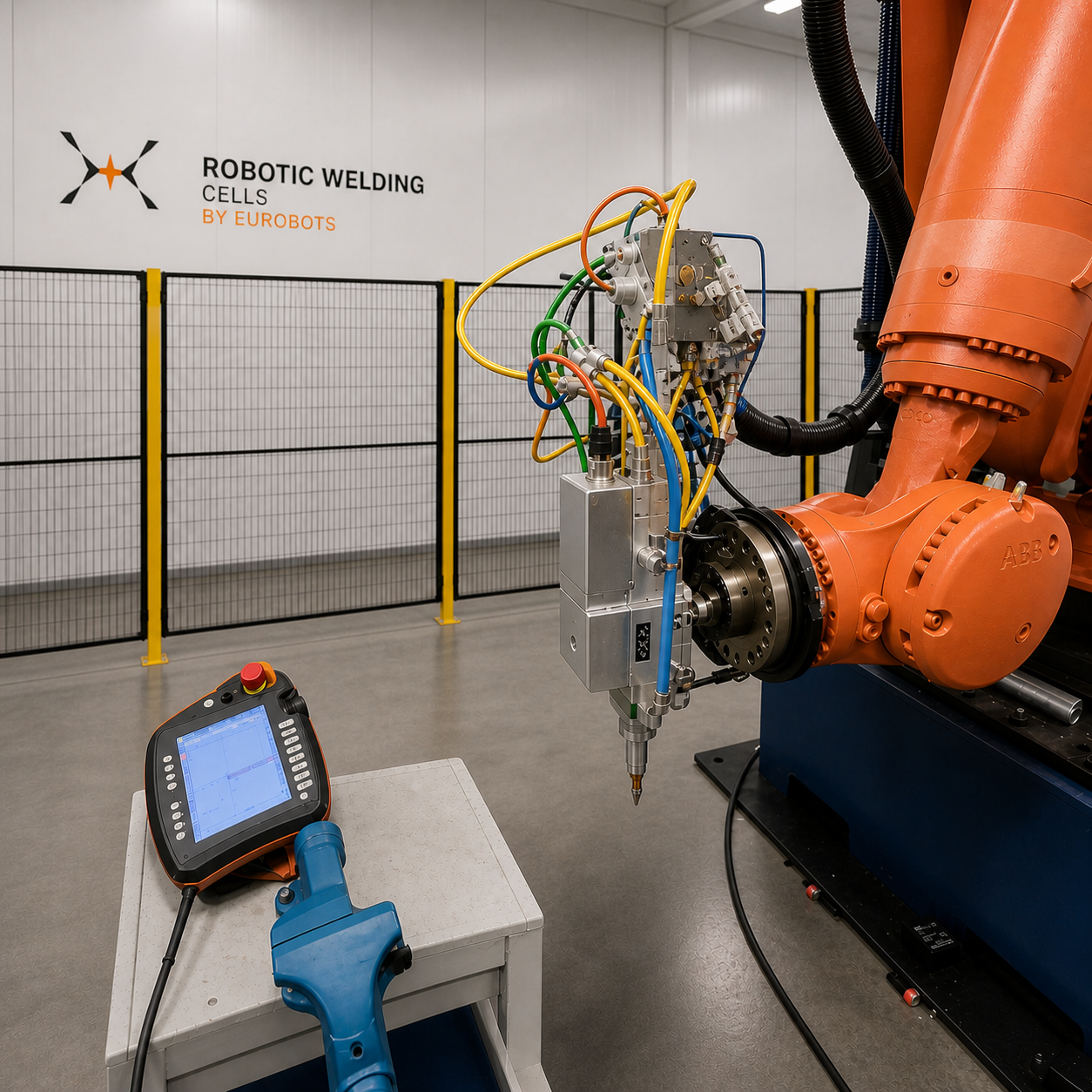
For robotic welding cell integrators, FOX is most relevant as a plant-level coordination concept rather than a replacement for robot programming or weld process control. Integrators building MIG, MAG, TIG or spot welding cells typically focus on robot reach, torch access, fixture repeatability, fume extraction, seam tracking, power source integration and safety zoning. Those fundamentals do not change. What could change is the way cells are monitored and optimized after commissioning. A centralized AI manager could combine robot controller data, welding power source parameters, vision inspection results and maintenance records to identify patterns that are difficult to see at cell level alone. For example, recurring spatter-related defects might correlate with part variation from an upstream process, or cycle losses in one cell might actually be caused by delayed part presentation from material handling.
This is particularly relevant in facilities deploying a mix of traditional industrial robots and collaborative systems from vendors such as Universal Robots or Doosan for secondary welding, tack welding, handling or inspection support tasks. In a cobot welding environment, where throughput is often lower but flexibility is higher, centralized AI supervision may help determine when a collaborative cell should remain in high-mix production and when a higher-volume job should be shifted to an enclosed robotic welding cell. Integrators may also see growing demand for digital twin-ready cell designs, structured data models and cleaner interfaces to plant software. In practice, that means specifying gateways, historian connectivity, event tagging and standardized alarm structures early in the project, not as an afterthought. Welding cell builders that can expose actionable data while preserving deterministic machine behavior will be better placed to support this next layer of factory AI.
Adoption will depend on integration depth and governance
The near-term question is not whether AI can analyze factory data, but whether manufacturers can operationalize it without adding another disconnected software layer. Reference designs such as FOX can accelerate pilot projects, yet real value will depend on governance, data quality and clear boundaries between advisory AI and machine-level control. Production teams will want evidence that recommendations are traceable, secure and compatible with existing validation procedures. Procurement teams will also examine vendor lock-in risk, especially in plants running heterogeneous automation estates from ABB, KUKA, FANUC, Yaskawa, Universal Robots and Doosan. For welding-intensive sectors such as automotive, heavy equipment and metal fabrication, the most credible use cases are likely to be bottleneck detection, predictive maintenance, quality correlation and simulation-led line balancing rather than fully autonomous control from day one.
As manufacturers assess centralized AI management tools, welding cell projects are likely to be judged increasingly on data readiness as well as mechanical and process performance. Companies planning new robotic welding or cobot welding installations may therefore want to review how cell controls, sensors, quality systems and digital twin models will connect into wider factory operations platforms.
For manufacturers evaluating new welding automation capacity, Robotic Welding Cells can provide technical guidance on cell architecture, robot and cobot integration, and data-ready welding cell design. Readers who want to compare options for turnkey systems are invited to request a quote.
Request a quote
Looking for a specific configuration, or want to discuss our current stock? Tell us about your project — we reply within 24 hours from our Bilbao office.