
Why a refurbished welding cell beats a new one — on most projects
A refurbished robotic welding cell delivers 90% of the capability of a new one at 40–60% of the cost — and ships in weeks, not months. From 25 years of trading welding cells, here's the honest case for refurbished, the cases where new is the right answer, and the numbers that make the decision concrete.
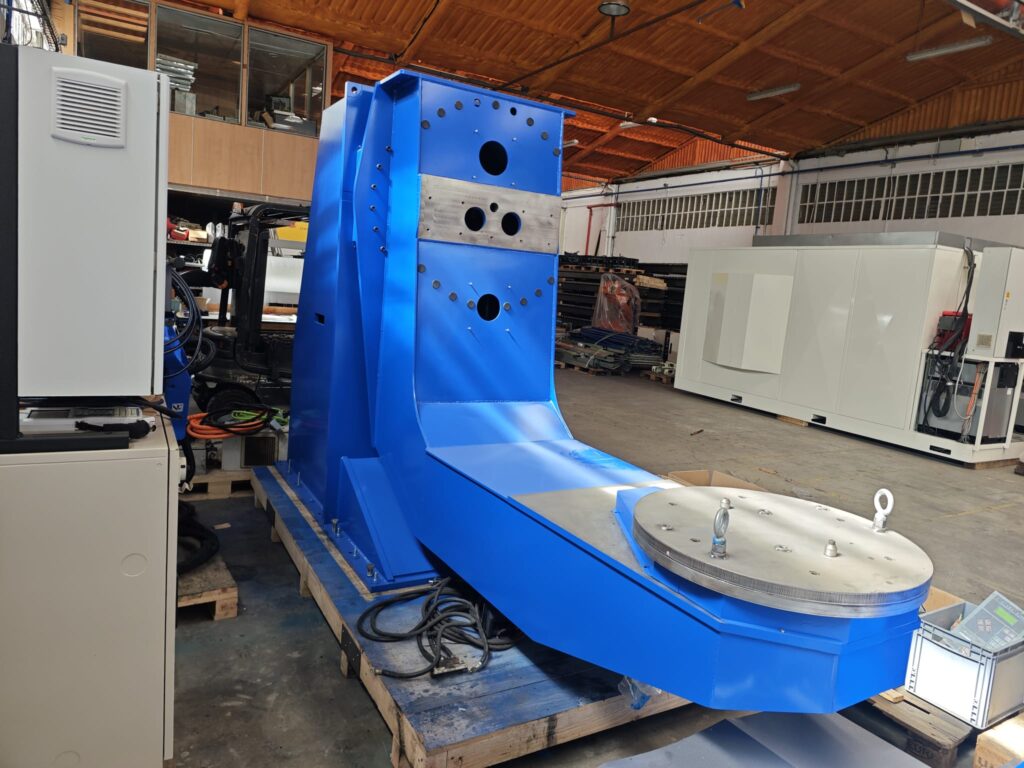
The decision between a new robotic welding cell and a refurbished one is, on paper, obvious: same output, half the price, faster delivery. In practice it’s nuanced — because ‘refurbished’ is a word that ranges from ‘wiped the dust off’ to ‘every wear part replaced and 200-hour acceptance test.’ This article makes the case for refurbished honestly, including when new is genuinely the better choice.
We’ve delivered 120+ welding cells across 40+ countries in 25 years. The vast majority were refurbished. A meaningful minority were new (we resell new equipment as well as second-hand on certain configurations). Here’s what we’ve learned about when each wins.
The CapEx differential
The first conversation with any buyer starts with the price gap. It’s larger than most people expect.
- New robotic welding cell, MIG/MAG configuration: €120,000–€180,000 typical, including robot, positioner, power source, fencing, controls and basic programming. Premium configurations (twin-station, advanced seam tracking, large positioners) push above €200,000.
- Refurbished equivalent from our catalog: €40,000–€90,000 including the same components, our 7-point inspection protocol, CE dossier, and 6+ months warranty.
- Saving: 40–60% on direct equipment cost, before installation and training (which are similar in both cases).
On a typical mid-volume welding investment of €150,000 new, a refurbished alternative frees €60,000–€90,000 of capital for related investments — workpiece tooling, weld inspection equipment, operator training, or simply staying liquid through the payback period.
Time to production
The capex gap is well known. The time gap is often more decisive in practice.
- New cell, lead time from order to commissioning: typically 6–12 months. Robot OEMs allocate slots quarterly; integrators stack work; commissioning waits on customer-side civil works.
- Refurbished cell from our Bilbao warehouse: 4–8 weeks from order, typically. Cell is already inspected, refurbished and CE-compliant when it leaves the warehouse. Commissioning at customer site adds 1–2 weeks.
For a manufacturer who needs welding capacity to fulfill an order pipeline, the difference between 8 weeks and 8 months is not financial — it’s existential. We’ve shipped cells to customers who would have lost contracts waiting for new equipment.
Sustainability and circular economy
This was a marketing line ten years ago. It’s now a procurement requirement at most large customers.
A robotic welding cell embodies roughly 18–25 tonnes of CO2 in its manufacturing: steel, electronics, motors, copper. Refurbishing extends the useful life of that embodied carbon by 8–15 years rather than producing a duplicate. Customers under SBTi commitments or CSRD reporting requirements increasingly need to document Scope 3 reductions; refurbished equipment is one of the cleanest ways to do it.
We provide a refurbishment dossier with every cell that includes the original commissioning year and the refurbishment scope. Several of our customers use this directly in their sustainability reports.
Performance — same output, properly refurbished
The doubt buyers raise most often: ‘is a refurbished cell actually as productive as a new one?’
The honest answer: yes, if the refurbishment was done properly. The robot is a mechanical asset designed for 80,000–100,000 operating hours. A 2014 cell at 25,000 hours has 70%+ of its life remaining. After our refurbishment — wear-part replacement, calibration, full functional test — the output specifications match nameplate.
What changes:
- Top mechanical speed: identical. Industrial robots don’t lose top speed with age unless joints are damaged, and damaged joints are replaced during refurbishment.
- Repeatability: ±0.05 mm new vs ±0.07 mm refurbished, on average. Difference rarely matters in welding applications (weld puddle is 3–8 mm wide).
- Controller features: this is where the gap shows. A 2014 controller does not run the latest path-planning algorithms that ship with 2026 controllers. For most welding it’s irrelevant. For laser welding with adaptive optics, it can matter.
- Software maintenance: OEM software support windows close after 7–10 years. Our cells with controllers older than 2015 we discount further to reflect the limited support window.
When new IS the right choice
We tell buyers when refurbished isn’t right. It happens.
- Next-generation process: cobot welding, AI weld-quality monitoring, generative path-planning, additive-hybrid. These are features on robots from 2020+. Our typical inventory is 2010–2018; finding a 2022 cell is rare.
- Very specific configurations: positioners above 5 tonnes payload, custom multi-station integrations, integrated cobots. New is faster to specify than waiting for the right second-hand match.
- OEM warranty contractually required: some aerospace primes and certain pharma applications have customer contracts that require new equipment with current OEM warranty. Refurbished isn’t an option, regardless of cost.
- Full process re-engineering: if you’re rebuilding a production line from scratch and need a guaranteed lead-time for go-live, the predictability of new is sometimes worth the premium.
For everything else — which is the majority of welding investments — refurbished is the rational choice.
A typical comparison
To make it concrete, here’s a recent buyer comparison from our floor:
| New cell (Tier-1 OEM quote) | Refurbished (our catalog) | |
|---|---|---|
| Robot | Yaskawa Motoman GP25 | Yaskawa Motoman HP20D, 2012, 18,500 hours |
| Positioner | MT1-3000 (current model) | MT1-3000 S2D, 2014 |
| Power source | Fronius TPS 4000i | Fronius TPS 4000, refurbished |
| CE compliance | Issued at delivery | Original technical file, transferred |
| Warranty | 12 months | 6 months extendable |
| Lead time | 8 months | 5 weeks |
| Total price | €155,000 | €56,500 |
| Saving | — | €98,500 (64%) |
The €98,500 saving is real, conditional on three things: the inspection was thorough, the refurbishment scope is documented, the supplier stays accessible after the invoice. We design our process to deliver all three.
Our 25 years in numbers
- 120+ welding cells delivered across automotive, heavy fabrication, pipe & tube, agricultural and job shops
- 40+ countries served from our Bilbao warehouse, primarily Europe with regular shipments to North Africa and Middle East
- Average refurbishment scope: 47 individual checks, 18 typical part replacements, 12 measured calibrations
- Average customer: a manufacturer with one to four welding cells already on the floor, looking to add capacity for a new contract
- Repeat customer rate: well over half of our buyers come back for the next cell within 24 months
The second-hand market for industrial robotics is small, technical, and reputation-driven. We’ve grown by being the supplier that runs the inspection protocol seriously. The article on how we evaluate every welding cell before listing walks through exactly what that means.
How to compare yourself
If you’re currently weighing new vs refurbished, the most useful exercise is: take a quote from one new-equipment supplier and one refurbished supplier (us or anyone else) and compare them line-by-line on equipment spec, refurbishment scope, warranty terms, and lead time. The math becomes obvious quickly.
Browse our current catalog → — every cell listed is in stock at our Bilbao warehouse, inspected, refurbished and ready to ship. Filter by process, robot brand, or cell type to narrow to your application.
Get a comparison quote → — if you have a new-equipment quote already, send us the spec and we’ll come back within 24 hours with a refurbished alternative if one is in stock, or a clear ‘buy new’ recommendation if it isn’t.
Read next: How we evaluate every welding cell before listing · MIG/MAG vs Laser welding: which is right
Related articles
Request a quote
Looking for a specific configuration, or want to discuss our current stock? Tell us about your project — we reply within 24 hours from our Bilbao office.