
MIG/MAG vs Laser welding: which is right for your application?
We catalog only MIG/MAG and laser welding cells in our Bilbao warehouse — the two processes that dominate robotic welding. Here's the same decision framework we use with buyers: thickness, throughput, material, budget. With concrete numbers and a look at what's actually moving in the second-hand market.
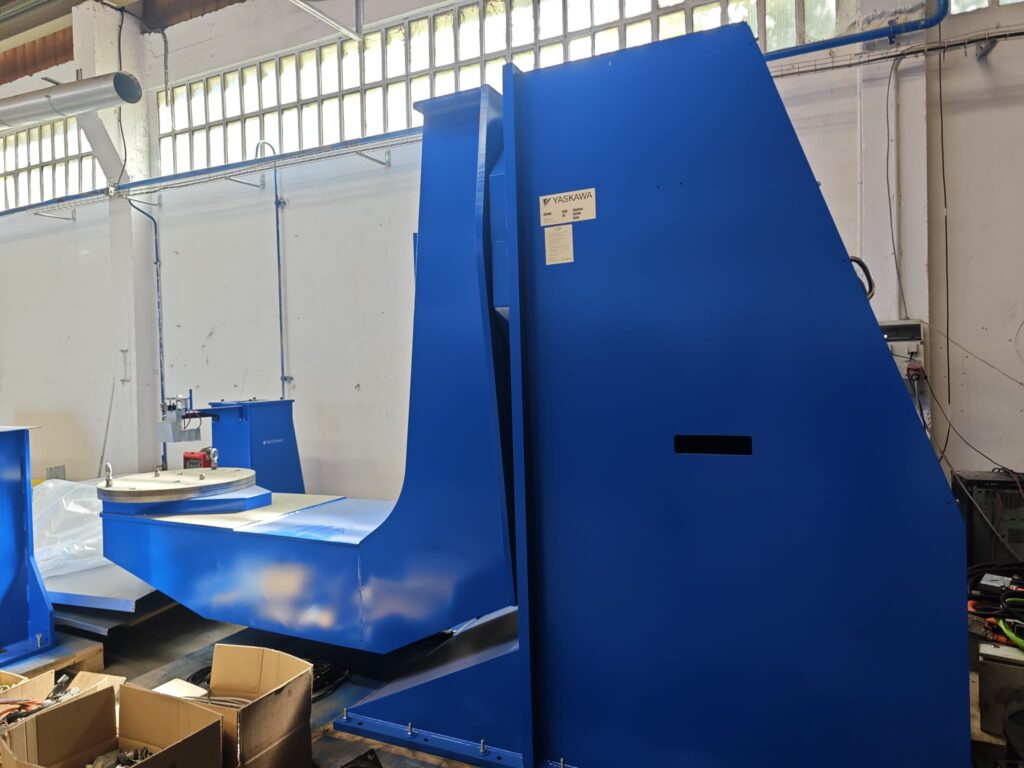
When a buyer asks us ‘should I look at MIG/MAG or laser?’, the honest answer is almost always ‘depends on three things you can answer in 20 seconds’: material thickness, weld length per part, and the budget envelope. Everything else is secondary.
In 25 years of trading welding cells across 40+ countries, we’ve shipped both processes to manufacturers ranging from automotive Tier-2 plants to one-off custom fabricators. What follows is the same decision framework our engineers walk through with every buyer — published so you can pre-screen yourself before talking to anyone.
A note on scope: we catalog only MIG/MAG and laser cells. TIG, sub-arc and plasma exist on robotic cells but they’re rare on the second-hand market — the cells we get into the warehouse are about 80% MIG/MAG and 20% laser, mirroring what’s installed in factory floors today.
What MIG/MAG does well
MIG/MAG (Gas Metal Arc Welding, also called GMAW) is the workhorse of robotic welding. If you’re not sure which process you need, it’s the safer default.
The strengths:
- Broad material range: carbon steel, stainless, aluminium, with the right wire and gas mix. A single MIG cell can handle 80% of a typical job-shop’s mix.
- Forgiving on operator skill: programming is mature, training is short. Most welding-shop electricians can troubleshoot a MIG cell with phone support. Laser cells require specialist training.
- Lower capex: a refurbished MIG cell from our catalog typically lists at €40,000–€70,000 including positioner. The equivalent laser cell starts around €90,000 and goes well above €150,000.
- Lower consumables cost: contact tips, nozzles and shielding gas are commodity items, available worldwide. Laser optics are not.
Where it falls short: heat input is higher than laser, so distortion on thin sheet (below 1.5 mm) is a real problem. Visible weld bead is larger — if cosmetics matter to your end customer, MIG often needs a finishing step.
What laser welding does well
Laser welding has grown fast in the last ten years, particularly in automotive and battery manufacturing. The strengths are real, but so are the trade-offs.
- High precision: weld widths from 0.3 mm. Heat-affected zone is a fraction of MIG. On structural parts where dimensional accuracy after welding matters, laser is dominant.
- Low heat input: less distortion, less post-weld machining, less rework. On thin gauge (below 2 mm) the productivity gain alone justifies the higher capex within 12–18 months.
- Clean welds: minimal spatter, minimal cleanup. Cosmetic-grade welds straight off the cell.
- High speed on long welds: linear weld speeds 3–5x MIG on appropriate geometries.
Where it falls short: optics replacement is expensive (€8,000–€20,000 every few thousand hours), and laser cells are unforgiving on fit-up. Gap tolerance is typically ±0.1 mm vs ±0.5 mm for MIG. If your upstream forming is loose, your laser cell becomes a bottleneck.
The decision matrix
Three questions, in order:
1. What’s your typical material thickness?
- Below 1.5 mm: laser is usually the right answer. MIG distortion eats your margins.
- 1.5–6 mm: either works; budget and throughput decide.
- Above 6 mm: MIG, almost always. Laser at this thickness needs hybrid (laser + MIG) which is a different cell category and not common second-hand.
2. What’s your weld length per part?
- Less than 200 mm total: MIG is fine; the speed advantage of laser doesn’t dominate at short welds.
- 200–800 mm: laser wins on throughput if you’re running enough volume.
- Above 800 mm or continuous welds: laser dominates.
3. What’s your budget envelope?
- Under €60,000: MIG only, refurbished. New laser is never below €120,000.
- €60,000–€100,000: refurbished MIG with premium positioner, or entry-level refurbished laser.
- Above €100,000: full configuration choice; decide on technical merits, not budget.
If two answers point to laser, look at laser. If two point to MIG, save the capex.
Industries where each shines
We see clear patterns in our shipments:
- Automotive Tier-2 (body panels, BIW): laser dominant. Tight tolerance, thin gauge, long weld lengths.
- Heavy fabrication (yellow goods, agricultural equipment): MIG dominant. Material thickness 6–20 mm, fit-up tolerance loose.
- Pipe and tube: depends on diameter. Small precision tube uses laser; structural pipe uses MIG. Some customers run both.
- Job shops (mixed parts, low volume per SKU): MIG dominant. Programming overhead and gap tolerance favor the more forgiving process.
- Battery/electronics manufacturing: laser, increasingly. Specialist application, often new rather than second-hand.
What we see in our second-hand catalog
Of the welding cells that pass our 7-point inspection protocol and enter the catalog:
- ~80% are MIG/MAG, mostly from heavy fabrication and Tier-2 automotive divestments
- ~20% are laser, mostly from automotive consolidations and the occasional battery-line decommissioning
- Average price: MIG €55,000, laser €110,000, both including positioner and full CE dossier
- Average age at intake: 2014, with operating hours typically between 18,000 and 35,000
The second-hand market lags new installations by about 5–7 years on average. Today’s catalog is largely cells built 2010–2018, with controllers from that generation (DX100/DX200 for Yaskawa, R-30iA/R-30iB for Fanuc, IRC5 for ABB).
When buying new makes sense over second-hand
Refurbished is not always the right answer. We say so to buyers when it isn’t.
- Next-generation process integration: cobot-based welding, AI weld-quality monitoring, additive-hybrid. These features mostly exist on cells from 2020 onward — too new for our typical inventory.
- Very specific geometric requirements: ultra-large positioners (above 5 tonnes), custom multi-station configurations. Easier to specify new than to find a match second-hand.
- OEM warranty/support requirement: some end customers (notably aerospace primes and certain pharma) contractually require new equipment with current OEM warranty.
For everything else — and that’s most welding applications — refurbished delivers 90% of the capability at 40–60% of the cost.
How to pre-screen on our catalog
Browse the full catalog → and filter by Process (MIG/MAG or Laser) at the top of the page. The current selection mirrors what we have in stock at the Bilbao warehouse and ready to ship across Europe within 4–8 weeks of order.
If you need help matching cells to your specific application — material, thickness, weld length, throughput target — talk to one of our engineers →. The team in Bilbao will pre-shortlist cells in stock that match your requirements within 24 hours.
Want a deeper read? Our other articles cover how we evaluate every welding cell before listing and why refurbished beats new on most projects.
Related articles
Request a quote
Looking for a specific configuration, or want to discuss our current stock? Tell us about your project — we reply within 24 hours from our Bilbao office.