
How we evaluate every welding cell before it enters our catalog
In 25 years and 120+ cells delivered, we've learned that the difference between a good used welding cell and a regretted purchase is almost always visible during inspection. This is the same 7-point protocol our engineers run on every cell that enters our Bilbao warehouse — published so you can use it on any supplier.
A robotic welding cell is rarely a small purchase. Even on the second-hand market, you’re typically committing €40,000–€90,000 to a machine that will run three shifts a day for the next ten years. Get the evaluation right and you save 40–60% versus a new equivalent. Get it wrong, and you spend the savings — and more — on retrofits, downtime and emergency call-outs.
In 25 years of trading industrial robotics and 120+ welding cells delivered across 40+ countries, we’ve seen every variant of this calculation go right and wrong. Some of those mistakes were ours, in our early years. Most were avoidable.
This article is the same 7-point protocol our engineers run on every welding cell that arrives in our Bilbao warehouse before it enters this catalog. We’re publishing it because — frankly — the more buyers run this checklist on every supplier (including us), the better the second-hand market becomes. We’re confident our cells pass it. We want yours to as well.
1. Robot brand, age, and operating hours
The robot is the most expensive single component of the cell, and the only one whose useful life is well-documented.
In our experience:
- Brand: Yaskawa Motoman, Fanuc, ABB, Kuka and Panasonic are the safe bets for welding. Spare parts are available, integrators know how to program them, and remote diagnostics are mature. Niche brands (Reis, Comau, Nachi) are not bad — but spare parts can take weeks instead of days, and we factor this into our pricing.
- Age: a 2010–2018 robot is in our sweet spot. Older than 2010 and you start running into obsolete controllers (DX100 vs DX200, R-30iA vs R-30iB) that may lack TCP/IP integration and modern fieldbus. Newer than 2018 and we’re paying close to new prices ourselves — there’s no margin to pass to you.
- Hours operated: industrial robots are designed for 80,000–100,000 hours of mechanical life. Every cell in our catalog has its operating-hour record pulled from the controller log and listed on the dossier. A 2014 robot at 25,000 hours is still in its first third. The same robot at 75,000 hours we’d typically refuse to take in.
If a seller can’t give you operating hours from the controller log, walk away. It’s a 30-second query on any modern robot. The absence of an answer is the answer.
2. Process compatibility
Welding cells are built for a specific process. MIG/MAG dominates the market — broad material range, low setup cost, forgiving on operator skill. Laser welding is high-precision and lower-heat, but the optics are expensive and process-sensitive. We catalog only MIG/MAG and laser cells: TIG, sub-arc and plasma exist but are rare on robotic cells, and we don’t stock them.
When evaluating, verify:
- The power source matches the process. A Fronius TPS, Lincoln PowerWave, or Miller PipeWorx is not interchangeable with a laser source — different control loops, different wire feed.
- The torch and consumables are still in production. A discontinued torch model means stockpiling spare parts for ten years or paying for an adapter retrofit. We replace torch kits during refurbishment as a default.
- The interface protocol between robot and power source (DeviceNet, EtherNet/IP, Profinet) is supported by your existing infrastructure. Mismatch is a six-month integration project; we flag it in every dossier.
Read also: MIG/MAG vs Laser welding: which is right for your application? — the same decision framework we use with buyers, with concrete numbers on each process.
3. Power source condition
The power source is the second-most-expensive component after the robot. Three checks our team runs:
- Internal cleanliness: opening the front cover should reveal copper that looks like copper, not green oxide. Dust caked on the heatsinks tells you it’s been running in an environment without filtration — and that the IGBT modules have been thermally stressed.
- Calibration record: every reputable refurbisher will run a current/voltage calibration after refurb. Our certificates show actual measured values within ±2% of nominal across the working range, archived for the life of the cell.
- Wire feed motors: brushed motors (older) wear out faster than brushless. We listen for grinding under load. A wire feed motor swap is normal during refurb; a hidden wear-out a year after delivery is not.
4. Positioner condition (axes, payload, repeatability)
The positioner is what holds and rotates the workpiece. It’s also the component most often ignored during second-hand purchases — and the one most likely to fail in service. We pay particular attention because positioner failure typically takes the whole cell down.
For each positioner axis, verify:
- Repeatability: ±0.1 mm on a single-station positioner, ±0.05 mm on a precision rotating table. We run repeatability tests in front of the customer on request.
- Backlash: with the brake released, manually rotate each axis. Any ‘play’ greater than 0.5° at the workpiece is a worn gearbox — €4,000–€8,000 to replace, and we’d typically replace it before listing.
- Payload: published rating is the maximum, not the working capacity. A 3-tonne positioner running 2.8-tonne fixtures all day will fail the bearings within 18 months. We size our cells at 70% of nameplate as safe working envelope.
A real example from our floor
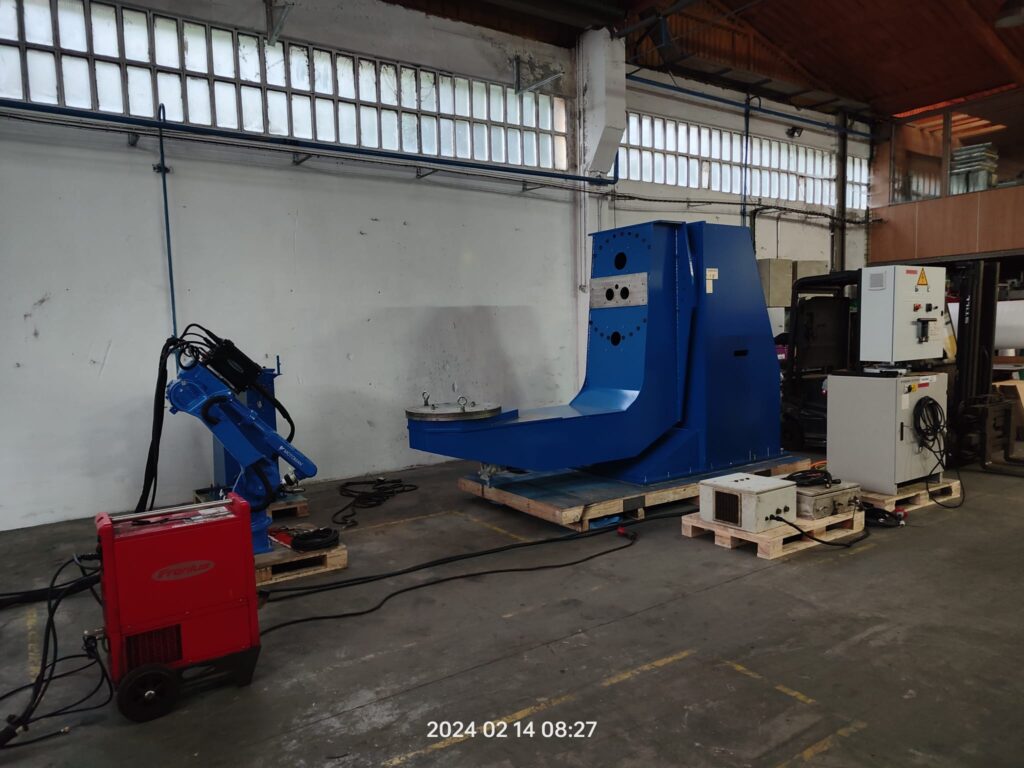
The cell currently featured in our catalog — a Yaskawa Motoman HP20D with MT1-3000 S2D positioner, 2012 vintage, €56,500 — passed exactly this protocol before we listed it. Robot at 6-axis configuration, 20 kg payload, 1,717 mm reach, controller DX100. Positioner Yaskawa MT1-3000-S2D, 2014 build, 3-tonne payload. Power source Fronius TPS 4000. CE conformity dossier complete.
Inspected and refurbished in our Bilbao warehouse, 2026.
This is the kind of dossier you should expect from any serious supplier. If you can’t get it, the savings are imaginary.
5. Safety fencing and CE compliance
European law (Machinery Directive 2006/42/EC, harmonised standard EN ISO 10218) requires every robotic cell to have a current CE declaration. Used cells do not automatically inherit the original CE. Any modification — different robot, different fence layout, new controls — requires re-certification.
In our process:
- Cell unmodified, original CE valid: we transfer the original technical file with the sale. The CE applies to the as-delivered configuration.
- Cell modified or CE missing: we perform — or commission — a new CE conformity assessment before listing. This is built into our pricing; we don’t pass it as a surprise to the buyer.
A welding cell sold ‘as-is, no CE’ is a cell you cannot legally operate in the EU. If you’re buying outside our catalog, walk away or budget €3,000–€8,000 for full re-certification before commissioning.
6. Refurbishment scope: what was actually done
‘Refurbished’ is the most-abused word in the second-hand industrial market. It can mean anything from ‘we wiped the dust off’ to ‘we replaced every wear part and ran a 200-hour acceptance test.’
Insist on a written refurbishment scope — for each component:
- What was inspected
- What was replaced (with part numbers)
- What was tested (with measured values)
- What was left as-is
We hand this dossier to every buyer. We’re working on a dedicated Refurbishment Process page on this site that walks through the scope in detail with photos from our shop floor — coming soon.
7. Warranty and post-sale support
A new welding cell from an integrator typically comes with 12 months parts-and-labour warranty. We offer at least 6 months on every refurbished cell, with a clear scope (which parts are covered, what excludes warranty — for example, operating outside the rated payload).
Equally important: who do you call when something fails at 02:00 on a Sunday during a critical production run? Verify:
- Phone or remote-diagnostic response time: 4 hours during business hours is standard; 24/7 is premium. We commit to 4-hour business response.
- Spare parts availability: same-day for high-wear items (torches, contact tips), 48 hours for electronic boards, 1 week for mechanical assemblies. We stock parts for every brand we sell.
- Field service network: through certified installation partners across Europe, we can have an engineer on site within 48–72 hours in most countries we serve.
Three red flags that should end the conversation
- No operating hours from the controller. The information exists; refusal to share it means it’s bad.
- No refurbishment scope document. ‘Trust us’ is not a procurement strategy on a six-figure asset.
- No CE declaration or technical file. You cannot legally commission the cell in the EU without one.
A simple scoring framework
For each of the seven points, score the cell from 0 to 3:
- 0 — missing or refused
- 1 — present but incomplete or below standard
- 2 — present and acceptable
- 3 — exceeds expectations
A well-evaluated cell scores 17 or higher out of 21. A score below 12 is a project, not a purchase. A score below 8 is a write-off — even if the price looks attractive.
Why we wrote this
Twenty-five years and 120+ welding cells in, we still see buyers walk into deals that cost them more than buying new would have. Almost every time, the warning signs were visible during evaluation; the buyer just didn’t know what to look for.
Run this checklist on us. Run it on every supplier. The 40–60% saving is real — but only when the evaluation is.
Want a cell that’s already passed this protocol?
Browse our current catalog → — every welding cell is inspected against this exact protocol before listing, with the full refurbishment scope and CE documentation included in the dossier.
Talk to an engineer → — for a specific project (payload, process, application), our team in Bilbao will pre-shortlist cells in stock that match your requirements within 24 hours.
Want a deeper read? See also Why a refurbished welding cell beats a new one — on most projects for the cost and time-to-production case behind buying refurbished.
Related articles
Request a quote
Looking for a specific configuration, or want to discuss our current stock? Tell us about your project — we reply within 24 hours from our Bilbao office.