
ABB Unveils OmniVance Collaborative Finishing Cell
ABB Robotics has introduced the OmniVance Collaborative Surface Finishing Cell, a plug-and-play cobot system for sanding and polishing aimed at improving consistency and throughput.
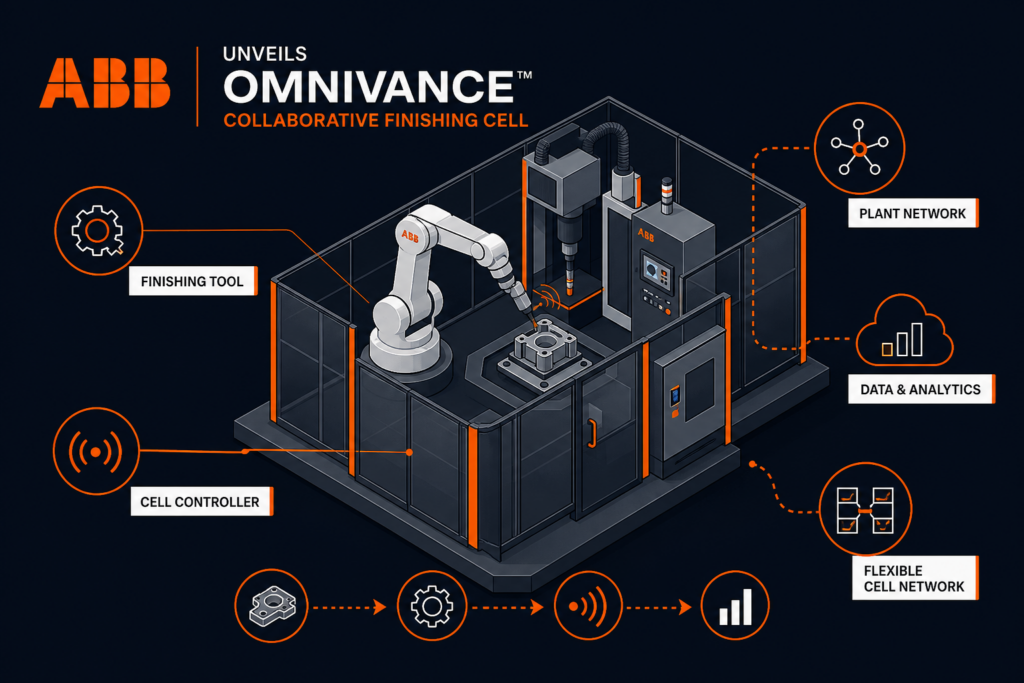
ABB adds a collaborative finishing cell to its OmniVance portfolio
ABB Robotics has introduced the OmniVance Collaborative Surface Finishing Cell, a self-contained automation package designed to handle repetitive sanding and polishing operations with a collaborative robot. Reported first by The Robot Report, the launch expands ABB’s standardized application-cell offering beyond material handling and machine tending into surface finishing, a process area where manufacturers often still rely on manual labor. According to ABB’s product announcement published by ABB News Center, the cell is delivered as a complete plug-and-play system that includes an ABB GoFa cobot and integrated safety components. The stated objective is to reduce the barrier to entry for companies that need more repeatable finishing quality but do not have in-house robotics engineering resources.
The launch matters particularly for automotive suppliers, metalworking subcontractors, and general industrial manufacturers processing cast, machined, or fabricated parts that require consistent cosmetic or functional finishing. Surface finishing is not welding, but it sits close to welding in many production flows: welded assemblies often need edge blending, spatter removal, pre-paint preparation, or cosmetic finishing before downstream inspection and coating. In those environments, process variability, operator fatigue, and abrasive-tool wear can directly affect throughput and rework rates. ABB says the new cell is intended to automate those repetitive tasks while maintaining a compact footprint and a simplified deployment model, an approach that aligns with broader market demand for pre-engineered robotic cells rather than fully bespoke automation projects.
Why standardized cells are gaining traction in manufacturing
Standardized robotic cells are becoming more relevant because many small and mid-sized manufacturers want automation that can be commissioned quickly and operated by production personnel rather than specialist robot programmers. ABB describes the OmniVance cell as an easy-to-use finishing solution for automatic polishing or sanding on a collaborative platform, as outlined on its ABB application cells page. That positioning reflects a wider industry shift also visible across portfolios from ABB, KUKA, FANUC, Yaskawa, Universal Robots, and Doosan, all of which have been expanding packaged application ecosystems around robots and cobots. For buyers, the attraction is not only lower integration effort but also more predictable documentation, safety architecture, spare parts planning, and operator training.
From a technical perspective, collaborative finishing cells still require careful assessment of process forces, dust extraction, abrasive media management, and part fixturing. Sanding and polishing can generate variable contact loads and airborne particulates that differ significantly from light assembly applications commonly associated with cobots. This means the practical performance of any collaborative cell depends on the interaction between robot payload, compliance, spindle or tool selection, and the required surface specification. A pre-engineered cell can simplify these decisions, but it does not remove the need for process validation. Manufacturers evaluating such systems will still need to review cycle time, achievable Ra or visual finish targets, consumable change intervals, and the effect of part-to-part tolerances on path accuracy.
Safety, compliance, and integration considerations
Although ABB presents the system as collaborative, deployment in Europe still requires a formal risk assessment under the Machinery framework and alignment with relevant standards. Depending on the final configuration, applicable references may include ISO 10218 for industrial robot safety, ISO/TS 15066 for collaborative robot applications, and electrical safety requirements under IEC and EN standards used in machine design and control systems. For finishing applications, integrators also need to consider guarding strategy, speed-and-separation monitoring where relevant, emergency stop architecture, and any local requirements related to dust, extraction, and operator exposure. A collaborative robot does not automatically mean fence-free operation; the process hazard and tooling hazard remain central to the safety concept.
ABB’s launch materials, also summarized by Automate, emphasize that the cell is fully self-contained and intended as a complete package. That is significant for procurement teams because packaged cells can shorten factory acceptance and site installation compared with custom-engineered systems. At the same time, production managers should verify how the cell interfaces with upstream and downstream equipment, including part presentation, barcode or recipe selection, quality inspection, and traceability. In automotive Tier-1 environments, those digital integration points often determine whether a cell remains a standalone workstation or becomes part of a controlled manufacturing line with auditable process data.
What this means for welding cell integrators
What this means for welding cell integrators is that the market is moving further toward modular, application-specific robotic workstations that can be deployed with lower engineering overhead. For companies designing robotic welding cells or cobot welding stations, ABB’s finishing cell is a reminder that customers increasingly want adjacent secondary operations automated in the same project scope. A welded component may pass through robotic MIG/MAG or TIG welding and then require deburring, sanding, or polishing before inspection and packaging. Integrators that already work with ABB, KUKA, FANUC, Yaskawa, Universal Robots, or Doosan platforms may find growing demand for hybrid cells or linked stations that combine welding, rework handling, and surface preparation. This affects cell design choices such as fixture accessibility, part transfer, fume and dust management, tool changing, and the segregation of welding hazards from collaborative finishing tasks.
For welding-focused manufacturers, the broader lesson is that automation decisions are increasingly being made at process-chain level rather than station level. A buyer comparing manual finishing against a collaborative cell will look at labor availability, consistency, ergonomics, and total cost per part in the same way they evaluate robotic welding. Where welding quality is already stabilized, finishing can become the next bottleneck. That makes standardized cells like ABB’s relevant even outside pure finishing departments. Companies reviewing automation roadmaps for fabricated metal parts, exhaust components, brackets, frames, or cosmetic assemblies may now consider whether a packaged finishing cell can complement existing welding automation and reduce non-value-added manual touch time. Manufacturers that want to assess how collaborative finishing or robotic welding could fit into their production flow can request a quote for a cell concept tailored to part geometry, throughput targets, and applicable ISO, IEC, and EN compliance requirements.
Related articles

Request a quote
Looking for a specific configuration, or want to discuss our current stock? Tell us about your project — we reply within 24 hours from our Bilbao office.