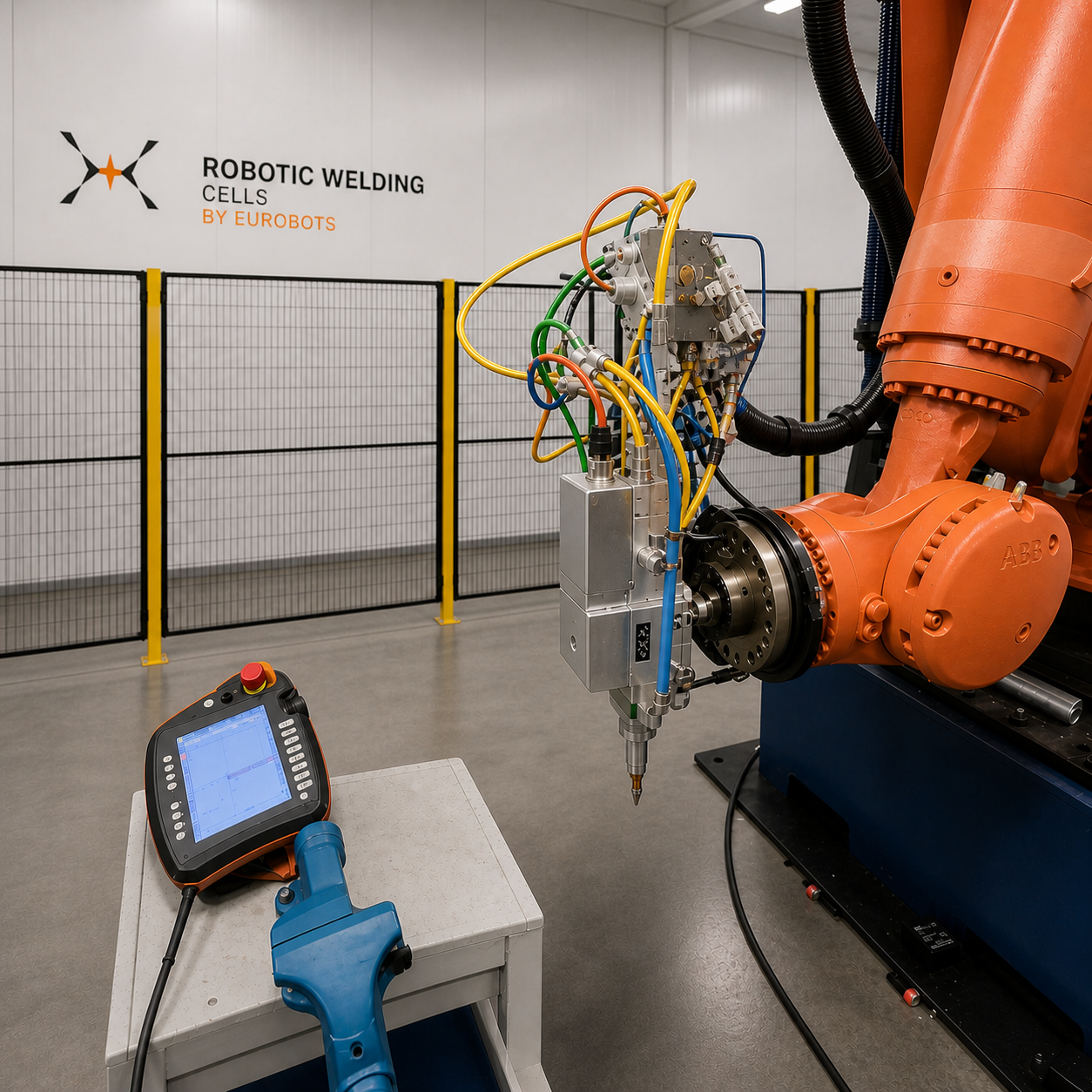
Industrial Robotics Adoption Remains Essential for Growth
Industrial robotics is increasingly seen as necessary for productivity, resilience, and welding automation, but adoption still depends on economics, skills, safety, and integration choices.
Industrial robotics is moving from a discretionary capital project to a strategic requirement for many manufacturers, yet adoption is still uneven across sectors and regions. That is the central tension highlighted by The Robot Report, which argues that modernizing the global economy with industrial robotics is necessary, but far from guaranteed. For production managers and manufacturing engineers, the message is familiar: demand for output, traceability, and labor resilience is rising, while the barriers to automation remain practical rather than theoretical. Integrators and end users are not debating whether robots can perform more factory tasks; they are assessing whether projects can be justified, deployed, and maintained at plant level under real cost, safety, and skills constraints.
The case for wider industrial robot deployment is strong. Manufacturers face persistent pressure to improve throughput, stabilize quality, and reduce dependence on hard-to-fill manual roles, especially in repetitive or hazardous operations such as arc welding, material handling, and machine tending. Welding is a particularly relevant example because it combines labor scarcity, variable quality risk, and high exposure to fumes, heat, and awkward postures. According to TWI, automation is becoming a larger part of welding and fabrication as robotics costs fall and companies seek greater competitiveness. At the same time, the economics are not universal. High-mix, low-volume production, limited fixturing discipline, and inconsistent upstream part quality can still slow return on investment, especially for small and medium-sized metalworking firms.
Why industrial robot demand is rising
Several structural drivers are pushing industrial automation forward. First is productivity: robots can maintain cycle consistency over multiple shifts and support data-driven process control. Second is resilience: manufacturers increasingly want capacity that is less vulnerable to absenteeism and labor shortages. Third is compliance: more customers now expect documented process repeatability, weld traceability, and standardized quality records. These factors are especially visible in automotive Tier-1 supply chains, where takt time discipline and auditability are already embedded. The supplier landscape reflects this demand. Established robot vendors such as ABB, KUKA, FANUC, and Yaskawa continue to dominate traditional industrial robot welding applications, while collaborative robot suppliers including Universal Robots and Doosan are expanding access to lower-payload, flexible automation cells for SMEs and mixed-production environments.
Collaborative automation is also changing how companies approach first-time robot adoption. Rather than committing immediately to a large fenced line, some manufacturers are evaluating modular cells, mobile bases, and pre-engineered welding packages. The trend toward simpler deployment has been noted by Automate, which points to pre-engineered cobot solutions for applications including welding. Academic work is also exploring how conventional robots can be adapted into more collaborative systems to improve sustainability and flexibility, as discussed by MDPI Electronics. For buyers, this does not eliminate engineering complexity, but it does broaden the range of viable automation formats between a manual workstation and a fully automated line.
What still slows adoption
If industrial robotics is increasingly necessary, why is adoption not inevitable? The answer lies in implementation friction. Capital expenditure remains the most visible barrier, but not the only one. Many factories still lack the process stability needed for successful automation: part tolerances may drift, tack quality may vary, and fixture design may be insufficient for repeatable robotic welding. Skills are another limiting factor. A robot can reduce dependence on manual welding labor, but it increases the need for programming, maintenance, process engineering, and troubleshooting capability. This is particularly relevant where plants expect a robot or cobot to compensate for weak production engineering. In practice, automation tends to reward disciplined manufacturers more than it rescues disorganized ones.
Safety and compliance also shape project feasibility. Whether an installation uses a conventional industrial robot or a collaborative platform, risk assessment remains mandatory. Integrators typically work within frameworks such as ISO 10218 for industrial robot safety, ISO/TS 15066 for collaborative applications, and relevant IEC and EN electrical and machinery safety requirements, including CE-related obligations in Europe. In welding cells, standards around arc equipment, fume extraction, guarding, interlocks, and functional safety are often as decisive as robot selection itself. A cobot does not automatically remove the need for guarding if the torch, workpiece, spatter, or positioning system introduces hazards. That distinction matters for procurement teams comparing collaborative welding with more conventional robotic cells.
What this means for welding cell integrators
For welding cell integrators, the current market environment creates both opportunity and responsibility. Demand is broadening beyond large automotive programs toward general fabrication, contract manufacturing, and SME workshops, but buyers increasingly expect faster commissioning and clearer ROI. Integrators therefore need to design cells that balance flexibility with process robustness. In robotic MIG/MAG or TIG welding, that often means combining the robot with seam tracking, through-arc sensing, offline programming, positioners, and fixtures engineered for repeatability. In cobot welding, it may mean accepting lower deposition speed or duty cycle in exchange for easier redeployment and smaller footprint. The right architecture depends on batch size, weld complexity, part variation, and required documentation.
Vendor choice is becoming more application-specific as well. ABB, KUKA, FANUC, and Yaskawa remain strong options for higher-duty industrial welding cells with external axes and complex motion requirements. Universal Robots and Doosan can be suitable where ease of programming, operator accessibility, and compact deployment matter more than maximum throughput. For integrators, the commercial challenge is to avoid overselling collaboration where a standard industrial robot is technically more appropriate, or overspecifying a large cell where a modular cobot package can meet production needs. The broader lesson from the market is that industrial robotics adoption will continue, but project success will depend on engineering realism, not automation rhetoric.
From strategic necessity to executable projects
Manufacturers that view robotics as part of a wider modernization program are likely to move faster than those treating it as a standalone equipment purchase. The most effective projects connect robot selection to weld procedure stability, part presentation, digital quality records, operator training, and lifecycle support. That is why the current discussion around industrial robotics matters for the welding sector: the technology case is increasingly established, while the competitive advantage now lies in execution. Companies assessing robotic welding cells or cobot welding stations should compare not only payload, reach, and software, but also safety architecture, fixture strategy, commissioning time, and maintainability over several years.
For manufacturers planning new welding capacity or upgrading manual stations, a detailed application review is often the best starting point. Robotic Welding Cells can provide a technical assessment of robotic welding and cobot welding options, including cell layout, safety concept, and expected production fit. Readers who want to evaluate a project can request a quote for a tailored welding cell proposal.
Request a quote
Looking for a specific configuration, or want to discuss our current stock? Tell us about your project — we reply within 24 hours from our Bilbao office.