NeoEyes NE503 Edge AI Camera Targets Industrial Vision
CamThink’s NeoEyes NE503 brings 20 TOPS of on-device AI, 4K imaging and IP67 PoE design to industrial vision, with implications for welding quality control and automated cell monitoring.
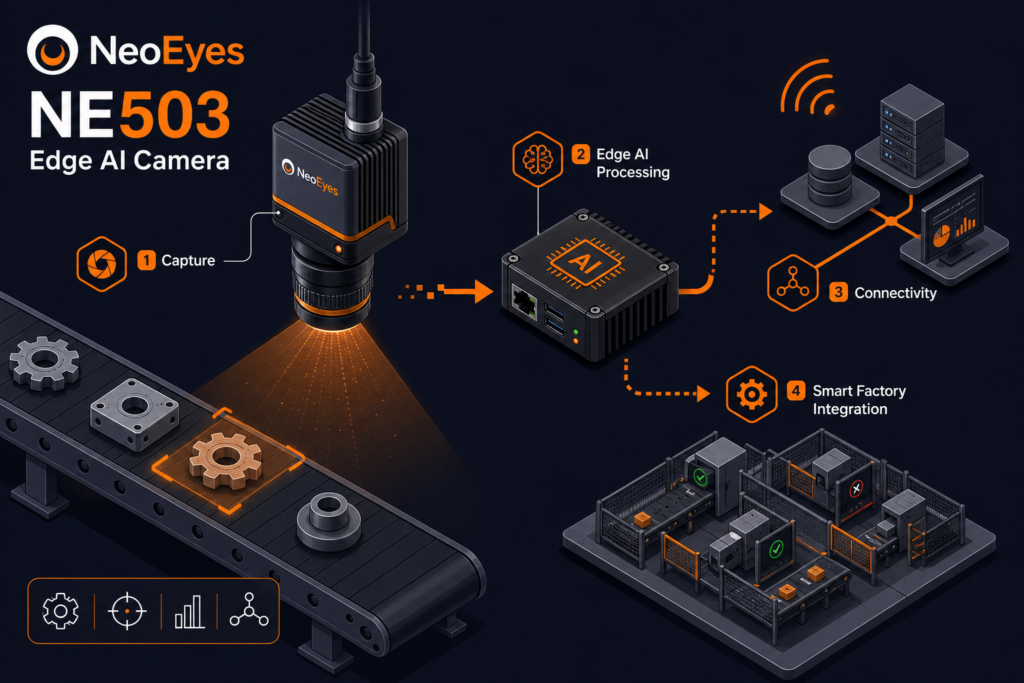
CamThink’s new NeoEyes NE503 edge AI camera adds a notable option to the industrial vision market by combining local inference performance with a compact machine-vision form factor. Reported by Hackster.io, the device is positioned around 20 TOPS of on-device AI compute, aiming to reduce the latency and bandwidth constraints that often limit cloud-connected or PC-dependent inspection systems. For production managers and manufacturing engineers, the significance is less about headline processing numbers than about where those numbers can be used: directly at the machine, close to weld seams, fixtures, conveyors, and robot work envelopes where decisions must be made in milliseconds rather than seconds.
The available product information indicates that the NE503 combines a Hailo-15H AI processor with a Sony IMX678 image sensor in a 4K camera package. According to CamThink, the unit is designed with an IP67 enclosure, PoE connectivity, RTSP streaming, and support for containerized AI applications. Additional reporting from AndroidPIMP describes the platform as an open deployment environment with modular I/O and on-device logic, a combination that aligns with current industrial automation demand for distributed intelligence rather than centralized image processing cabinets. In practical terms, this architecture can support object detection, OCR, pose estimation, and anomaly recognition without sending every frame to an external server.
Why on-device AI matters on the factory floor
Industrial users have been moving steadily toward edge vision because machine uptime, deterministic response, and cybersecurity are now as critical as raw image quality. A camera that can execute inference locally may simplify system design in stations where network congestion, variable lighting, and fast cycle times make remote processing less reliable. In welding and metal fabrication, these conditions are common. Spatter, smoke, reflections, and part-to-part variation can challenge conventional rule-based vision tools, while AI models running at the edge can be trained to classify defects, verify part presence, detect torch position drift, or confirm that a component is correctly fixtured before a robot starts a weld program.
This is particularly relevant in mixed-model production, where one cell may process multiple assemblies with small geometry changes. Traditional machine vision often requires extensive scripting and threshold tuning for each variant. Edge AI cameras offer a different path: deploy a trained model near the process and update it as production data accumulates. That does not remove the need for robust lighting, lens selection, and process engineering, but it can reduce dependence on industrial PCs and shorten the loop between image capture and action. For manufacturers already using robots from ABB, KUKA, FANUC, Yaskawa, Universal Robots, or Doosan, this kind of camera can become another smart node in the cell, feeding pass/fail signals, part classification, or process-state information into the PLC, robot controller, or MES layer.
Potential use cases in welding inspection and automation
The NE503’s specification profile suggests several realistic applications in welding environments. Pre-process inspection is one of the most immediate. Before arc start, the camera can verify joint fit-up, component orientation, hole presence, tack weld location, or barcode and OCR data on incoming parts. During the process, edge AI may support monitoring tasks such as torch-to-joint alignment, fixture occupancy, or PPE and intrusion detection around collaborative workspaces. Post-process, the same platform could be used for bead presence checks, weld length confirmation, spatter assessment, or sorting of acceptable and nonconforming assemblies. The fact that pretrained models for common vision tasks are already referenced in broader coverage by Geeky Gadgets/Geeky Fence coverage of the launch points to lower entry barriers for pilot projects, although industrial users will still need application-specific validation.
For regulated production environments, the camera itself is only one part of the compliance picture. Integrators deploying AI-enabled vision in robotic cells still need to align the overall machine design with applicable ISO, IEC, and EN standards. Depending on the installation, that may include ISO 10218 for industrial robot safety, ISO/TS 15066 for collaborative robot applications, IEC 60204-1 for electrical equipment of machines, and EN ISO 13849-1 for safety-related control systems. If the camera is used for quality decisions rather than safety functions, the validation burden is different, but traceability, false-positive management, and change control remain essential. Production engineers will also want to assess ingress protection, thermal behavior, network architecture, and how AI model updates are governed over the life of the cell.
What this means for welding cell integrators
For welding cell integrators, the NE503 is best understood as a building block for more autonomous and data-aware systems rather than a standalone breakthrough. The main design opportunity is to place intelligence directly where process variation occurs: at the loading station, inside the guarded welding area, or at the unload inspection point. That can reduce cabinet space, simplify cabling, and avoid the cost and maintenance overhead of a separate industrial PC for every vision task. In robotic MIG, TIG, laser, or resistance welding cells, an edge AI camera may complement seam tracking sensors and conventional machine vision by handling classification and anomaly detection tasks that are difficult to encode with fixed rules.
There are also implications for cobot welding. Collaborative cells often operate in smaller workshops where floor space, engineering resources, and IT support are limited. A compact IP67 PoE camera with local inference can fit these environments if it integrates cleanly with cobot ecosystems and standard field architectures. Integrators should still evaluate cycle-time impact, retraining requirements, and whether the model remains stable under welding glare and contamination. The strongest near-term use case may be not fully automated weld quality judgment, but layered inspection: AI-assisted pre-checks, process-state verification, and final visual screening that escalates uncertain cases to an operator or higher-level quality system.
Manufacturers considering upgrades to robotic welding or cobot welding cells may want to assess how edge AI vision could improve inspection, traceability, and process control. For companies planning a new cell or retrofit, Robotic Welding Cells can review the application and provide a quotation for a system design that integrates robots, safety, and industrial vision.
Related articles
Request a quote
Looking for a specific configuration, or want to discuss our current stock? Tell us about your project — we reply within 24 hours from our Bilbao office.