
Comau and Omron Expand Industrial Automation Partnership
Comau and Omron have formed a strategic collaboration to speed deployment of advanced industrial automation in high-growth sectors, with implications for flexible manufacturing and welding cell integration.
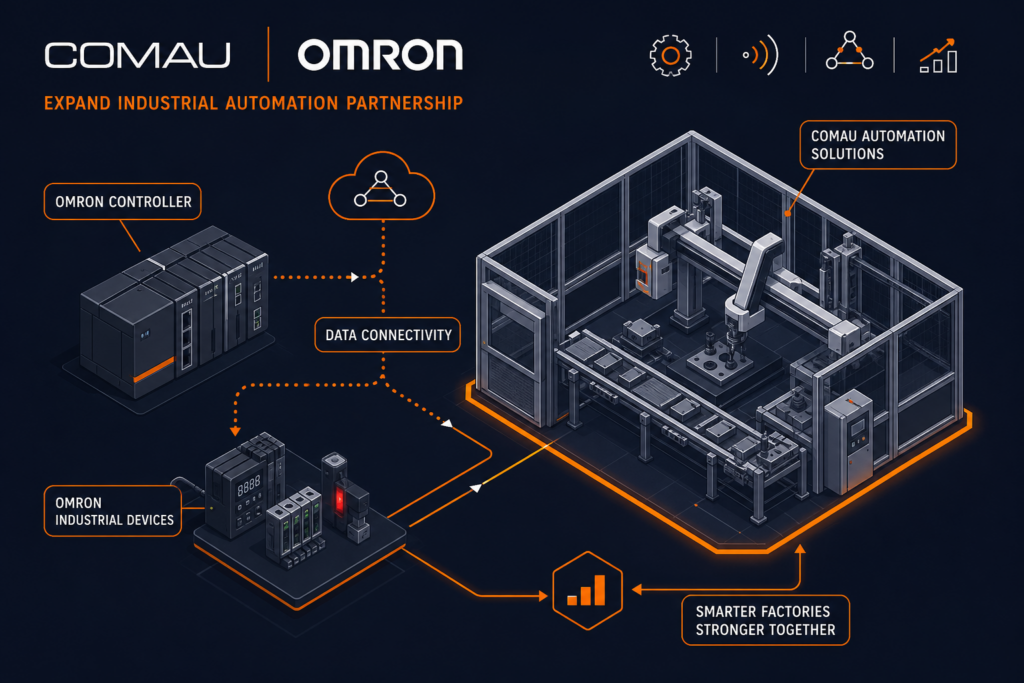
Comau and Omron target flexible automation growth
Comau and Omron Robotics have signed a strategic collaboration agreement aimed at accelerating the deployment of advanced industrial automation across high-growth manufacturing sectors. Reported first by Robotics & Automation News, the partnership is positioned around the combination of Comau’s industrial robotics, system integration and application engineering with Omron’s automation portfolio, including sensing, control, safety and software technologies. According to statements published by Omron and Comau, the initial focus will be on electronics, semiconductors, medical manufacturing and light industrial intralogistics, all sectors where manufacturers are looking for flexible, relatively fast-to-deploy automation rather than long, highly customized capital projects.
For production managers and manufacturing engineers, the significance is less about a single product launch and more about a broader market pattern. End users increasingly want integrated automation packages that combine robot arms, machine vision, motion control, safety, digital tools and after-sales support under a more unified architecture. That demand has been visible across the supplier landscape, from ABB and KUKA to FANUC, Yaskawa, Universal Robots and Doosan, as factories try to reduce integration risk while still preserving enough openness to connect robots with PLCs, MES layers and plant-wide quality systems. A Comau-Omron alliance fits this trend because it links robot-centric automation with a strong controls and sensing ecosystem, potentially shortening engineering cycles for applications that require coordinated handling, assembly, inspection or packaging.
Why the partnership matters beyond its initial target sectors
The sectors named in the announcement are not traditionally the heaviest users of arc welding, but they are highly relevant to the wider automation market because they reward modularity, traceability and rapid changeover. Semiconductor and electronics production, for example, place a premium on precision handling, clean process control and data-rich automation. Medical manufacturing adds validation, repeatability and regulatory discipline. Intralogistics applications require safe interaction between equipment, operators and material flow systems. These requirements are pushing automation suppliers toward architectures where robots are only one layer in a larger system that includes machine safety, condition monitoring, edge computing and standardized communications.
That systems view also matters in metal fabrication. Even when the end application is robotic MIG/MAG, TIG or spot welding, buyers increasingly expect the welding cell to integrate upstream and downstream functions such as part identification, fixture verification, seam tracking, pallet handling and quality data capture. This is where partnerships between robot OEMs and automation specialists can influence project economics. If a supplier can offer a more coherent stack of robot control, safety devices, HMI, vision and software, the integrator may spend less time on interface engineering and troubleshooting. In Europe, that has direct implications for compliance with machinery and safety requirements, including the Machinery framework, EN ISO 10218 for industrial robot safety, ISO/TS 15066 for collaborative robot operation where cobots are used, and IEC 60204-1 for electrical equipment of machines. Depending on the cell design, EN ISO 13849 or IEC 62061 may also shape the safety-related control architecture.
What this means for welding cell integrators
For welding cell integrators, the Comau-Omron collaboration is a reminder that competitive differentiation is moving from the robot manipulator alone to the quality of the complete automation package. In robotic welding, the core hardware still matters: payload, reach, repeatability, torch package routing, positioner synchronization and process compatibility remain central. Yet many projects are won or lost on adjacent capabilities such as vision-guided part location, safety zoning, recipe management, remote diagnostics and line integration. A partnership that combines robotics with a mature automation platform could make it easier to build standardized cells for medium-volume production, especially where customers want scalable layouts that can start with one station and expand to multiple robots or linked handling modules.
This is particularly relevant in the current market for cobot welding and compact cells serving SMEs. Integrators working with collaborative or hybrid concepts must balance accessibility and floor-space efficiency against throughput, duty cycle and risk assessment constraints. While Comau is not typically grouped with collaborative specialists such as Universal Robots or Doosan, the broader lesson applies across vendors including ABB, KUKA, FANUC and Yaskawa: customers want welding cells that are easier to deploy, easier to validate and easier to connect to existing factory automation. In practice, that means more demand for standardized fieldbus support, clearer functional safety design, and software environments that reduce commissioning time. It also means welding integrators should watch how non-welding automation partnerships evolve, because the same controls, sensing and digital service models often migrate into fabrication applications within a few product cycles.
Implications for procurement and factory investment planning
From a procurement perspective, strategic alliances such as this one can reduce supplier fragmentation, but they also raise practical questions. Buyers will want clarity on who owns system responsibility, how support is structured across regions, and whether the combined solution remains open enough to accommodate preferred welding power sources, positioners, conveyors and plant software. For Tier-1 automotive suppliers and larger metalworking groups, that openness is essential because robot cells rarely operate in isolation. They must exchange data with traceability systems, quality databases and production scheduling tools, often under strict cybersecurity and uptime requirements. For SMEs, the calculation is slightly different: the priority is usually faster deployment, lower engineering overhead and a service model that does not depend on multiple subcontractors.
The Comau-Omron agreement therefore reflects a broader industrial automation direction rather than a narrow sector move. Manufacturers are asking for automation that is modular, standards-based and easier to scale across sites. Integrators in welding and adjacent fabrication processes should read this as a signal to strengthen their own system architecture choices, especially around safety, controls and digital connectivity. Companies evaluating new robotic welding cells, cobot welding stations or flexible automation lines can use this market development as a prompt to review how well a proposed solution will integrate with existing equipment and future expansion plans.
For manufacturers planning a new robotic welding cell or upgrading an existing automation layout, Robotic Welding Cells can provide a technical assessment and a tailored quotation based on part mix, throughput, safety requirements and integration scope.
Related articles
Request a quote
Looking for a specific configuration, or want to discuss our current stock? Tell us about your project — we reply within 24 hours from our Bilbao office.