
Cognex AI Vision System Targets Robotic Welding Accuracy
Cognex has introduced an integrated AI vision system for robotics, a development that could improve weld alignment, inspection, and quality control in automated welding cells.
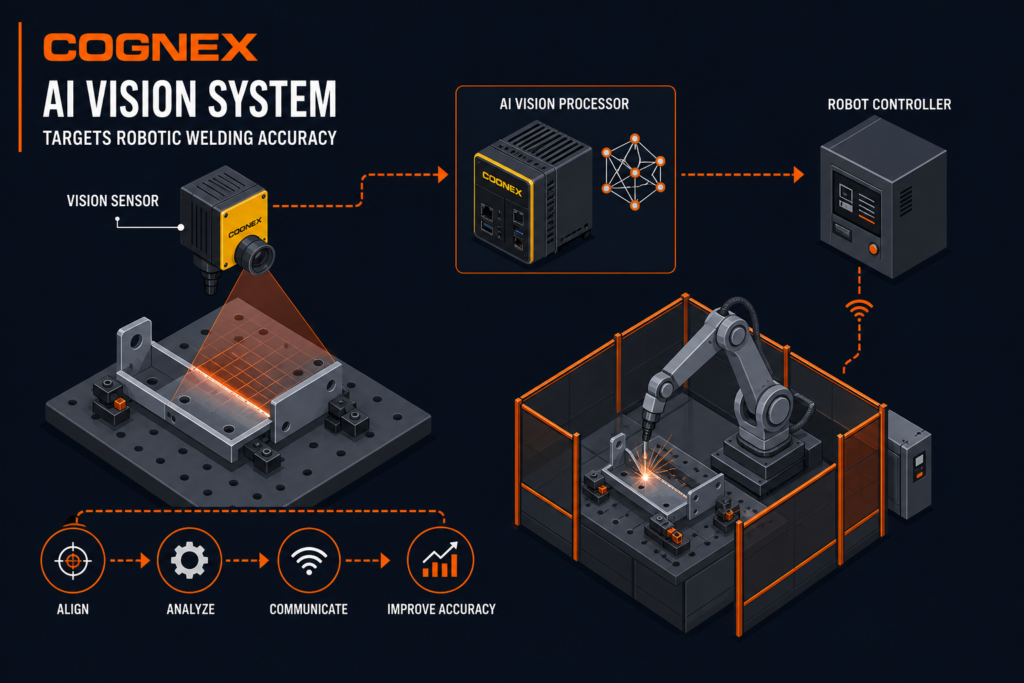
Cognex adds embedded AI vision to robotics workflows
Cognex has introduced a fully integrated AI-powered vision system for robotics, positioning machine vision as a more tightly embedded layer in industrial automation. Reported by The Robot Report, the new platform combines Cognex-developed edge AI, advanced AI, and rule-based vision tools with high-performance embedded computing. For manufacturers evaluating robotic welding, this matters because vision is no longer limited to basic presence checks or simple part location. A more integrated architecture can support deterministic, real-time inspection and guidance at line speed, which is directly relevant to weld seam finding, part alignment, bead verification, and post-process quality control.
In welding environments, variability in part presentation, tack distortion, reflective surfaces, and mixed-model production often limits the performance of conventional fixturing and fixed-program robot paths. Vision-guided robotics aims to reduce that dependency by allowing the robot to adapt to actual part position and geometry. Cognex describes its broader vision-guided robotics approach as a way to improve guidance and alignment while reducing inflexible tooling and costly fixturing, according to Cognex. For production managers and integrators, the practical implication is that AI-enabled vision may help stabilize throughput when upstream variation would otherwise create rework, stoppages, or manual intervention.
Why vision matters in robotic welding cells
Robotic welding has always depended on repeatability, but repeatability alone is not enough when incoming parts vary or when product mix increases. In arc welding cells, vision can be used before welding to locate edges, holes, joints, and datum features; during welding to support seam tracking in some architectures; and after welding to inspect bead position, continuity, spatter, and obvious defects. Cognex specifically highlights robotic welding as an application where AI-powered machine vision can automate part alignment, inspection, and quality verification, helping improve precision and efficiency in vision-guided operations, according to Cognex.
That capability is increasingly relevant across cells built around major robot brands such as ABB, KUKA, FANUC, Yaskawa, Universal Robots, and Doosan. In heavy industrial cells, 2D and 3D vision can help six-axis robots compensate for part shift before MIG/MAG or TIG welding. In collaborative applications, cobots are often selected for lower-volume, higher-mix work where vision can reduce manual teaching and improve consistency between batches. For Tier-1 automotive suppliers and metal fabrication SMEs alike, the business case is usually less about replacing weld process expertise and more about reducing setup time, scrap, and dependence on rigid fixtures. If embedded AI tools can classify complex visual patterns more reliably than traditional rule-based inspection alone, they may expand the range of weldments that can be automated economically.
Integration, standards, and deployment considerations
For B2B buyers, the technical question is not only whether an AI vision system detects features accurately, but how well it integrates into the wider cell architecture. Welding cells typically require coordination among the robot controller, welding power source, safety PLC, HMI, fieldbus network, and traceability systems. A vision platform with onboard processing can reduce latency and simplify deployment compared with architectures that rely heavily on external compute. That can be useful where deterministic response is needed for high-throughput inspection or robot guidance. However, integrators still need to validate cycle time, lighting robustness, camera protection against fumes and spatter, and communication compatibility with PLC and robot ecosystems.
Standards remain central. Machine vision does not replace the need to design cells in line with applicable safety and performance requirements, including ISO 10218 for industrial robot safety, ISO/TS 15066 where collaborative operation is relevant, and broader machinery safety frameworks under IEC and EN standards used in Europe. Depending on the installation, integrators may also consider EN ISO 13849 for safety-related control systems and IEC 60204-1 for electrical equipment of machines. In welding applications, the vision subsystem must also be engineered around environmental realities such as arc flash, smoke, heat, and contamination. Protective housings, air knives, and maintenance access become as important as algorithm performance. For procurement teams, this means that a vision upgrade should be assessed as part of the whole cell, not as a standalone sensor purchase.
What this means for welding cell integrators
For welding cell integrators, the release signals a continued shift toward more software-defined automation. Instead of treating vision as an add-on for a narrow task, newer systems are being positioned as integrated perception layers that support guidance, inspection, and adaptive decision-making in one package. That can influence welding cell design in several ways. First, fixture strategy may change: if vision can reliably locate and verify parts, some projects may justify simpler tooling. Second, programming strategy may evolve toward more conditional robot paths and recipe handling, especially in high-mix production. Third, quality assurance can move closer to the process, with automated inspection data feeding MES or traceability systems rather than relying solely on downstream manual checks.
There are still limits. AI vision does not eliminate the need for weld procedure qualification, torch access studies, or metallurgical process control. It also does not guarantee performance on highly reflective, dark, or contaminated surfaces without careful lighting and training data. But for integrators building robotic welding or cobot welding cells, a more capable embedded vision stack can reduce engineering effort in applications where part variation has historically blocked automation. This is particularly relevant for SMEs that want flexible cells and for automotive suppliers under pressure to document quality while maintaining takt time. Companies reviewing new welding cell projects, retrofits, or vision-guided robotic upgrades can use developments like this as a prompt to reassess whether seam location, pre-weld verification, and post-weld inspection should be designed into the cell from the start rather than added later.
Manufacturers planning a robotic welding cell or evaluating a cobot welding upgrade can request a quote to assess how AI vision, robot selection, and standards-compliant cell design fit their production requirements.
Related articles
Request a quote
Looking for a specific configuration, or want to discuss our current stock? Tell us about your project — we reply within 24 hours from our Bilbao office.