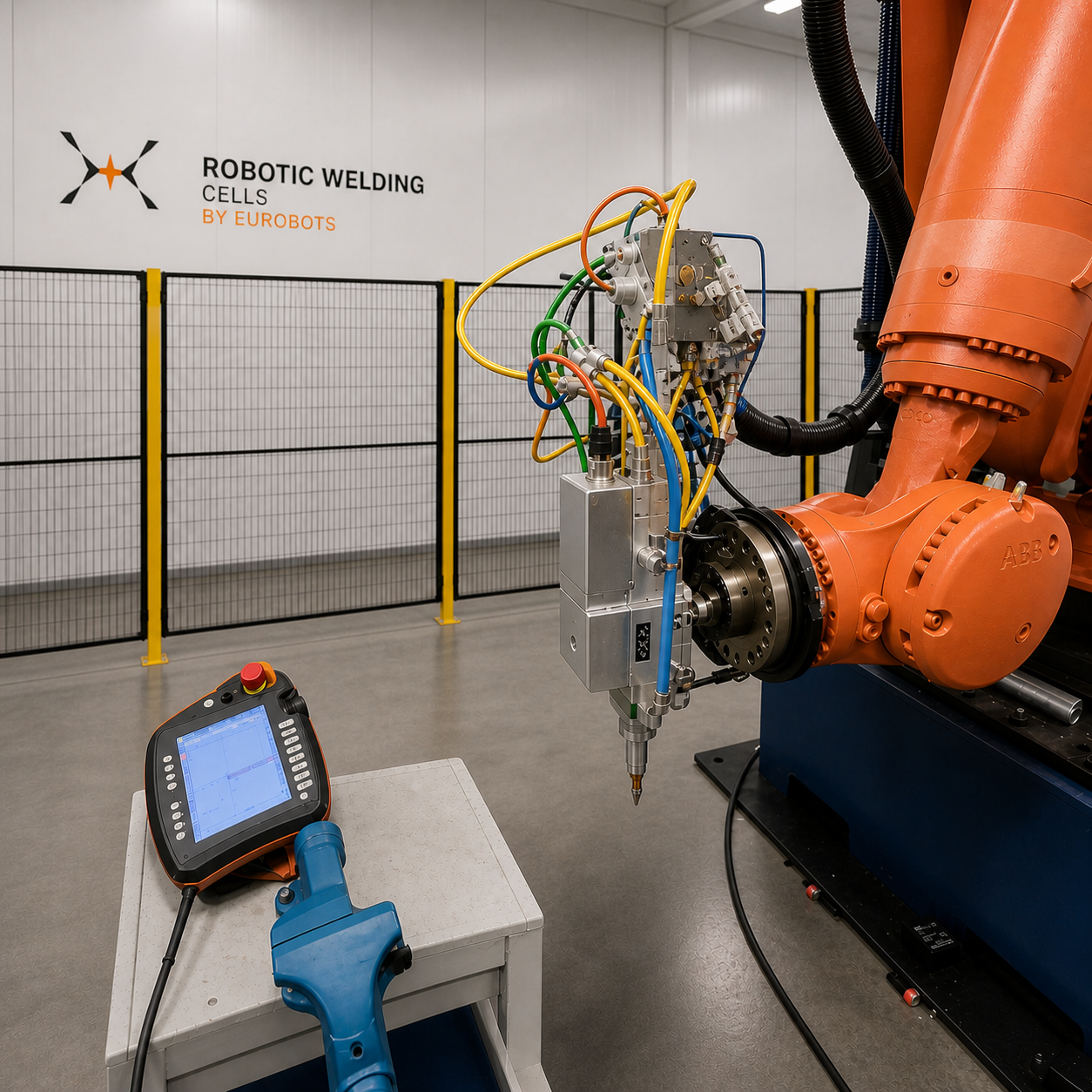
PAL Robotics launches AI-ready arm platform for industry
PAL Robotics has introduced a seven-axis, ROS 2-compatible robotic arm platform aimed at advanced manipulation, with implications for industrial automation and welding cell integration.
PAL Robotics expands advanced manipulation options
PAL Robotics has introduced a new robotic arm platform designed for advanced AI-driven manipulation, extending the Barcelona company’s portfolio beyond the mobile and service robotics systems for which it is already known. According to the original report in Robotics & Automation News, the platform is intended for researchers, developers and robotics engineers that need a more accessible and flexible route into manipulation tasks. The published details indicate a system built around ROS 2 compatibility, seven degrees of freedom and an AI-ready architecture, with commercial sales expected later in 2026 after its unveiling at ICRA. For industrial users, that combination is notable because it reflects a broader shift in robot design: hardware is increasingly being specified not only by payload and reach, but also by software openness, perception integration and the ability to support machine learning workflows.
PAL Robotics has framed the new arm as a way to reduce common barriers around integration complexity, rigidity and deployment cost. That positioning aligns with the company’s wider strategy around open development environments and modular robotic platforms, visible across systems such as TIAGo Pro and Kangaroo on its corporate site. On PAL Robotics, the company emphasizes AI-ready computing, manipulation, navigation and high-fidelity simulation as core enablers for moving robotic concepts from laboratory work into real operating environments. For manufacturing stakeholders, that matters because many manipulation projects stall between proof of concept and plant deployment. A platform that arrives with a modern software stack, simulation support and a kinematic structure suited to dexterous tasks may shorten that transition, particularly in applications where parts are variable, fixtures are limited or perception must compensate for inconsistent presentation.
Why the platform matters for industrial automation
The industrial significance of the launch lies less in direct competition with mainstream six-axis welding robots and more in the direction it signals for flexible automation. Traditional articulated robots from ABB, KUKA, FANUC and Yaskawa remain the default choice for high-duty-cycle welding, handling and machine tending because they offer established ecosystems, broad payload ranges and mature offline programming tools. Collaborative robot suppliers such as Universal Robots and Doosan have meanwhile expanded the market for lower-force, more easily redeployed automation. PAL Robotics appears to be targeting a different but increasingly relevant layer of the market: advanced manipulation where perception, compliance, software experimentation and AI model integration are central requirements rather than optional add-ons.
That distinction is relevant for production managers evaluating future automation roadmaps. In sectors such as fabricated metal products, electronics subassembly and mixed-model production, there is growing demand for robots that can identify, grasp, orient and present components with less deterministic fixturing. A seven-axis arm can provide additional kinematic flexibility in constrained workspaces, around jigs, or when approaching parts from multiple angles. ROS 2 compatibility also matters because it has become a practical framework for integrating sensors, simulation, motion planning and higher-level decision layers. As noted in a prior preview by Robotics & Automation News, PAL Robotics positioned the system as a new manipulation robot to be formally shown at ICRA 2026, reinforcing that the launch is part of a deliberate push into this segment rather than a one-off prototype announcement.
What this means for welding cell integrators
For welding cell integrators, the immediate takeaway is not that PAL Robotics is replacing dedicated arc-welding robots, but that advanced manipulation platforms are becoming more relevant at the edges of welding automation. In many robotic welding projects, the weld process itself is already stable; the bottleneck is upstream or downstream handling. Parts may arrive in bins, on pallets, or with inconsistent orientation. Tack-welded assemblies may need repositioning, inspection or handoff between stations. A more dexterous arm with AI-ready perception could support pre-weld part presentation, post-weld unloading, regripping, seam localization or adaptive fixture loading in hybrid cells that combine conventional welding robots with flexible handling modules.
Integrators designing robotic or cobot welding cells must, however, separate experimental flexibility from production robustness. Welding environments impose heat, spatter, electromagnetic noise and strict uptime requirements. Any arm introduced into such a cell must be assessed for ingress protection, cable routing, repeatability, thermal resilience and functional safety integration. Compliance with relevant machinery and robot safety frameworks remains essential, including ISO 10218 for industrial robot safety, ISO/TS 15066 for collaborative applications where applicable, and broader machinery requirements under IEC and EN harmonized standards used in European installations. If a manipulation arm is paired with welding equipment, integrators also need to consider torch approach paths, part grounding, scanner integration and communication with PLC, safety controller and power source. In that context, PAL Robotics’ software openness may be attractive for R&D-heavy integrators, while established welding robot vendors will still dominate core arc motion where process libraries, coordinated positioners and welding package support are critical.
From research platform to factory deployment
The broader market question is whether platforms like this can bridge the persistent gap between AI robotics research and repeatable industrial deployment. Many manufacturers are interested in adaptive robotics, but procurement decisions still depend on maintainability, spare parts, supportability and standards compliance over a multi-year lifecycle. If PAL Robotics can translate its research-oriented strengths into industrial documentation, validated interfaces and integrator-friendly deployment tools, the platform could find a role in pilot cells, advanced assembly stations and flexible material handling around welding and fabrication lines. That would not displace the installed base from ABB, KUKA, FANUC, Yaskawa, Universal Robots or Doosan, but it could expand the set of tools available to system builders tackling variable, perception-led tasks.
For metalworking SMEs and Tier-1 suppliers, the practical implication is to watch how these new manipulation platforms mature over the next 12 to 24 months. The strongest use cases are likely to emerge where conventional automation struggles with part variability rather than where cycle time alone is the deciding factor. Companies planning new welding cells or retrofits may benefit from evaluating whether AI-enabled manipulation can reduce fixture complexity, manual loading or non-value-added handling around the weld process.
Companies assessing robotic welding, cobot welding or flexible handling around welded assemblies can request a quote to compare standard welding cell architectures with newer AI-enabled manipulation options for pilot and production deployments.
Request a quote
Looking for a specific configuration, or want to discuss our current stock? Tell us about your project — we reply within 24 hours from our Bilbao office.